UMG·DailyNK Survey of 50 North Korean Residents This Year
"3 out of 4 Watch Overseas Videos at Least Once a Month"
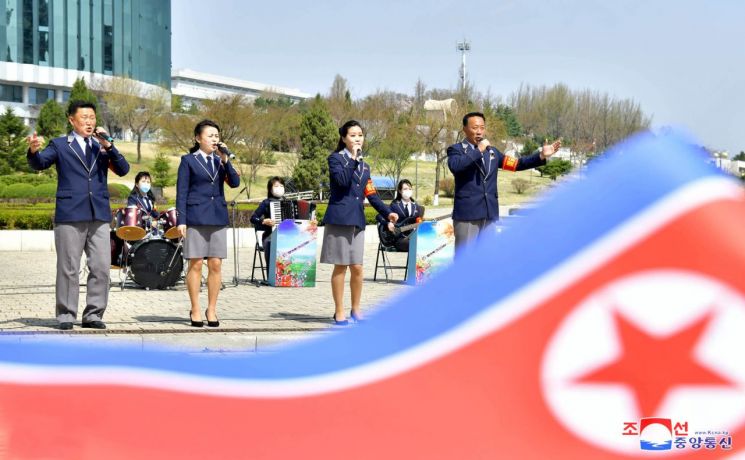 North Korean residents celebrating 'Kim Jong-un's 10 years in power' last April [Image source=Yonhap News]
[Asia Economy Reporter Jang Hee-jun] Although North Korea is increasingly tightening control over the inflow of external cultural products, a survey revealed that the majority of residents have experience watching South Korean dramas or movies. In particular, three out of four people watch foreign videos at least once a month, and after experiencing such content, they reported developing curiosity about South Korean society.
According to a survey on North Korean residents' use of external information and media environment, conducted by the North Korean human rights organization National Unification Broadcasting (UMG) and Daily NK on the 30th, 49 out of 50 respondents (98%) answered "yes" to the question, "Have you ever watched foreign content including South Korean content?"
This survey was conducted through telephone interviews with 50 North Korean residents this year. However, since the respondents agreed to external telephone interviews, it is likely that they have a more proactive tendency toward outside contact compared to the general North Korean population.
When asked about the types of foreign videos they watch (multiple responses allowed), 96% said South Korean dramas and movies, 84% Chinese dramas and movies, 68% South Korean performances, 40% South Korean documentaries, and 24% Western dramas and movies such as those from the United States.
Regarding the frequency of watching foreign videos, 28% said they watch at least once a week, 46% at least once a month, and one person said almost every day. This means that three out of four people watch foreign videos at least once a month. Twenty percent responded that they watch about once every two to three months.
As for the channels through which they access foreign videos (multiple responses allowed), borrowing from family or relatives was the most common at 64%, followed by borrowing for free from friends at 50%, and purchasing at local jangmadang markets at 22%.
Respondents identified the foreign information North Korean residents need (multiple responses allowed) as cultural and entertainment programs produced in South Korea (74%), South Korean news (72%), and information useful for daily life (68%). The proportion who answered North Korea-related news was 44%.
Notably, 79.2% said that after watching South Korean or other foreign video content, they developed curiosity about South Korean society. Responses also showed that 56.3% began learning South Korean speech patterns, and 39.6% started imitating South Korean clothing styles.
However, watching such foreign videos appears to be somewhat closed off. When asked who they watch with (multiple responses allowed), 90% of respondents said "immediate family," and 64% said they watch alone. Only 18% said they watch with friends or neighbors.
North Korea has strengthened control over the inflow of external cultural products by enacting the "Anti-Reactionary Thought and Culture Rejection Law" in December 2020, which punishes distributors of South Korean videos with the death penalty and viewers with up to 15 years in prison. Since the spread of COVID-19, North Korea's border closure has disrupted North Korea-China exchanges, making the dissemination of information to North Korea even more difficult. However, on the other hand, the media environment within North Korea has continued to develop over the past few years, with a significant increase in residents using computers and storage devices such as microSD cards becoming more common.
© The Asia Business Daily(www.asiae.co.kr). All rights reserved.

















