Half of Nationwide Construction Sites Come to a Complete Stop
Regardless of the Purpose of Introducing Overwork and Overload Improvements
Need for Strategic Improvement of Freight Rate Increase Measures
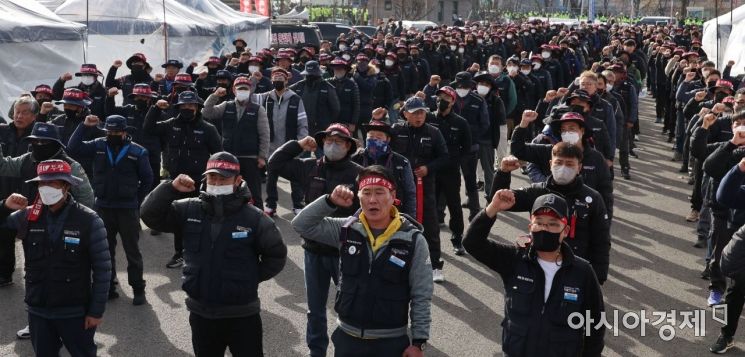 On the 29th, when the government issued a work commencement order against the general strike by the Cargo Solidarity Headquarters of the Public Transport Union under the Korean Confederation of Trade Unions (KCTU), members of the Cargo Solidarity Seoul-Gyeonggi Regional Headquarters held a rally at the Inland Container Depot (ICD) in Uiwang, Gyeonggi Province, shouting slogans condemning the order.
 /Uiwang=Photo by Kim Hyun-min kimhyun81@
[Asia Economy Reporters Sunmi Park, Chaeseok Moon, Byungseon Gong]
"The damage caused by the strike in the cement, automobile, petroleum, petrochemical, steel, and feed industries amounts to about 1 trillion won. From this weekend, production facility shutdowns will also be inevitable."
As the week-long general strike by the Cargo Solidarity Headquarters of the Korean Confederation of Trade Unions (KCTU) Public Transport Workers' Union continues, on the 30th, seven shipper organizations urged the strike to stop and stated that the union's unfair demands should not be accepted.
Shippers: "Police Deployment Prepared for Union Occupation"
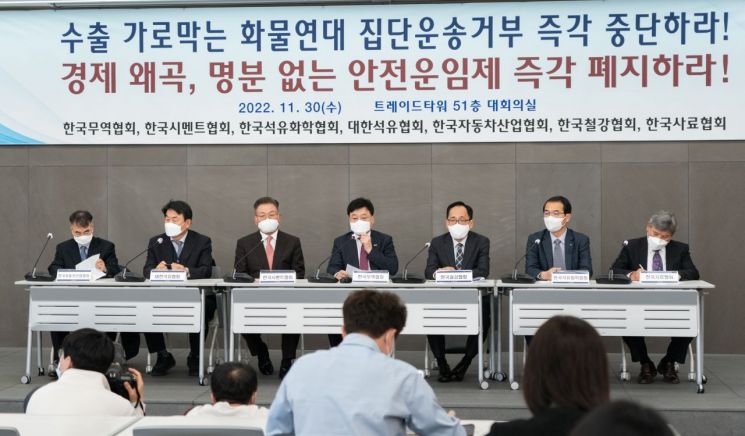 People attending the 'Emergency Press Conference of Cargo Owners' Associations Regarding the Cargo Solidarity Collective Transport Refusal.' Among them was Jeong Manki, Executive Vice Chairman of the Korea International Trade Association (center), along with representatives of cargo owners from the cement, automobile, petroleum, petrochemical, steel, and feed industries. (Photo by Korea International Trade Association)
On this day, seven shipper organizations including the Korea International Trade Association, Korea Cement Association, Korea Petrochemical Industry Association, Korea Petroleum Association, Korea Automobile Manufacturers Association, Korea Iron & Steel Association, and Korea Feed Association held a press conference at the Trade Center in Samseong-dong, Gangnam-gu, appealing that the damage caused by the Cargo Solidarity general strike is enormous and urgent countermeasures are needed.
Lee Chang-gi, Vice Chairman of the Cement Association, expressed concern, saying, "Due to disruptions in cement supply, half of the construction sites nationwide have come to a halt," adding, "The scale of the ripple effects beyond the industry will be even greater." Earlier, the government issued a work commencement order to those refusing transportation in the cement sector the previous day, but the Cargo Solidarity declared a hardline struggle and clearly opposed participation.
The petrochemical industry also reported daily damages of 68 billion won due to the strike. Kim Pyeong-jung, head of the Petrochemical Association, predicted, "If the strike continues, from this weekend, we expect to further reduce facility operating rates or even halt operations."
Representatives of six industries attending the briefing made strong remarks that the 'public authority' deployment system should be strengthened to control union members' physical force if necessary. Jeong Dong-chang, Vice Chairman of the Petroleum Association, stated, "The membership rate of tanker drivers in Cargo Solidarity is estimated at about 70% nationwide and over 90% in the metropolitan area," urging, "If the collective transportation refusal by Cargo Solidarity prolongs, there is concern over petroleum product supply disruptions, so police deployment around key shipment points and vehicle escorts during shipments are necessary."
Additionally, the shippers requested reforms including ▲ the formation of a Safe Freight Commission with an equal number of service demanders (shippers) and suppliers (drivers + carriers) ▲ securing and utilizing objective data such as income and fuel costs instead of relying on driver surveys when calculating costs ▲ simplification of surcharge rates in subsidiary clauses that impose burdens only on shippers without holding drivers responsible.
Jung Manki, Vice Chairman of the Korea International Trade Association, emphasized, "The permanent implementation of the Safe Freight System is incompatible with the market economy and even raises constitutional concerns," urging, "We hope Cargo Solidarity cooperates to share data from digital tachographs of large trucks in real time with traffic authorities and stakeholders such as shippers."
Seoul Subway Strike Begins Today
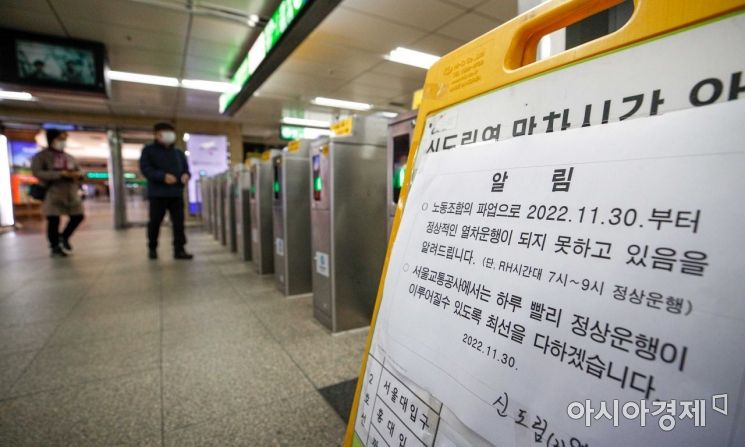 On the 30th, Seoul Metro, operated by Seoul Transportation Corporation, which runs the Seoul subway, went on strike, causing delays in subway operations. A strike-related notice is posted at Sindorim Station in Guro-gu, Seoul. Photo by Jinhyung Kang aymsdream@
Meanwhile, the Seoul Metro Workers' Union, operating the Seoul subway, went on a full strike today, but no major chaos occurred during the morning commute. Substitute personnel were deployed in preparation for the strike, allowing normal operation at five-minute intervals, and many commuters started their journeys earlier than usual.
However, if the strike prolongs and the Railway Workers' Union proceeds with its planned strike from the 2nd of next month, citizens' inconvenience will inevitably increase. The Seoul Metro Union began the general strike around 6:30 a.m. during daytime working hours. This is the first strike in six years since the 2016 strike opposing the performance-based pay system on lines 1 to 8 operated by Seoul Metro. Approximately 13,000 union members are participating, including about 11,000 from the Seoul Metro Union and 2,000 from the integrated union.
However, according to relevant laws, the subway is an essential public service, so on weekdays, only about 9,700 members excluding essential personnel participate in the strike.
Seoul City deployed about 13,000 substitute workers to ensure normal subway operation during rush hours. However, due to limitations in personnel deployment, the goal is to maintain 72.7% of normal service during less congested daytime hours and 85.7% during rush hours.
Industrial Sector Losses Snowballing into Trillions
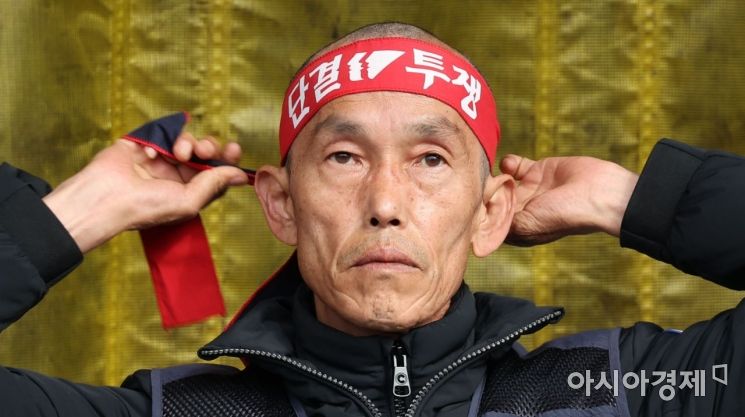 On the 29th, when the government issued a work commencement order against the general strike of the Cargo Solidarity Headquarters of the Public Transport Union of the Korean Confederation of Trade Unions, Lee Bong-ju, chairman of the Cargo Solidarity Headquarters, protested the order by shaving his head and then tying a headband again at the rally held at the Inland Container Depot (ICD) in Uiwang-si, Gyeonggi Province. / Uiwang = Photo by Kim Hyun-min kimhyun81@
As the KCTU Public Transport Workers' Union Cargo Solidarity Headquarters general strike continues into its seventh day, industrial sector losses have exceeded the trillion-won mark. Representatives of various industries' shipper organizations have appealed not only against the expansion of the Safe Freight System items but also for its complete abolition.
At a press conference held by the Korea International Trade Association with six major shipper organizations regarding the Cargo Solidarity general strike, participants urged the immediate cessation of the strike causing direct economic losses in the trillions and called for the abolition of the Safe Freight System. Above all, shipper organizations believe that the existing Safe Freight System has failed to achieve its intended effects. Regardless of its original purpose to improve overwork, overloading, and speeding, it has degenerated into a continuous means of raising freight rates and has problems reflecting various market conditions, necessitating system improvements.
In particular, the cement industry demands the formation of a fair Safe Freight Commission and securing objectivity in cost investigations. They propose that the commission be composed equally of service demanders (shippers) and suppliers (drivers and carriers) with 3 members each, plus 4 public interest members, and that reasonable adjustments be made by public interest members and the government. They also suggest maintaining only the safe entrusted freight paid to drivers and abolishing the safe transport freight so that freight rates are determined through market competition among transport operators.
Lee Chang-gi, Vice Chairman of the Cement Association, said at the briefing, "The cement industry subject to the Safe Freight System has borne a 35% increase in transportation costs over the past three years since the system's implementation," adding, "The system should be improved so that the individual intentions of market participants are respected, prices are determined by market consensus, and the price function works positively." The cement industry estimates that due to the general strike, shipments have fallen to less than 10% of weekday levels, resulting in daily sales losses of about 18 billion won.
Safe Freight System Application Causes Production and Export Declines
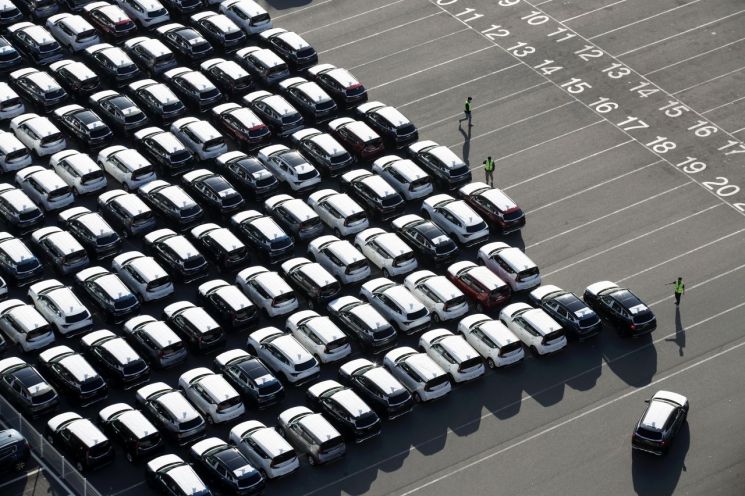 On the first day of the general strike by the Cargo Solidarity of the Korean Public Service and Transport Workers' Union under the Korean Confederation of Trade Unions on the afternoon of the 24th, the car carrier operation rate dropped at the Kia Autoland Gwangju 2 Plant finished car parking lot in Seo-gu, Gwangju, causing finished cars to accumulate. (Image source=Yonhap News)
The Automobile Industry Association openly opposed the application of the Safe Freight System to 'automobiles.' They expressed concerns that rising direct and indirect costs of automobile exports amid labor rigidity and various regulations weakening production competitiveness could lead to declines in domestic production and exports. Furthermore, frequent strikes due to annual wage and collective bargaining in the automobile industry could be exacerbated by the Safe Freight System, potentially spreading damage to parts suppliers. The automobile industry estimates a daily burden of about 400 million won due to labor costs and temporary storage operation expenses caused by this strike.
The Korea Iron & Steel Association also actively argued that applying the Safe Freight System to steel products is difficult. Since logistics costs are much higher for medium, small, or micro enterprises that distribute and process steel products than for large manufacturers, the increased logistics costs from the Safe Freight System could weaken the competitiveness of small and micro steel processing companies. Steel logistics characteristics vary widely due to factors such as company size, transport units (5~25 tons), and ease of loading/unloading, making standardization difficult with at least ten different product categories, which complicates Safe Freight System application.
Heo Dae-young, head of the Korea Iron & Steel Association, lamented, "The steel industry is estimated to have suffered shipment disruptions totaling 600,000 tons and losses amounting to 800 billion won due to this strike," adding, "Since steel is a basic material, shipment disruptions could spread to related industries such as construction, automobile, and shipbuilding, causing production setbacks. This is especially serious as we are still recovering from typhoon damage in September while facing transportation refusals."
The Korea Petrochemical Industry Association and Korea Petroleum Association raised concerns that shipment disruptions starting from the 28th could expand to reduced operating rates or facility shutdowns from the weekend and urged the strike to end. Currently, only about 30% of the industry's daily shipment volume of 74,000 tons (approximately 97 billion won) is being shipped, estimating daily damages of about 68 billion won. Due to recent sluggish business conditions, factories are operating at about 80% capacity, making further operating rate adjustments difficult, and a complete shipment halt would inevitably lead to factory shutdowns.
Kim Pyeong-jung, head of the Petrochemical Association, pointed out, "Exports are mainly conducted using containers, but container drivers are not shipping, and all ports are blocked," adding, "Exports are not functioning normally, and if this continues, factory operations will also be affected." The Korea Feed Association also voiced concerns about livestock starvation if the Cargo Solidarity general strike prolongs.
© The Asia Business Daily(www.asiae.co.kr). All rights reserved.



















