20 Years in Power, Eyeing Next Year's Presidency... "Blaming Kurdish Terrorism"
Stirring 'Security Anxiety' to Boost Support as Protector
Inflation Worsens Due to Interest Rate Cuts... A Tactic to Distract Public from Economic Failures
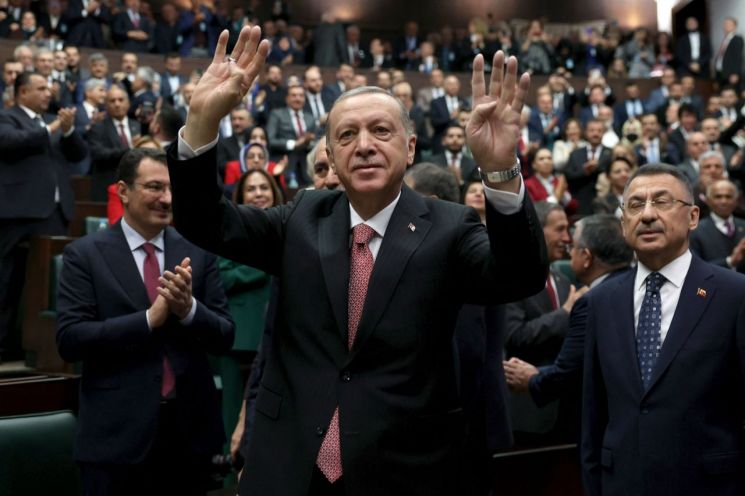
[Asia Economy Reporter Park Byung-hee] Since the bomb attack in Istanbul, the largest city in Turkey, on the 13th that resulted in six deaths, tensions have been escalating along the border area between Turkey and northern Syria. Recep Tayyip Erdogan, President of Turkey, has pointed to Kurdish armed groups such as the Kurdistan Workers' Party (PKK) and the Kurdish People's Protection Units (YPG) as the perpetrators behind the bombing and has announced plans for a ground troop deployment to the Kurdish region in northern Syria.
There is a prevailing analysis that President Erdogan's intention is to divert public attention from the economic difficulties. Having been in power for 20 years this year, President Erdogan is aiming to extend his rule for another five years through the presidential election scheduled for June next year.
Hiding Economic Failures?
On the 30th, the British weekly magazine The Economist reported growing concerns that President Erdogan, who is trailing behind potential rivals in various opinion polls, might take extreme measures to overturn an election defeat.
The deployment of ground troops to the Kurdish region is mentioned as one such measure. Despite PKK and YPG's claims that they are not involved in the Istanbul bombing, President Erdogan announced on the 26th that a ground invasion of Syria would be carried out.
Regarding this, Adel Bakawan, director at the French Institute of International Relations (IFRI), explained in an interview with France 24 that Turkey's operation to eliminate Kurdish armed groups serves as an opportunity to divert voters' attention from poor economic performance and allows President Erdogan to highlight himself as the protector of Turkey. This could be a chance for Erdogan to boost his approval ratings ahead of the election.
Bakawan said, "Turkey's current economic crisis is severe, and President Erdogan's situation is not good. From Erdogan's perspective, facing difficult circumstances, as the election approaches, he will increasingly need to rally his supporters by claiming that enemies are threatening Turkey's security, stability, and unity."
Turkey will hold its presidential election on June 18 next year. President Erdogan is seeking a five-year extension of his rule. However, public opinion is unfavorable due to fatigue from his long-term dictatorship combined with economic failures. According to a poll released on the 18th by Turkish polling firm Metropoll Research, support for Erdogan's economic policies stood at only 36%.
Turkey's consumer price inflation rate for October, announced by the Turkish Statistical Institute on the 3rd, recorded 85.51% year-on-year, the highest since 1997. Amid global inflation caused by the Ukraine war and US interest rate hikes, Turkey is experiencing even more severe inflation due to President Erdogan's policies.
President Erdogan has blamed the central bank's high-interest rate policy for inflation and has continuously pressured the central bank to lower benchmark interest rates, sparking controversy. Erdogan's demand for interest rate cuts has instead devalued the Turkish lira, further exacerbating inflation.
There are also suspicions that the Turkish government is manipulating inflation figures. A private research institute in Turkey analyzed that the actual inflation rate for October reached 185.34%. As prices soar, worker protests demanding wage increases have continued throughout Turkey this year.
"The Sultan of the 21st Century"
President Erdogan is called the "Sultan of the 21st Century." The title "Sultan," referring to the supreme ruler in the Islamic empire, officially disappeared from Turkey 100 years ago in 1922 when the republic was established. The nickname reflects a sarcastic view of Erdogan's relentless thirst for power as he has ruled Turkey for 20 years.
Erdogan co-founded the Justice and Development Party (AKP) in 2001 and became prime minister in 2003. He served as prime minister for 11 years through two re-elections. Toward the end of his premiership, he changed the presidential election system from an indirect to a direct election through constitutional amendments, as the AKP party constitution prohibited four consecutive terms as prime minister. After stepping down as prime minister in 2014, Erdogan immediately assumed the presidency, maintaining real power. During his presidency, he again amended the constitution to change the parliamentary system to a presidential system and abolished the prime minister's office entirely. As president, he wields absolute power, holding authority over appointing vice presidents, ministers, and senior officials, as well as the power to dissolve parliament and declare a state of emergency.
© The Asia Business Daily(www.asiae.co.kr). All rights reserved.

















