Loan Amount Proportional to Annual Salary Remains Under DSR Regulation
Mortgage Loans at 7%... Borrowing Money Is Daunting Due to Interest Burden

[Asia Economy Reporter Sim Nayoung] Although real estate market loan regulations will be significantly eased starting from the 1st, it is difficult to find forecasts in the financial sector that this measure will actively lead to actual loans or bring warmth to the frozen housing market. This is because the mortgage loan interest rates, which fluctuate around a maximum of 7%, are a heavy burden, and the Debt Service Ratio (DSR) regulation, which limits the loan amount proportional to one's income, remains in place.
Looking only at the deregulation details, they are groundbreaking. The Loan-to-Value ratio (LTV) for mortgage loans for non-homeowners in regulated areas will be raised to 50%. Mortgage loans will be allowed for apartments exceeding 1.5 billion KRW in speculative and speculative overheating zones. The mortgage loan limit for low-income and actual demanders will increase from the existing 400 million KRW to 600 million KRW.
Despite these measures, banks have shown lukewarm responses. A representative from a commercial bank said, "The internal opinion within banks is that unless the DSR is eased, this is only a half-hearted deregulation," adding, "Since the real estate market is so bad, the government has come up with measures, but it is just for show."
The core of the DSR regulation is that when the total loan amount exceeds 100 million KRW, the annual principal and interest repayment amount cannot exceed 40% of the annual income (50% for secondary financial institutions). Financial authorities consider the DSR as the last line of defense for managing household debt. The DSR regulation was excluded from this deregulation list due to concerns that lifting it would allow loans beyond the borrower's repayment ability and trigger household debt risks.
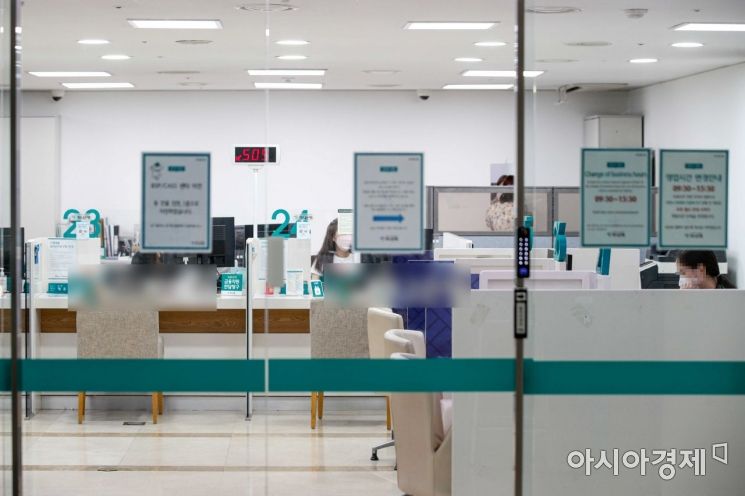 On the 7th, a scene at a bank counter in downtown Seoul shows major commercial banks lowering loan interest rates while raising interest rates on regular savings and installment savings products./Photo by Kang Jin-hyung aymsdream@
However, no matter how many other real estate regulations are eased, unless my annual salary increases, the amount I can borrow when buying a house remains the same?this is the trap of the DSR regulation. This is why dissatisfaction remains among non-homeowners and actual demanders who are not high-income earners with hundreds of millions in income.
In fact, the case of office worker Kim San (43), who visited a bank counter last month for mortgage consultation, illustrates this. Kim's annual salary is 60 million KRW. He already has a 50 million KRW overdraft loan with a 7% interest rate. Kim said, "I checked the loanable amount with a mortgage loan variable interest rate of 6.20%, 40-year installment repayment, and equal principal and interest method, and found that I can borrow up to 155 million KRW." He added, "No matter how much the LTV is raised to 50%, I cannot get even 200 million KRW due to the DSR, so it is useless," and lamented, "If this is the case, the government should lower apartment prices to half of the current level."
The interest rate barrier is also high. As of the 30th of last month, the variable interest rates of the five major banks (KB Kookmin, Shinhan, Hana, Woori, NH Nonghyup) ranged from 5.37% to 7.31%. Fixed interest rates (5 years fixed then variable) were between 5.05% and 6.87%. The Bank of Korea is likely to raise rates further until the first half of next year, which would push mortgage loan rates close to the 8% range. The financial sector expects that when the real estate market recovers and interest rates stabilize around the second half of next year, loan demand will revive mainly among high-income earners and dual-income couples.
© The Asia Business Daily(www.asiae.co.kr). All rights reserved.


















