Chemical Research Institute Successfully Fabricates Carbon Nanotube Material Transistor
"Performance Improved 20 Times Compared to Existing Models"
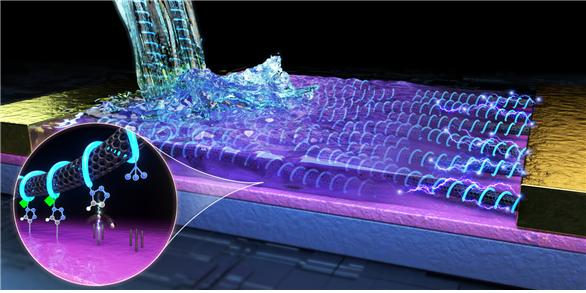 Image of transistor manufacturing technology using carbon nanotubes with click reaction. Photo by Korea Research Institute of Chemical Technology
[Asia Economy Reporter Kim Bong-su] Domestic researchers have succeeded in developing next-generation high-performance semiconductor technology using the 'click chemistry' technique, which won the 2022 Nobel Prize in Chemistry.
The Korea Research Institute of Chemical Technology announced on the 30th that the research team led by Dr. Lim Bo-gyu and Dr. Jung Seo-hyun, together with Professor Noh Yong-young's team at Pohang University of Science and Technology, developed a transistor with high reproducibility and stability using carbon nanotube semiconductors, known as the dream new material.
Carbon nanotubes are materials composed of six carbon atoms connected in a hexagonal honeycomb pattern, forming very small and thin tube shapes. They have been found to possess electrical properties more than 70 times superior to conventional silicon semiconductors, attracting worldwide attention. However, carbon nanotubes have a mixture of semiconducting and metallic properties, so for several years, research has focused on selectively separating semiconducting carbon nanotubes to realize high-performance carbon nanotube transistors. Because the density of carbon nanotubes within the film is uneven and the connectivity between tubes is irregular, there are large performance variations and low reproducibility even among carbon nanotube transistors fabricated under the same conditions. Additionally, when used in biosensor fabrication, the film may detach during the washing process, causing significant sensitivity differences between devices.
The research team overcame these limitations by developing a technology that can easily control the density within the film while adjusting the reaction time, forming a high-density carbon nanotube film with a short reaction time. In particular, they utilized the 'click reaction' technique, which won the 2022 Nobel Prize in Chemistry. Using the very simple chemical reaction called 'click reaction,' which involves 'azide' and 'alkyne' molecules as key components, they formed carbon nanotube films with excellent reproducibility.
The click reaction refers to a reaction where two different chemical functional groups form a bond in a short time, like clicking a computer mouse. It occurs easily at room temperature without the need for high heat or complex catalysts. The researchers who developed the click reaction?Carolyn R. Bertozzi, Morten Meldal, and K. Barry Sharpless?were announced as this year’s Nobel Prize in Chemistry laureates earlier last month.
The research team synthesized polymers containing 'azide' groups to selectively wrap and separate semiconducting carbon nanotubes. They also synthesized 'alkyne'-based polymers capable of undergoing click reactions with azides. These were chemically fixed onto glass substrates using light or heat. The alkyne-fixed substrates were then immersed in a carbon nanotube solution wrapped with azide polymers, and carbon nanotube films were fabricated through click reactions.
The transistors based on these carbon nanotube films showed more than 20 times improved performance compared to conventional methods and exhibited very uniform characteristics with minimal performance variation between devices. The fabricated films can form high-density carbon nanotube films within 5 minutes even when using low-concentration carbon nanotube solutions. They form strong chemical bonds with the substrate, providing stability that resists detachment even under various solvent washing processes.
The research team plans to conduct various follow-up studies for the commercialization of carbon nanotube electronic devices such as hydrogen sensors and biosensors by utilizing the research results demonstrating high reliability and reproducibility of electronic device characteristics.
The results of this study were published in the September online issue of the international chemical engineering journal, Chemical Engineering Journal.
© The Asia Business Daily(www.asiae.co.kr). All rights reserved.
![Clutching a Stolen Dior Bag, Saying "I Hate Being Poor but Real"... The Grotesque Con of a "Human Knockoff" [Slate]](https://cwcontent.asiae.co.kr/asiaresize/183/2026021902243444107_1771435474.jpg)
















