Martial Arts and Hwajoo Representatives Hold Emergency Meeting on 30th
Cement, Tea, Petroleum, Petrochemical, Steel, and Feed Industries Participate
"Even with 3-Year Extension of System, 'Hwajoo' Authority Needs Strengthening"
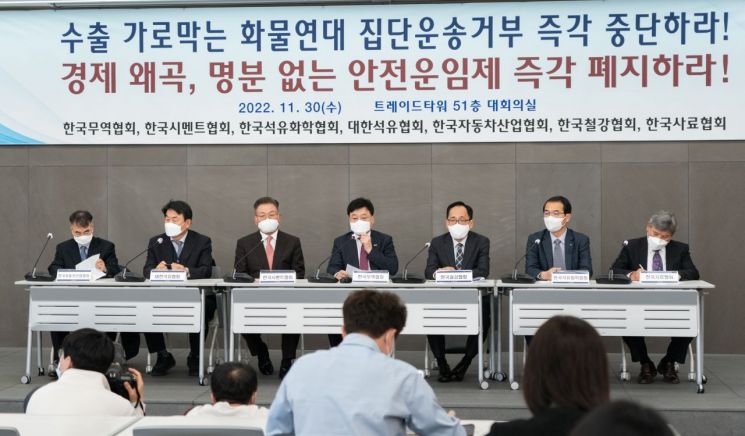 People attending the 'Emergency Press Conference of Cargo Owners' Associations Regarding the Cargo Solidarity Collective Transport Refusal.' Among them was Jeong Manki, Executive Vice President of the Korea International Trade Association (center), along with representatives of cargo owners from the cement, automobile, petroleum, petrochemical, steel, and feed industries. (Photo by Korea International Trade Association)
[Asia Economy Reporter Moon Chaeseok]
"Even if the Safe Freight Rate System is extended for 3 years, we will continuously demand that the Safe Freight Rate Committee, which is biased with 3 cargo owners and 6 drivers plus transportation operators, be restructured, and that the clause imposing fines on 'cargo owners' who pay less than the minimum freight cost be deleted."
Jung Manki, Executive Vice President of the Korea International Trade Association (KITA), made this statement on the 30th while urging the Cargo Solidarity of the Korean Public Service and Transport Workers' Union (KPTU) to stop their strike. He emphasized that even if the government operates the Safe Freight Rate System, which was scheduled to expire this year, for an additional 3 years as the labor sector wishes, the decision-making structure among stakeholders, where cargo owners who manufacture goods suffer losses, must be thoroughly changed.
At 8:30 a.m. on the same day, Jung spoke at an emergency press conference held in the large conference room on the 51st floor of the Trade Tower in Samseong-dong, Gangnam-gu, Seoul, regarding the Cargo Solidarity's collective transport refusal. He said, "We cannot change the principles of economic organizations." Attending the conference were Jung Manki, Executive Vice President of KITA; Lee Chang-gi, Vice Chairman of the Korea Cement Association; Jung Dong-chang, Vice Chairman of the Korea Petroleum Association; Kim Joo-hong, Senior Director of the Korea Automobile Manufacturers Association; Kim Pyung-jung, Director of the Korea Petrochemical Industry Association; Heo Dae-young, Director of the Korea Iron and Steel Association; and Cho Jeong-rae, Executive Director of the Korea Feed Association.
When asked by the media how they would respond going forward, given that the Safe Freight Rate System's 'abolition' is unlikely and a '3-year extension' is probable contrary to the economic sector's opinion, Jung said, "Even though the Ministry of Land, Infrastructure and Transport has hinted at a 3-year extension, we cannot change the principles of economic organizations, and our position is that it should be abolished immediately." However, he acknowledged, "There is the other party (labor sector), and it is also a matter decided by the political sphere, so we cannot ignore this reality." He added, "Although there are public interest members on the Safe Freight Rate Committee, the fact that there are 3 cargo owners and a total of 6 transportation operators and drivers must be changed even if the system is extended for 3 years," and "We have repeatedly requested the government to increase the number of cargo owners."
He also stressed the need to improve the administrative clause that imposes fines on 'cargo owners' who pay less than the minimum freight cost stipulated by the Safe Freight Rate System. Jung said, "Currently, it is not the 'contracting parties' but the 'customers' who are fined if they do not pay according to the prices set by the Ministry of Land, Infrastructure and Transport," and emphasized, "It is unacceptable to impose fines on customers who are not contracting parties, and the clause imposing fines on cargo owners should be deleted."
The six cargo owner industries, including cement, who attended the meeting expressed concerns that if the strike prolongs, there will be severe damage such as shutdowns and reduced operating rates. Lee Chang-gi, Vice Chairman of the Korea Cement Association, said, "If shipments do not normalize after this weekend, there are concerns that production plants will have to shut down," and added, "Since the next two weeks are expected to be the 'golden time,' I hope this issue is resolved well."
Kim Pyung-jung, Director of the Petrochemical Association, said, "Currently, the industry's average plant operating rate is about 80%, which is almost the 'lower limit,' and unlike in the past when the operating rate could be reduced because shipments were not made at 100%, we cannot lower the operating rate further due to safety issues." He appealed, "It takes at least two weeks to turn equipment off and on, which could cause astronomical sales losses, and during those two weeks, work cannot be done properly."
Many companies also expressed concerns about losing transactions with buyers. According to KITA, since the strike began on the 24th, 41 companies have reported 70 difficulties over the past week. About half of the companies expressed worries about losing transactions with buyers. Lee Junbong, Head of KITA's Logistics Service Office, said, "Among the support programs for small and medium enterprises (SMEs) operated by KITA, there is a program that matches buyers and supports submission of petitions overseas," and added, "Even after the Cargo Solidarity strike ends, we will actively support SMEs by introducing this program to help restore buyer transactions."
© The Asia Business Daily(www.asiae.co.kr). All rights reserved.

















