Cargo Solidarity Transport Refusal Halts Outbound Car Carrier Operations
Kia Delivery Companies Recruit Over 700 Drivers to Prepare for Transport Refusal Crisis
Increased Mileage Causes Consumer Complaints... Hyundai and Kia Extend Quality Assurance Mileage
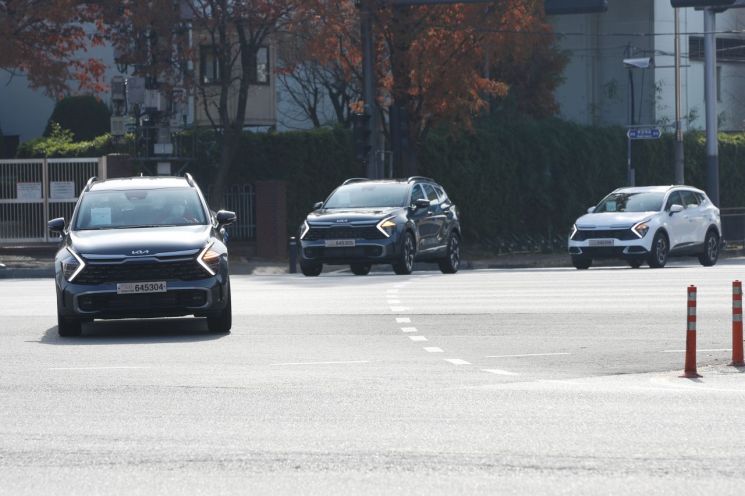 On the second day of the Cargo Solidarity general strike on the 25th, completed vehicles with temporary license plates are being moved to the storage yard at Kia Gwangju Plant in Seo-gu, Gwangju. Photo by Yonhap News
[Asia Economy Culture Young Intern Reporter] As the transportation refusal by the Cargo Solidarity Headquarters of the Public Transport Union under the Korean Confederation of Trade Unions (KCTU) continues for the sixth day, hundreds of people are being mobilized daily for the 'road delivery (individual road transport)' task, where completed vehicles are driven directly from the factory to the shipping yard.
Road delivery refers to drivers who have been issued temporary operation permits being paid daily wages to drive completed vehicles directly to the shipping yard. Currently, Kia's delivery companies have recruited hundreds of daily-wage drivers in preparation for the strike and are directly transporting completed vehicles from the Gwangju plant to the shipping yard.
According to Kia Autoland Gwangju Plant on the 29th, all 108 car carriers (delivery trucks) responsible for transporting vehicles have stopped operating due to the Cargo Solidarity's transportation refusal. Since the 25th, completed vehicles shipped from the factory have been transported by road delivery to the shipping yard in Pyeong-dong, Gwangsan-gu, Gwangju Metropolitan City, and the logistics center in Jangseong, Jeollanam-do.
The delivery companies responsible for transporting completed vehicles are recruiting 500 to 700 daily-wage drivers on a first-come, first-served basis to be deployed for road delivery in preparation for the transportation refusal. Daily-wage drivers gather every day at 5 a.m. at the Gwangju-Kia Champions Field parking lot, take a bus to Plants 1 and 2, and start road delivery.
They drive the completed vehicles directly to the shipping yard and then return to the factory by bus prepared by the delivery company. They transport 1 to 3 completed vehicles per day. Anyone with a driver's license can work, and the daily wage is 150,000 KRW, making it known as a so-called 'sweet part-time job.'
Hyundai Motor Company is also using road delivery to directly transport new cars to customers. Employees from the Ulsan Plant delivery center are deployed for road delivery, and about 540 vehicles were delivered on the morning of the 25th alone.
However, some buyers are dissatisfied, saying, "I received a new car, but the mileage is already 100 km, so it feels like I bought a used car." Although they paid a large amount for a new car, the accumulated mileage increases due to road delivery. However, buyers say they have no choice but to accept the car because refusing road delivery results in their turn being pushed back.
In response, Hyundai Motor Company and Kia announced on the 28th that they will extend the quality warranty mileage by 2,000 km. A Kia Gwangju Plant official said, "We provide mileage warranty extension benefits to customers who agree to road delivery," adding, "We are doing our best to ensure safe driving and vehicle protection to prevent consumer complaints."
Meanwhile, Kia Gwangju Plant is preparing storage spaces in anticipation of a prolonged strike. Currently, the parking lots of Gwangju 1st Combat Flight Group and Hampyeong Butterfly Festival site, as well as unopened roads in the Gwangju Energy Valley Industrial Complex, are being prepared as storage spaces, and additional spaces are being sought.
© The Asia Business Daily(www.asiae.co.kr). All rights reserved.
![Clutching a Stolen Dior Bag, Saying "I Hate Being Poor but Real"... The Grotesque Con of a "Human Knockoff" [Slate]](https://cwcontent.asiae.co.kr/asiaresize/183/2026021902243444107_1771435474.jpg)
















