Statistics Korea Announces 'Industrial Activity Trends'
[Asia Economy Sejong=Reporter Kim Hyewon, Sejong=Reporter Son Seonhee] Production in October decreased by 1.5%, marking the largest decline in 30 months. Consumption also fell for the second consecutive month.
According to the industrial activity trends for October released by Statistics Korea on the 30th, the October total industry production index (seasonally adjusted, excluding agriculture, forestry, and fisheries) stood at 115.4 (2015=100), down 1.5% from the previous month. Total industry production has declined for four consecutive months following July (-0.2%), August (-0.1%), and September (-0.4%). This is the first time in 29 months since January-May 2020 that this indicator has decreased for four straight months. The scale of the decline was also the largest in 30 months since April 2020 (-1.8%), when the Korean economy began to be hit by the COVID-19 pandemic.
By sector, manufacturing and other mining and manufacturing production fell by 3.5%. This was due to reduced production of finished vehicles such as passenger cars and a decrease in semiconductor assembly equipment production. Service industry production dropped by 0.8%, marking the largest decline in 22 months since December 2020 (-1.0%).
The retail sales index (seasonally adjusted), which reflects consumption trends, was 120.4 (2015=100), down 0.2%. Consumption had decreased for five consecutive months from March (-0.7%) to July (-0.4%), rebounded temporarily in August, but returned to a declining trend in September and October. Relatively warm weather during the winter season led to reduced clothing consumption. The Itaewon tragedy is expected to partially impact consumption contraction from the fourth quarter onward. Eo Unseon, the economic trend statistics director at Statistics Korea, said, "Mining and manufacturing production was sluggish, and service industry production also slowed as retail sales faltered, showing a weakening trend in economic recovery."
The sharp drop in production last month, comparable to the initial economic shock of the COVID-19 crisis, was due to the sluggish manufacturing sector, which is the backbone of the Korean economy. In particular, production declines were significant in the automobile and machinery equipment sectors. With ongoing external uncertainties such as the prolonged Ukraine crisis, China's stringent lockdown measures, and global tightening, combined with two consecutive months of weak consumption, concerns about economic slowdown have intensified.
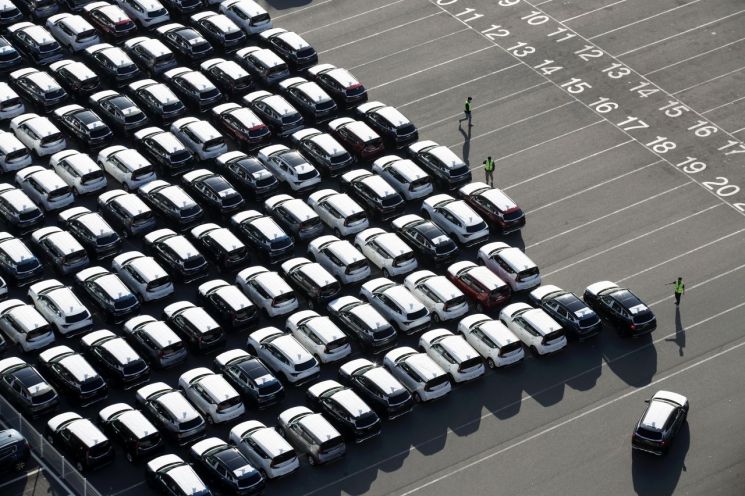
Manufacturing production last month fell by 3.6%, dragging down total mining and manufacturing production (-3.5%). Such poor performance in manufacturing was the worst in two years and five months since May 2020 (-7.5%), the early stage of the COVID-19 crisis. Notably, sectors such as automobiles (-7.3%) and machinery equipment (-7.9%) were sluggish. The production of recreational vehicles (RVs), which had recently shown strong performance, showed signs of adjustment, and production of some models was halted, according to analysis.
The average manufacturing operating rate last month was 72.4%, down 2.7 percentage points from the previous month. Due to highly uncertain demand, production momentum is fading. Manufacturing inventories decreased by 1.4% compared to the previous month. However, it is difficult to view the inventory reduction entirely positively. Director Eo explained, "The reduction in semiconductor inventories had a significant impact, but as business uncertainty increased, demand weakened. It also appears that production was lowered to deplete inventories in some way."
Consumption continued to contract for the second consecutive month. Durable goods consumption, including passenger cars, was sluggish (-4.5%), and sales of transitional season clothing also declined due to warmer-than-average temperatures last month.
The economic outlook remains uncertain. The coincident index of economic indicators, which reflects the current economy, was 102.4, unchanged from the previous month, while the leading index of economic indicators, used for economic forecasting, fell by 0.1 points to 99.2. The leading index has been declining for four consecutive months. In addition to external uncertainties, domestic negative factors such as prolonged high inflation, interest rate hikes, and the Cargo Solidarity strike have added challenges. However, expectations of a slowdown in the pace of tightening by the U.S. Federal Reserve next month have formed, making it premature to judge a turning point in the economic trend.
The Ministry of Economy and Finance stated, "Although there are positive factors such as the decline in international oil prices and easing supply chain disruptions, concerns remain over continued export declines and the impact of the Cargo Solidarity collective transport refusal." It added, "Regarding consumption and investment, there are positive factors such as an increase in foreign tourists and the World Cup effect, but risks include the Itaewon accident impact, downturns in the semiconductor and real estate markets, still high inflation levels, and rising interest rates." The ministry concluded, "We will make every effort to stabilize prices and livelihoods while thoroughly managing risks both domestically and internationally and revitalizing exports and investment."
© The Asia Business Daily(www.asiae.co.kr). All rights reserved.

















