Patent Application for Self-Repair Helper App
Partnering with iFixit to Sell Parts for S21, S20, etc.
Premium Smartphone Prices Soar
Growing Calls to Guarantee 'Repair Rights' to Reduce Consumer Burden
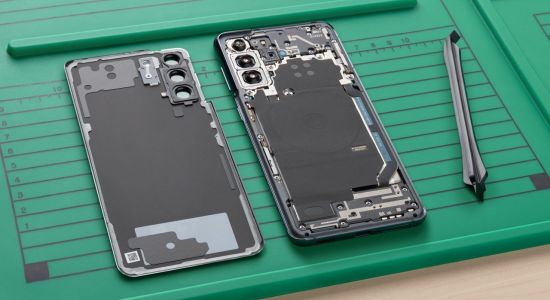
[Asia Economy Reporter Minyoung Cha] There is good news for those who have paid hundreds of thousands of won in repair costs due to smartphone screen damage. Following Apple, Samsung Electronics also plans to offer an app that allows users to easily repair their smartphones at home.
According to IT specialist media such as SamMobile and The Verge on the 30th, Samsung Electronics recently filed a patent application with the U.S. Patent Office for a 'Self-Repair Assistant' app. The icon features a blue background with images of gears and a wrench. Although a patent application does not necessarily lead to an app release, it is interpreted as a measure to enhance customer convenience.
 Patent image of the 'Self Repair Assistant' app filed by Samsung Electronics with the United States Patent and Trademark Office. Photo by SamMobile
Since August, Samsung Electronics has been providing genuine Samsung parts, repair manuals, and repair tools through the global online repair company Ifixit in the U.S. They are selling parts and self-repair kits for the Galaxy S20 and S21 series, as well as the Galaxy Tab S7+ model. This is notable as it is the first time Samsung has handed over repair rights to a private company rather than its own service centers.
As of today, the price of the screen and battery repair kit for the 'Galaxy S21 Ultra' model sold on Ifixit is $239.99 (approximately 320,000 KRW). The USB Type-C port costs $66.99 (about 90,000 KRW), and the rear glass panel is priced at $76.99 (around 100,000 KRW). Ifixit provides 74 types of Samsung smartphone disassembly guides but does not sell parts for all smartphone models.
Samsung's move is driven by smartphone users demanding the right to repair their devices themselves. The price of premium smartphones has risen above 1 million KRW, and with higher specifications, the replacement cycle has more than doubled. Screen sizes have also increased, leading to more frequent damage. The burden of repair costs has led some users to attempt repairs on their own.

Apple also officially announced in November last year that it would support DIY repair services and launched related services starting in April this year. Although self-repair services are not yet offered in Korea, Apple has filed related international patents, which are currently under review. Apple plans to gradually expand the service to more countries, starting with the U.S. Besides Samsung, global smartphone companies such as Apple, Google, Motorola, and Huawei are also selling smartphone repair parts in collaboration with Ifixit.
Self-repair systems have not yet been introduced in Korea. At this year's National Assembly audit, Samsung Electronics MX Division President (CEO) Notae Moon responded to the question, "Can't self-repair be done like in the U.S.?" by saying, "Unlike Korea, the U.S. has an environment where face-to-face repairs are difficult." However, he added, "Since demands for self-repair continue, we will carefully review and decide whether to proceed." During the last presidential election, Democratic Party candidate Lee Jae-myung pledged to expand consumer repair rights for electronic and home appliances as one of his campaign promises. The 'Right to Repair Act' proposed by Justice Party lawmaker Kang Eun-mi is also pending in the standing committee.
Manufacturers often cite safety and cost issues as reasons against self-repair. Geographic differences, such as the lack of active service centers in the U.S., are also mentioned. An industry insider noted, "From the manufacturer's perspective, there are parts they may oppose because it could affect sales, and it is a complex issue with intertwined challenges."
© The Asia Business Daily(www.asiae.co.kr). All rights reserved.
![Clutching a Stolen Dior Bag, Saying "I Hate Being Poor but Real"... The Grotesque Con of a "Human Knockoff" [Slate]](https://cwcontent.asiae.co.kr/asiaresize/183/2026021902243444107_1771435474.jpg)


















