Resumption of Tax Subcommittee Meetings After Repeated Disruptions
Discussion Expected on Tax Law Amendments Including Special Tax Treatment Act
Ruling and Opposition Agree on Expanding Deduction Rates
Differences in Proposed Figures Anticipate Difficulties
Government Also States 'Above 8% Not Possible'
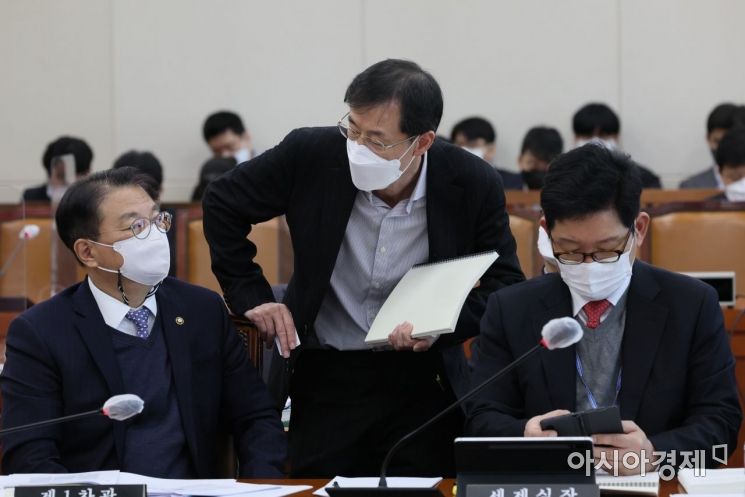 Bang Gi-seon, the 1st Vice Minister of Strategy and Finance, is attending the Tax Subcommittee of the National Assembly's Strategy and Finance Committee on the 30th, waiting for the meeting to begin. Photo by Yoon Dong-ju doso7@
[Asia Economy Reporter Lee Hyun-joo] The Tax Special Cases Restriction Act, which includes tax credits for investments in national strategic technologies such as semiconductors, is expected to be actively discussed at the National Assembly's Planning and Finance Committee's Tax Subcommittee. With the National Advanced Industry Special Act, one of the Semiconductor Special Acts, expected to pass within the year through bipartisan agreement, attention is turning to the other pillar, the amendment to the Tax Special Cases Restriction Act. Although the ruling and opposition parties, as well as the government, agree on the need to expand the current 6% integrated investment tax credit rate for companies, difficulties are anticipated as they have proposed different figures.
On the 30th, the Planning and Finance Committee will convene the Tax Subcommittee to begin discussions on the tax law amendments, including the Tax Special Cases Restriction Act. The Tax Subcommittee had been stalled since the 24th, but it is reported that it will resume as the ruling party accepted the opposition's request to discuss the three social economy laws (Basic Social Economy Act, Special Act on Promotion and Support for Social Economy Enterprise Product Purchases and Sales Channels, Basic Act on Realization of Social Value by Public Institutions) after the budget bill is processed. Especially since the 30th is the legal deadline for passing budget-related bills, it is said that both parties will find it difficult to ignore this. Analysts also suggest that the National Assembly's Industry, Trade, and Small and Medium Venture Business Committee's sudden agreement on the Advanced Industry Special Act, one pillar of the Semiconductor Special Act, has spurred discussions on the Tax Special Cases Restriction Act.
The core of the amendment to the Tax Special Cases Restriction Act is how much to raise the tax credit rate for investments in national strategic technology facilities. Since corporate tax burdens and national tax revenues are intertwined, all parties find it difficult to make concessions.
The ruling party's stance is that tax support should be provided at 20% or more for large corporations. Yang Hyang-ja, an independent member and chairperson of the People Power Party's Special Committee for Strengthening Semiconductor Industry Competitiveness, proposed significantly expanding the integrated investment tax credit rates from the current 6%, 8%, and 16% for large, medium-sized, and small enterprises respectively, to 20%, 25%, and 30%. Park Sung-joong of the People Power Party also proposed an amendment to expand the rate up to 30% for large corporations.
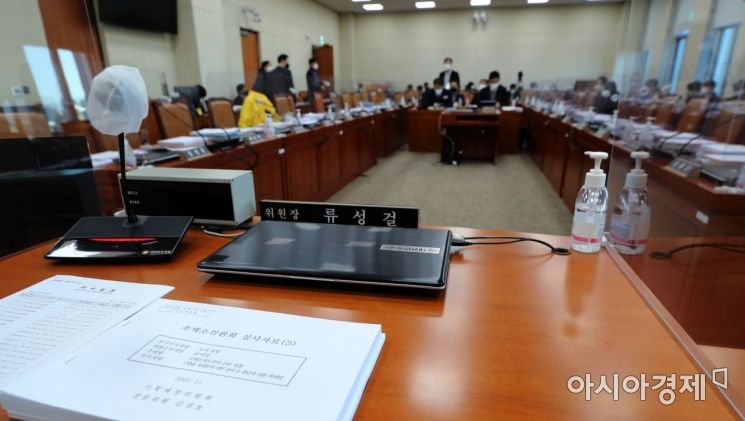 The Tax Subcommittee of the National Assembly's Planning and Finance Committee could not be held on the 30th. Photo by Yoon Dong-ju doso7@
On the other hand, the opposition party framed the tax credit issue as a "tax cut for the rich." Han Byung-do of the Democratic Party proposed an amendment to keep the large corporation credit rate at 6%, while expanding it to 10% for medium-sized enterprises and 20% for small enterprises. Recently, Kim Han-jung of the Democratic Party proposed a Tax Special Cases Restriction Act amendment to raise the credit rate up to 30%, including 10% for large corporations, to facilitate the passage of the Semiconductor Special Act.
The government presented a somewhat conservative credit rate when announcing the tax reform plan. It proposed maintaining the current rates for medium and small enterprises while expanding the credit rate for large corporations to 8%, the level of medium-sized enterprises. This is the same as the proposal by Kim Sang-hoon of the People Power Party.
At the subcommittee meeting, it is expected that the global trend of countries supporting research, development, and production of core technologies such as semiconductors will be highlighted. The United States stipulates a 25% tax credit on semiconductor facility and equipment investments through the CHIPS and Science Act, and China has expanded the income deduction rate for large corporations to the level of small enterprises. As countries expand policy support to secure advanced technologies and production bases, the need for policies to attract corporate investment domestically is being raised.
In the amendment to the Tax Special Cases Restriction Act, the government's position is as much a variable as that of the ruling and opposition parties. The government holds that a tax credit rate above 8% is impossible due to concerns over reduced tax revenues. According to a related review report by the National Assembly, the Ministry of Economy and Finance predicts that expanding the current 6% tax credit rate for large corporations to 8% would reduce tax revenues by 381.5 billion KRW next year and by 886 billion KRW by 2025. The Ministry is reportedly opposing the increase, stating, "Only the United States explicitly specifies a 25% tax credit worldwide, and it is questionable whether tax reductions will directly lead to domestic investment."
A People Power Party Planning and Finance Committee official said, "Is there any disagreement that semiconductors are the future advanced industry of our country?" and added, "We expect the opposition party to agree on this point as well."
© The Asia Business Daily(www.asiae.co.kr). All rights reserved.


















