Total Strike Continues for a Week
Serious Damage to Freight Industry
Economic Losses Reported Due to Shipping Disruptions and Production Facility Shutdowns
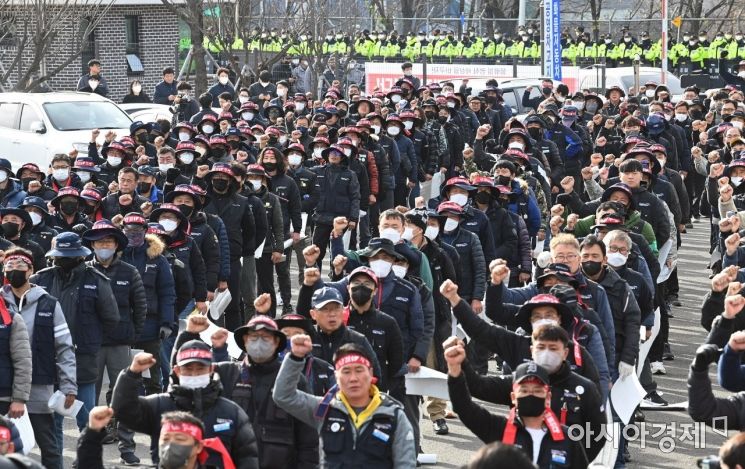 On the 29th, when the government issued a work commencement order against the general strike by the Cargo Solidarity Headquarters of the Public Transport Union of the Korean Confederation of Trade Unions, members of the Cargo Solidarity Seoul-Gyeonggi Regional Headquarters held a rally at the Inland Container Depot (ICD) in Uiwang-si, Gyeonggi Province, shouting slogans condemning the order. / Uiwang = Photo by Kim Hyun-min kimhyun81@
[Asia Economy Reporter Park Sun-mi] The economic losses in the industrial sector caused by the Cargo Solidarity's collective transport refusal (general strike), which has continued for a week, are estimated to approach several hundred billion won per day. Combining the estimated damage figures disclosed by each industry, if the strike prolongs, the scope and impact of the losses will expand, and the economic losses are expected to increase astronomically.
On the 30th, representative associations of domestic industries such as cement, petrochemicals, automobiles, and steel expressed economic losses due to shipment disruptions and production facility shutdowns related to the Cargo Solidarity's collective transport refusal.
The Korea Cement Association stated that if the Cargo Solidarity's collective transport refusal continues, it will be impossible to secure cement storage space, and they are considering partial production facility shutdowns starting this weekend. The daily domestic cement demand is about 180,000 to 200,000 tons (based on peak season), and due to the Cargo Solidarity's transport refusal, shipments are less than 10% on weekdays, resulting in an estimated daily sales loss of about 18 billion won. Even non-union members of BCT avoid transportation due to threats and sympathy with the Cargo Solidarity's transport refusal, causing complete shipment stoppages at cement production plants in Donghae, Danyang, Jecheon, as well as distribution bases in the metropolitan area, with only partial shipments ongoing in some areas of Chungcheong (Bugang, Maepo, etc.) and the southern region.
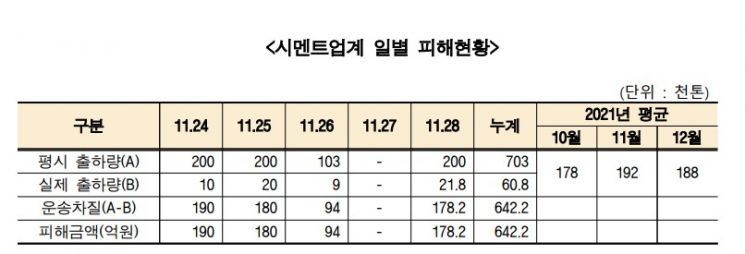
The Korea Petrochemical Industry Association has opened the possibility that shipment disruptions occurring since the 28th of this month may expand to reduced operating rates or facility shutdowns starting this weekend. Only about 30% of the industry's average daily shipment volume of 74,000 tons (approximately 97 billion won) is being shipped, estimating a daily loss of about 68 billion won. Moreover, due to recent sluggish business conditions, factories are operating at about 80% capacity, making additional operating rate adjustments difficult; thus, a complete shipment stoppage would inevitably lead to production plant shutdowns. Since at least two weeks are required for shutdown and restart, the astronomical sales disruptions and restart costs could further increase the burden on an industry currently recording losses.
The Korea Automobile Manufacturers Association estimates that the Cargo Solidarity's collective transport refusal is causing a daily burden of about 400 million won in labor costs and temporary storage operation expenses. Customer dissatisfaction is also increasing due to increased new car mileage, delayed delivery schedules, and concerns about other quality issues during driving. If the transport refusal prolongs, production disruptions will expand across the industry, inevitably causing a crisis throughout the automobile industry ecosystem, including parts suppliers. During the collective transport refusal in June, there was a production disruption of about 5,400 vehicles (257.1 billion won).
The Korea Iron and Steel Association estimates that shipment disruptions in the domestic steel industry total 600,000 tons, amounting to 800 billion won. This means that steel shipment disruptions exceeding 100 billion won occur daily. Since steel is a basic material, shipment disruptions of steel products could spread to related industries such as construction, automobiles, and shipbuilding, causing production disruptions in major industries. In particular, the domestic steel industry is still recovering from typhoon damage in September, and the ongoing transport refusal is causing even greater concerns.
The Korea Feed Association is concerned about livestock starvation and other damages if the Cargo Solidarity's general strike prolongs. Feed manufacturers face production disruptions if they cannot receive feed raw materials (corn, distillers grains, etc.) from ports, and since the average feed storage per farm is only 2 to 3 days, failure to continuously replenish could lead to the worst-case scenario of livestock starvation. Furthermore, the daily usage of raw materials imported by container, such as distillers grains, is 30-50 tons per factory, and shipments have been suspended for a week, making production stoppages at factories highly likely soon. Factories producing using alternative raw materials face concerns of daily losses amounting to tens of millions of won per factory due to sharp increases in production costs.
© The Asia Business Daily(www.asiae.co.kr). All rights reserved.


















