Emergency Meeting Held on the 30th with Muhyeop and Hwajoo Representatives
Cement, Tea, Petroleum, Petrochemical, Steel, and Feed Industries Participate
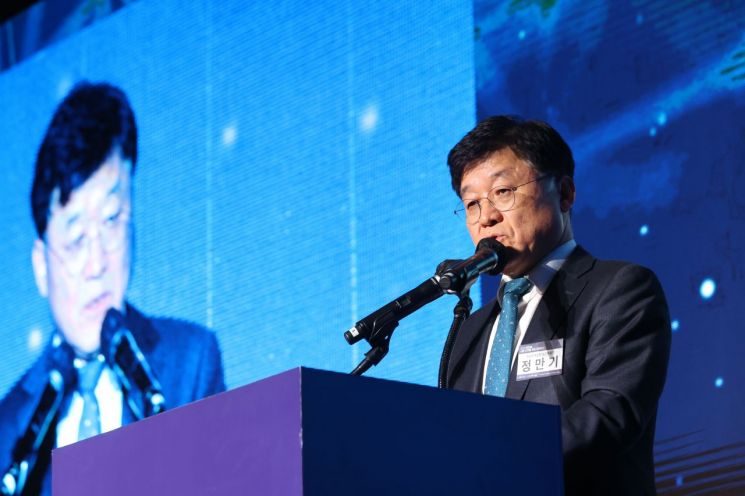 Jung Manki, Executive Vice Chairman of the Korea International Trade Association. (Photo by Yonhap News)
[Asia Economy Reporter Moon Chaeseok]
"The permanent implementation of the Safe Freight Rate System is incompatible with the market economy and raises concerns about its constitutionality. We urge the immediate cessation of collective transportation refusal actions and cooperation in sharing the data from digital tachographs of large freight vehicles in real-time with traffic authorities and stakeholders such as cargo owners."
Jung Manki, Executive Vice Chairman of the Korea International Trade Association (KITA), made these remarks on the 30th, calling on the Cargo Solidarity of the Korean Public Service and Transport Workers' Union under the Korean Confederation of Trade Unions (KCTU) to halt their strike. Although the government issued a 'work commencement order' to cement workers who refused transportation due to strike participation, he warned that the strike could adversely affect key industries including automobiles, petroleum, petrochemicals, and steel. KITA serves as the representative organization of cargo owners under the Shipping Act and acts as a channel to resolve logistics difficulties for its member companies.
At 8:30 a.m. that day, Jung emphasized the need to devise reasonable alternatives rather than strikes during the 'Emergency Press Conference of Cargo Owner Organizations Regarding Cargo Solidarity’s Collective Transportation Refusal' held in the large conference room on the 51st floor of the Trade Tower in Samseong-dong, Gangnam-gu, Seoul. He pointed out that permanently implementing the Safe Freight Rate System, as demanded by Cargo Solidarity, is a response incompatible with the market economy. The system does not meet the conditions justifying government intervention such as market failure, information asymmetry, public interest, or safety.
He criticized the low effectiveness of the permanent Safe Freight Rate System. While freight rates increased by more than 28% after the system’s implementation, accidents involving vehicles subject to the system rose by 8%. Jung stated, "In conclusion, government intervention in determining freight rates for trucks is unjustifiable from various perspectives," adding, "The system was initially introduced because the political sphere yielded to the collective selfishness of truck owners and others. The Safe Freight Rate System should be abolished."
Jung stressed the need to establish a system that verifies road infrastructure, drivers’ driving habits, and vehicle maintenance status. He said, "If various data recorded on digital tachographs, which are mandatory for large freight vehicles, were shared in real-time with traffic authorities and stakeholders, it would contribute to accident prevention," pointing out, "Currently, it is known that data sharing is hindered due to opposition from truck owners or transportation companies."
Ultimately, Jung argued that establishing an information-sharing system is preferable to permanently implementing the Safe Freight Rate System. He insisted that the balance should be sought with cargo owners, the demand side, rather than having service providers such as truck owners and carriers control the information. Jung emphasized, "Since transportation companies hold more cargo-related information than truck owners and could exploit the latter’s information deficiency, a platform business connecting cargo transportation stakeholders through an 'information network' could resolve issues in the market."
Jung concluded, "We urge Cargo Solidarity to immediately stop the unjustified collective transportation refusal actions aimed at permanently implementing the Safe Freight Rate System and to work toward solutions that allow cargo owners, truck owners, and carriers to all 'win-win.' In particular, we ask for cooperation in accurately diagnosing accident causes through sharing digital tachograph data and preparing appropriate measures accordingly."
© The Asia Business Daily(www.asiae.co.kr). All rights reserved.

















