Honda, Yamaha, Toyota, Volkswagen Factories Halt Operations
Earlier, Apple Partner Foxconn Faces Production Disruptions
"iPhone Pro Production Shortfall Expected to Reach 6 Million Units"
Industrial Activity Slump Leads to Decline in Raw Material Demand
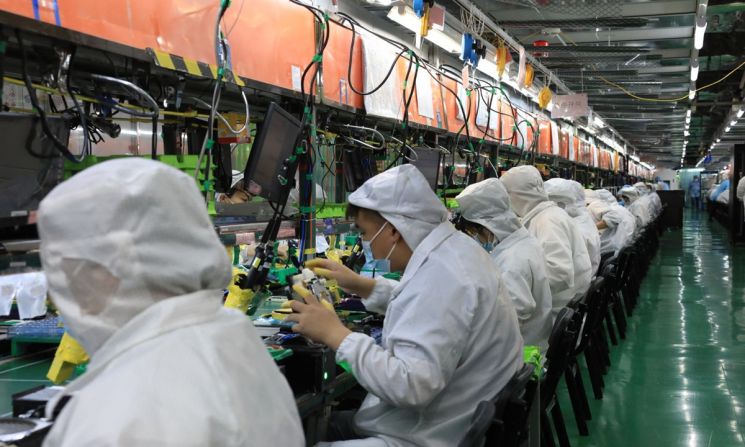 As the spread of COVID-19 leads to strengthened controls such as lockdowns by Chinese authorities, disruptions are occurring not only in the information technology (IT) industry but also in the operations of factories related to the automobile industry.
[Asia Economy Reporter Oh Gyumin] As the Chinese authorities strengthen controls such as lockdowns due to the spread of COVID-19, disruptions are occurring not only in the information technology (IT) industry but also in factory operations related to the automobile industry.
On the 29th, Bloomberg reported that Japanese automaker Honda suspended operations at its factory located in Wuhan, Hubei Province, due to movement restrictions caused by COVID-19. As of the 30th, it was also reported that the resumption of operations had not yet been decided.
Honda's Chongqing factory, which produces engines for weed trimmers, also stopped operations, and Yamaha Motor halted part of the production line at its Chongqing motorcycle factory. Toyota Motor is reportedly adjusting production at some of its factories in China for various reasons.
The day before, German automaker Volkswagen also suspended operations at its Chengdu factory in Sichuan Province, which it operates jointly with China FAW Group Corporation (FAW), due to a shortage of parts. Volkswagen's Changchun factory in Jilin Province also stopped two out of five production lines.
Earlier, the IT industry had been experiencing production difficulties due to China's COVID-19 controls. Foxconn, Apple's largest partner, is facing production disruptions at its Zhengzhou factory in Henan Province due to lockdowns, employee escapes, and protests.
According to sources familiar with the local situation, Bloomberg reported that the disruption at the Zhengzhou factory could result in a shortage of about 6 million units of iPhone 14 Pro production.
There is a possibility that demand for raw materials will decrease due to the contraction of industrial activity. If the Chinese government strengthens controls over industrial facility operations, electricity demand will decrease, leading to reduced use of coal and natural gas for power generation. Bloomberg also predicted that oil demand may decline due to reduced traffic from movement restrictions, and demand for cooking oil may also be weak due to reduced dining out caused by restaurant closures.
China's electricity demand increased by 4% in the first to third quarters of this year, which falls short of last year's 10% growth. According to Standard & Poor's (S&P) Global Commodity Insights, this growth trend is expected to continue into the fourth quarter. There are also forecasts that oil demand will decrease until the first quarter of next year.
Wang Xiaoyang, senior analyst at Sinolink Futures, said, "If COVID-19 outbreaks continue frequently and there are no significant changes in control policies, it will be difficult for raw material demand to increase," adding, "This will be a factor suppressing raw material prices in the coming months."
© The Asia Business Daily(www.asiae.co.kr). All rights reserved.

















