Ministry of Science and ICT Announces 'National Synthetic Biology Initiative' at Industry-Academia-Research Meeting on 29th
To Complete by 2028 for Public Use, Establishing Sector- and Region-Specific Public Biofoundries
Expected to Replace Over One-Third of Existing Manufacturing Industry, "Technology That Will Decide the Future of the Bio Industry"
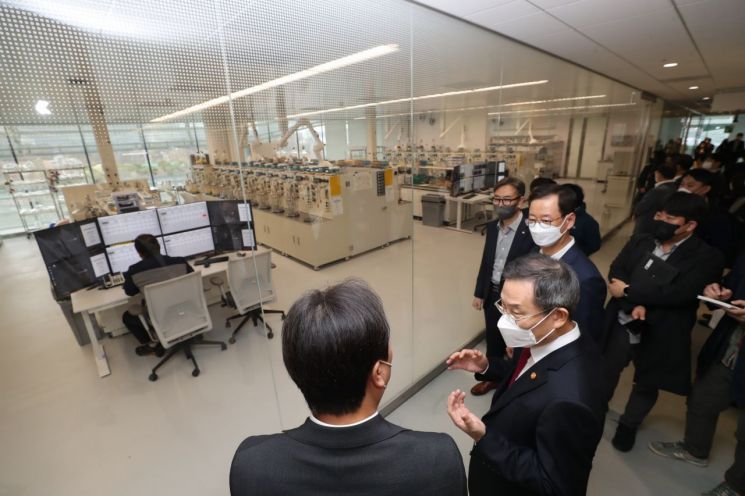 Minister Lee Jong-ho of the Ministry of Science and ICT visited CJ Blossom Park in Gwanggyo, Suwon, Gyeonggi Province on the 29th to inspect research facilities. The minister held a meeting with experts from industry, academia, and research institutes and announced the "National Synthetic Biology Initiative," stating plans to invest around 300 billion KRW by 2028 to establish a world-class national biofoundry. Photo by Ministry of Science and ICT
[Asia Economy Reporter Kim Bong-su] The government plans to invest a total of 300 billion KRW to establish a world-class national bio foundry (automated bio research and manufacturing facility) and focus on nurturing synthetic biology, which is rapidly emerging as a next-generation strategic technology.
On the afternoon of the 29th, Lee Jong-ho, Minister of Science and ICT, visited CJ Blossom Park located in Gwanggyo Technopark, Suwon, Gyeonggi Province, and held a meeting with related industry, academia, and research officials to announce the "National Synthetic Biology Initiative." Synthetic biology refers to technology that enables faster, more efficient, and large-scale biotechnology research and development through automation technologies such as artificial intelligence (AI), robotics, and big data. It is rapidly emerging worldwide as a next-generation strategic technology, notably utilized by multinational pharmaceutical company Moderna to develop its messenger ribonucleic acid (mRNA) COVID-19 vaccine, significantly shortening the development period.
To support synthetic biology research, the government plans to build a core infrastructure, the national bio foundry, at the highest global level. After preparatory steps including a preliminary feasibility study by next year, a total of 300 billion KRW will be invested from 2024 to 2028. The national bio foundry will integrate digital technologies such as AI and robotics into existing bio research facilities to increase research and development speed by more than five times, while securing world-class core infrastructure and integrated operational capabilities for artificial cell design and fabrication. Specialized public bio foundries for each sector will also be established. From 2027, regional public bio foundries providing specialized infrastructure and services for industries such as agriculture and food, marine, advanced new drugs, and energy will be built for regional and industrial use.
Bio manufacturing innovation actively utilizing the research outcomes of the bio foundry will also be promoted. Existing industries such as biohealth, chemicals, environment, food, and materials will be supported to transition to synthetic biology-based manufacturing processes using the bio foundry. Plans include supporting the startup and growth of innovative bio companies and promoting private investment.
To create a sustainable ecosystem, the government will establish domestic synthetic biology innovation governance and strengthen global cooperative partnerships. To lay the foundation for growth, legal and institutional improvements for synthetic biology development will begin within next year. The "Act on Promotion and Support of Synthetic Biology Research" will be proposed to foster sustainable ecosystems through cooperation among related institutions and public-private partnerships, as well as workforce development. KAIST will establish a graduate school specializing in synthetic biology next year. Through the development of convergent education programs combining bio, AI, and engineering, establishment of specialized departments, and integrated theoretical and practical training programs, 1,000 experts will be trained by 2030. Six strategic fields of synthetic biology will be designated, and dedicated research and development (R&D) programs will be newly established for focused nurturing.
Earlier, in October, the government held the National Science and Technology Advisory Council chaired by President Yoon Suk-yeol and announced plans to foster national strategic technologies, selecting the "advanced bio" sector as one of the 12 strategic technologies, with synthetic biology identified as a key technology within this sector. This initiative is a follow-up measure to that announcement.
Minister Lee Jong-ho stated, "Synthetic biology technology will lead a new evolution in the bio transformation era, overcoming the limitations faced by the bio sector through the convergence of bio and digital technologies," adding, "The National Synthetic Biology Initiative will serve as a milestone to proactively and strategically respond to the technological hegemony competition."
© The Asia Business Daily(www.asiae.co.kr). All rights reserved.

















