Urgent Order to Resume Work in Logistics Normalization Sectors... Up to 3 Years Imprisonment or Fine for Refusal
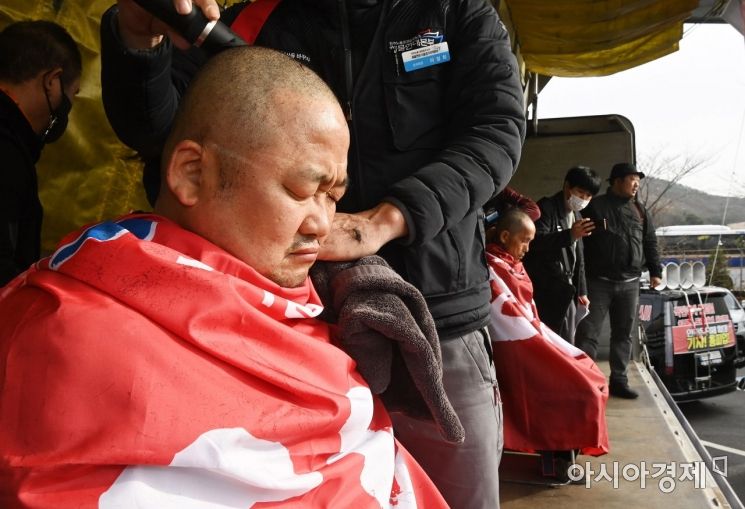 On the 29th, when the government issued a work commencement order against the general strike of the Cargo Solidarity Headquarters of the Public Transport Union of the Korean Confederation of Trade Unions, Lee Kwang-jae (left), head of the Seoul-Gyeonggi Regional Headquarters of the Cargo Solidarity Headquarters, and Lee Bong-ju, chairman of the Cargo Solidarity Headquarters, protested the order by shaving their heads at the rally held at the Inland Container Depot (ICD) in Uiwang-si, Gyeonggi Province. / Uiwang = Photo by Kim Hyun-min kimhyun81@
[Asia Economy Reporter Kim Min-young] Following the government's issuance of a work commencement order against those refusing transportation in the cement industry, the Ministry of Land, Infrastructure and Transport (MOLIT) has promptly initiated related measures.
On the 29th, Won Hee-ryong, Minister of Land, Infrastructure and Transport, stated, "From the moment the Cabinet resolution is finalized, the work commencement order will be enforced against those refusing transportation," adding, "This work commencement order is issued targeting the cement sector, which is judged to be the most urgent for logistics normalization, considering the scale of damage and ripple effects."
This measure marks the first application of the work commencement order system, introduced during the Roh Moo-hyun administration in 2004, under the Freight Motor Vehicle Transport Business Act.
Minister Won further explained, "MOLIT officials will take responsibility and depart immediately to various locations to deliver the order documents based on the results of on-site investigations starting from this time."
The work commencement order targets approximately 2,500 transportation workers in the cement industry. MOLIT plans to form 76 investigation teams composed of MOLIT staff, local governments, and police to conduct on-site inspections of about 200 cement transportation companies nationwide and deliver order documents to 201 cement transport operators.
During the on-site investigation, the lists and addresses of freight vehicle owners trading with the transportation companies will be identified, and the actual transportation status and refusal to transport will be confirmed. Furthermore, if it is judged that the transportation company is refusing transportation at the company level, the work commencement order will be delivered primarily to the company, and if any freight vehicle owners refusing transportation are confirmed, the order will be sent to their addresses.
Additionally, if freight vehicles participating in collective transportation refusal are identified during the on-site investigation, license plate verification and further investigation will be conducted to confirm the names and addresses of the freight vehicle owners, after which the work commencement order will be delivered.
Transportation operators and workers who receive the order must withdraw the collective transportation refusal and return to transportation duties by midnight the day after the order is issued. Transportation operators and workers cannot refuse without justifiable reasons, and refusal may result in imprisonment for up to three years or a fine of up to 30 million KRW. Violations of the order may also lead to suspension or cancellation of freight transportation business and transportation franchise permits.
However, as the Cargo Solidarity Union has declared its intention to oppose the government's work commencement order, conflicts between labor and government are expected to intensify. The Cargo Solidarity Union issued a statement saying, "The work commencement order violates our Constitution (Article 12, Paragraph 1), which prohibits forced labor, and the Labor Standards Act (Article 7)," and added, "Moreover, the arbitrary criteria such as 'significant obstruction' or 'substantial reason' allow the government to impose penalties at its discretion, which legal experts commonly agree violates the principle of legality in criminal law."
© The Asia Business Daily(www.asiae.co.kr). All rights reserved.

















