Hanwha Aero Demonstrates 'Arionsmet' at Camp Rumpfrees
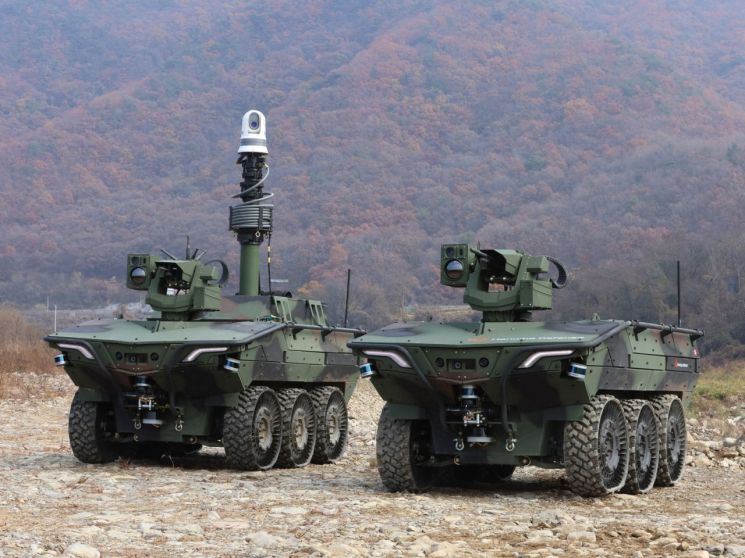
[Pyeongtaek=Ministry of National Defense Joint Press Corps & Asia Economy Military Specialist Yang Nak-gyu] A performance demonstration for the export of a domestically developed multipurpose unmanned vehicle to the United States was held at a US Forces Korea base. This is the first time a domestic company has showcased unmanned technology at a US Forces Korea base, indicating the US military's interest in our unmanned vehicle technology.
Hanwha Aerospace held a performance demonstration of the multipurpose unmanned vehicle 'Arion-SMET' at the US Forces Korea Pyeongtaek base 'Camp Humphreys' on the 29th. Arion-SMET is an English acronym for a 'small multipurpose unmanned vehicle capable of autonomous driving in rough terrain.' Attendees included Mark Fuller, Deputy Commander of US Eighth Army Operations, and officials from the Ground Vehicle Systems Center (GVSC) under the US Army Combat Capabilities Development Command.
Arion-SMET is the latest version of the multipurpose unmanned vehicle for infantry combat support developed by Hanwha Aerospace from 2016 to 2019 as the first domestic civil-military technology cooperation project. Previously, the US Department of Defense selected Arion-SMET as the first overseas comparative performance test (FCT) equipment among military unmanned vehicles developed in Korea.
FCT is a system by the US Department of Defense to evaluate excellent defense technologies possessed by allied countries and secure core technologies necessary for the development and acquisition of the US military's main weapon systems. Equipment selected for FCT receives support for testing and evaluation budgets. The US Department of Defense selects about 15 to 20 pieces of equipment annually with a budget of approximately 100 million dollars.
Arion-SMET performs missions such as cargo transport, patient evacuation, surveillance reconnaissance, remote search, and close combat. It can operate via remote driving within 1.1 km using a remote controller, as well as subordinate driving following a person or vehicle, and semi-autonomous driving with obstacle avoidance. It also supports autonomous return functionality in case of communication loss. Powered by electric charging, it can travel over 100 km on a single charge.
The exterior of Arion-SMET consists of six wheels, a chassis, cargo space, sensors and various control devices, and armaments. The wheels are commercial airless tires without air pressure, allowing operation even when punctured. These tires can bear more load than regular tires, enabling a total weight capacity of up to 2 tons. Arion-SMET's top speed is 43 km/h on paved roads and 34 km/h on unpaved roads.
The vehicle armor can protect against 7.62mm bullets fired from distances over 400 meters. The payload capacity is up to 550 kg. The cargo space can accommodate two lying patients and, with kit installation, can evacuate up to four people. When a vertical extension device (mast) equipped with sensors is installed in the cargo space, it transforms into surveillance reconnaissance mission equipment. The mast can extend up to 6 meters high, enabling surveillance up to 4 km day and night. It uses artificial intelligence (AI) to recognize objects and people.
The performance demonstration proceeded in the order of autonomous driving along route points, obstacle avoidance, communication loss return, automatic object recognition and target auto-tracking, gunshot detection, soldier and vehicle following, wired following, supply and patient evacuation, and vertical extension device mounting. Particularly impressive was the autonomous return to the initial driving start point after attempting communication recovery when communication between the operator and the unmanned vehicle was cut off during driving.
Additionally, the system automatically tracked targets with remote armament by recognizing people or vehicles, and detected the location of gunshots through sound and pressure, orienting the remote weapon's muzzle toward the direction of the gunfire. The remote weapon can be equipped with four types of firearms: K3 and K15 using 5.56mm rounds, and M60 and K16 using 7.62mm rounds. However, due to ethical concerns such as unnecessary killing, the remote weapon is designed to ask the operator, who is monitoring the situation via camera, for firing intent after target tracking rather than automatic firing.
According to Hanwha Aerospace, the US military is currently considering introducing an autonomous tunnel exploration robot developed by the Agency for Defense Development (ADD) at 'Camp Casey' in Uijeongbu, Gyeonggi Province, and is also considering operating it together with Arion-SMET. The US Marine Corps 3rd Expeditionary Force stationed in Okinawa, Japan, is also paying close attention to Arion-SMET for cargo transport.
Seo Young-woo, an executive at Hanwha Aerospace's Manned-Unmanned Complex Research Center, stated, "Arion-SMET's performance and tactical operation were verified during the Republic of Korea Army's export weapon system military trial operation last year," adding, "We are in discussions with US Forces Korea regarding trial operation and plan to participate in the US Department of Defense's performance comparison program and rapid acquisition projects in the future."
© The Asia Business Daily(www.asiae.co.kr). All rights reserved.
![Clutching a Stolen Dior Bag, Saying "I Hate Being Poor but Real"... The Grotesque Con of a "Human Knockoff" [Slate]](https://cwcontent.asiae.co.kr/asiaresize/183/2026021902243444107_1771435474.jpg)
















