Tourists Seeking Camel Experiences Increase Over 10 Times Compared to Usual
Surge in Tourists Taking 'Selfies' with Camels for SNS Verification Shots
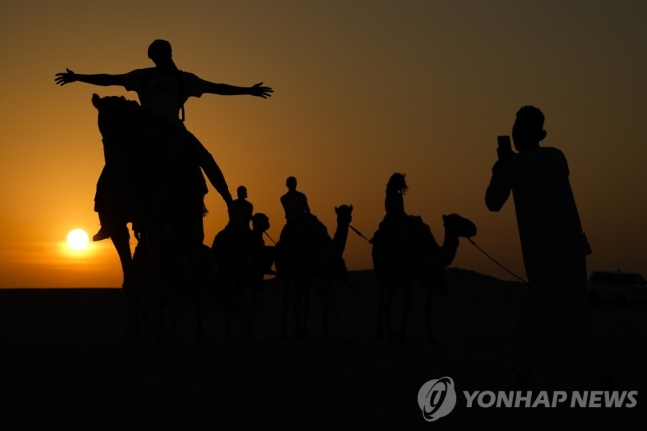
[Asia Economy Reporter Bang Je-il] The World Cup is a festival for people around the world. Every four years, hundreds of thousands of soccer fans from all over the globe gather at the host country of the World Cup. For this Qatar World Cup, over one million people have visited to watch the main matches, and as a result, innocent camels are being overworked and exploited.
According to the Associated Press on the 28th (local time), in Qatar, where the World Cup is currently in full swing, the representative tourist attraction, "camel experience," is selling like hotcakes. Soccer fans are trying to create new memories in Qatar by touring various places during times when there are no matches. Especially in Qatar, a Middle Eastern country with vast deserts, many tourists are flocking to the camel experience.
The popularity of the camel experience is largely due to the opportunity to take "proof shots" to post on social networking services (SNS) such as Instagram. As a result, it has become a trend for many tourists to ride camels or take selfies with them. Thanks to the popularity of the "camel experience," camel herders are earning much more than usual and are fully enjoying the World Cup boom.
Ali Jaber Al Ali, a Bedouin (Arab nomad) from Sudan who has been herding camels since childhood, said in an interview with the Associated Press on the 25th, "I am making a lot of money," adding, "I thank God, but the burden is also great."
Al Ali, who works with several other herders, said that before the World Cup, about 20 tourists on weekdays and 50 on weekends came for the camel experience on average, but now about 1,000 people come daily?500 in the morning and 500 in the afternoon?to ride camels. The herders working with him recently increased the number of camels from 15 to 60 to meet the surging demand.
Aside from the herders' income, the camels are suffering from unexpected overtime due to the surge in tourists. Since the World Cup began, camels in Qatar have been carrying as few as 15 to 20 people and as many as 40 people per day. Usually, camels used for the camel experience only get a short rest after carrying about five tourists. However, during the World Cup, camels have to wake up early in the morning to prepare for tourists who want to take stunning photos with the desert sunrise as a backdrop. Due to the sudden increase in workload, some camels are showing unusual behavior from fatigue accumulation. Al Ali explained, "When camels are too tired, they refuse to stand up or sit back down after standing."
In fact, on this day, when a herder forcibly tried to make a camel stand that was unwilling to get up, the camel groaned and cried out. An Australian female tourist who witnessed this incident shouted, saying, "It seems like the camels are being abused," causing a commotion, according to the Associated Press.
© The Asia Business Daily(www.asiae.co.kr). All rights reserved.

















