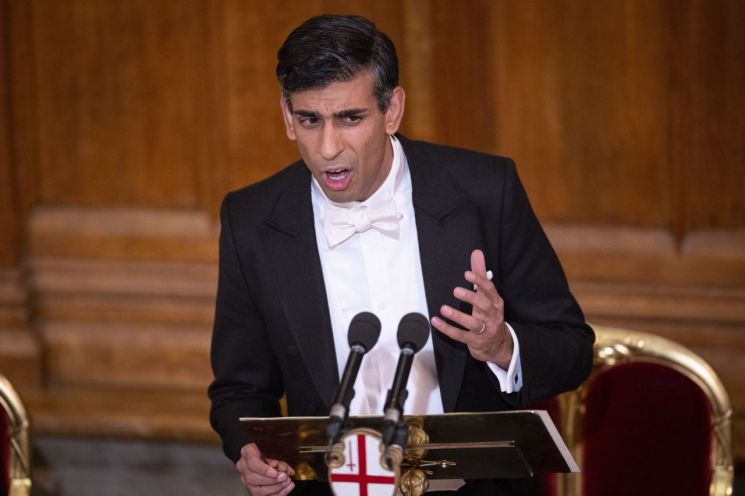
[Asia Economy Reporter Park Byung-hee] On the 28th (local time), UK Prime Minister Rishi Sunak stated at a banquet celebrating the retirement of the Mayor of the City of London, the financial district of London, that the so-called "golden era" with China has come to an end.
The golden era with China refers to the period during former Prime Minister David Cameron's administration, which pursued pro-China policies. However, after Cameron's resignation, relations between the UK and China continued to deteriorate, and recently, prime ministers who have declared a tough stance against China have successively taken office. Prime Minister Sunak has also made it clear that he will adopt a tough stance toward China.
However, foreign media analyzed that Sunak was reluctant to describe China as a "threat" to the UK in his speech that day. This is in contrast to former Prime Minister Liz Truss. Truss had stated that she would review foreign policy and define China as a threat to the UK. Foreign media reported that Sunak emphasized a pragmatic approach to China and used the term "systemic challenge" instead of "threat."
Sunak said, "The judgment that political and social reforms in China could be induced through trade with the West was naive," adding, "The golden era between the UK and China is over."
Sunak also expressed a critical view of China's stringent COVID-19 prevention policy known as Zero COVID. Recently, protests against the Zero COVID policy have been spreading in China, and on the 27th, a BBC reporter covering protests in Shanghai was arrested by Chinese public security, beaten, and released after several hours.
Sunak said, "The assault on the BBC reporter occurred as China chose to crack down harshly on the protests," and added, "China recognizes that it can pose a systemic challenge to the UK's values and interests, and the deeper China's authoritarianism becomes, the greater the difficulties for the UK will be."
However, Sunak stated that it is difficult to ignore China's influence on global economic stability and issues such as climate change, and he opposed using terms like "Cold War." He argued that the UK should adopt a more pragmatic approach toward competitors like China. Sunak emphasized that the UK will cooperate with the US, Canada, Australia, Japan, and others, meaning it will pragmatically confront competitors.
In short, Sunak has expressed a position that while adopting a tough stance toward China, he will not take extreme measures. When serving as Chancellor of the Exchequer in Boris Johnson's cabinet, Sunak warned Johnson that hostile approaches toward the EU and China were dangerous.
Sunak's views may cause conflicts with hardline pro-China MPs within the Conservative Party. Former Conservative Party leader Duncan Smith criticized Sunak's remarks in a Daily Express column, saying, "China is clearly a threat to the UK and its allies." Smith pointed out that Sunak's emphasis on pragmatism sounds close to appeasement.
Another senior Conservative MP also said that Liz Truss, who regarded China as a threat, was right about China policy and that Sunak needs to take a more correct stance. This senior MP added that Sunak's thinking seems similar to that of the Treasury, which views China more from the perspective of economic investment than as a threat.
Sunak also said that although Brexit has been completed, he wants stronger solidarity with Europe. However, he emphasized that there will be no solidarity that follows EU laws. Sunak stated that he will cooperate with the EU on energy and illegal immigration issues and will continue support for Ukraine.
© The Asia Business Daily(www.asiae.co.kr). All rights reserved.

















