Seoul National University Hospital Pediatric Neurosurgery Department Pi Jihoon
Nuclear Medicine Department Professor Paeng Jincheol Team
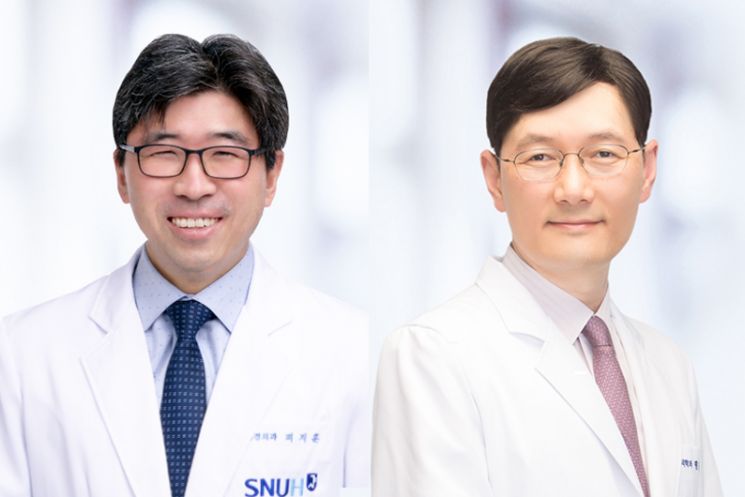 Professor Jihoon Pi, Department of Pediatric Neurosurgery, Seoul National University Hospital (from the left), Professor Jincheol Paeng, Department of Nuclear Medicine.
[Asia Economy Reporter Kim Young-won] Although known for its good prognosis, a way to predict the prognosis of the frequently recurring 'Dysembryoplastic Neuroepithelial Tumor (DNET)' has been opened.
The team of Professors Pi Ji-hoon (former fellow Kim Joo-hwan) from the Department of Pediatric Neurosurgery and Paeng Jin-cheol (former fellow Kang Yeon-gu) from the Department of Nuclear Medicine at Seoul National University Hospital announced on the 29th that they retrospectively analyzed methionine positron emission tomography (MET-PET) data of patients with dysembryoplastic neuroepithelial tumors who underwent surgery at Seoul National University Children's Hospital from 1997 to last year.
Dysembryoplastic neuroepithelial tumor is a rare brain tumor that mainly occurs in children and adolescents, causing seizures. It is painless and slow-progressing, and even if some tumor remains after surgery, it does not cause major problems, so it is called a 'tame' tumor.
However, according to the research team, the recurrence of this tumor was more frequent than previously known. Overseas cases have also reported recurrence in 20-30% of patients who underwent surgery for dysembryoplastic neuroepithelial tumors. One to two out of five patients experience tumor or seizure recurrence after surgery.
The research team hypothesized that recurrent dysembryoplastic neuroepithelial tumors have metabolic characteristics distinct from other tumors and analyzed the metabolic activity of the tumors through MET-PET examination. MET-PET is a brain tumor imaging technique in which a radioactive drug based on methionine, a type of amino acid, is injected, and the distribution of this drug is imaged. Tumor cells appear brighter on MET-PET images compared to surrounding tissue because they absorb a lot of methionine, indicating active metabolism.
The research team analyzed 27 MET-PET examination data sets of patients who underwent surgery to confirm the correlation between methionine uptake in dysembryoplastic neuroepithelial tumors and clinical events after surgery (uncontrollable seizure recurrence, tumor growth, tumor hemorrhage). The data consisted of total resection (10 cases, removal of both tumor and satellite lesions) and incomplete resection (17 cases, residual satellite lesions or part of the tumor).
As a result of the analysis, among patients with active methionine metabolism in the tumor, those who underwent 'total resection' with complete tumor removal did not experience recurrence or seizures after surgery. On the other hand, all patients who underwent incomplete resection and had active methionine metabolism experienced seizures or tumor recurrence after surgery. Among patients who underwent incomplete resection but had low or moderate methionine metabolism, clinical events occurred in about 27%. The research team explained that patients with high methionine uptake and active tumor metabolism have a significantly increased risk of recurrence if tumor remains after surgery.
Professor Pi said, "This study suggests the possibility of predicting surgical prognosis of dysembryoplastic neuroepithelial tumor patients by utilizing methionine metabolic activity observed in MET-PET images and effectively selecting cases requiring total resection," adding, "It has enhanced understanding of dysembryoplastic neuroepithelial tumors, a rare tumor distinct from other tumors, and we will continue in-depth research combining genomic analysis technology with these results in the future."
The results of this study were published online in the international journal Clinical Nuclear Medicine (IF=10.78).
© The Asia Business Daily(www.asiae.co.kr). All rights reserved.
![User Who Sold Erroneously Deposited Bitcoins to Repay Debt and Fund Entertainment... What Did the Supreme Court Decide in 2021? [Legal Issue Check]](https://cwcontent.asiae.co.kr/asiaresize/183/2026020910431234020_1770601391.png)















