NYT "China, the Center of the Global Economy... Increasing Uncertainty Impacts the World"
Global Credit Rating Agencies Also Voice Concerns
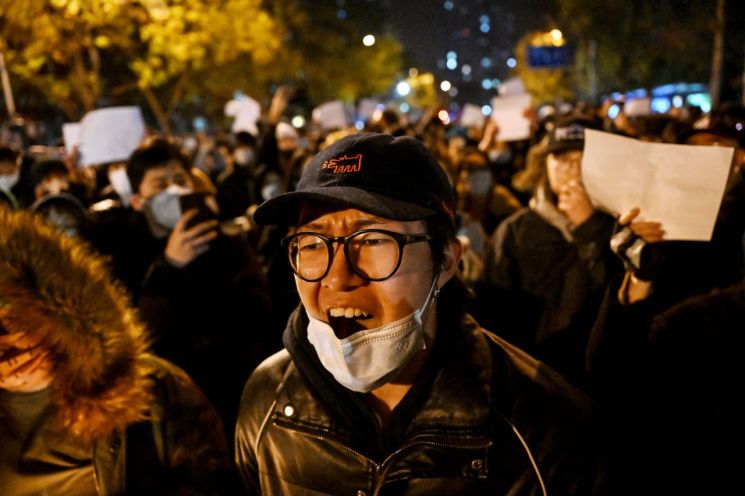
[Asia Economy Beijing=Special Correspondent Kim Hyun-jung] Large-scale protests rejecting China's zero-COVID prevention controls are emerging as a new trigger for the global economy. The current situation, where Chinese President Xi Jinping's response to nationwide resistance remains unclear, is dealing a blow to the market as another uncertainty factor alongside the Ukraine war, energy crisis, and inflation. Concerns are also rising that President Xi may use this protest as an opportunity to strengthen social control and authoritarian rule, potentially exacerbating supply chain instability.
On the 28th (local time), the New York stock market fell as social unrest spread by the large-scale protests in China became prominent. On the New York Stock Exchange (NYSE), the Dow Jones Industrial Average retreated 1.45% from the previous close, while the S&P 500, focused on large-cap stocks, and the tech-heavy Nasdaq index fell 1.54% and 1.58%, respectively. On the same day, the Hang Seng H-Share Index, composed of mainland Chinese companies listed in Hong Kong, plunged as much as 4.5% intraday, and the China CSI 300 Index dropped up to 2.8%.
◆Credit Rating Agencies Express Concerns= Global credit rating agencies are worried that the large-scale protests and turmoil inside China are increasing market uncertainty and could impact the entire world. Martin Fitch, Vice President of Moody’s, told the Hong Kong South China Morning Post (SCMP), "If the protests continue and authorities respond more forcefully, it will negatively affect credit," adding, "(The protests) will lead to increased uncertainty about China’s political risk level, erosion of trust, and weakened consumption."
Andrew Fenell, China analyst at Fitch, said, "We expect authorities to ease measures such as 'city lockdowns,' which have had the most direct impact on downward growth pressure next year," but added, "However, since many restrictions are likely to remain, a full shift in policy focus is unlikely." Hong Kong-based securities firm CLSA also released an estimate last week that the GDP share of cities with confirmed cases in China reached a record high of 68.9%.
Kerry Brown, Associate Fellow of the Asia-Pacific Program at the international affairs think tank Chatham House, told the New York Times (NYT), "China is at the center of the global economy," and "the current uncertainty will naturally have a huge impact on the rest of the world." He also emphasized that China is the largest oil importer, noting, "In terms of scale, there is no alternative outside China." Due to concerns over demand slowdown caused by protests and lockdowns in China, prices of U.S. Texas crude (WTI) and Brent crude fell intraday to their lowest levels in over a year since December last year, before rebounding on news of production cuts.
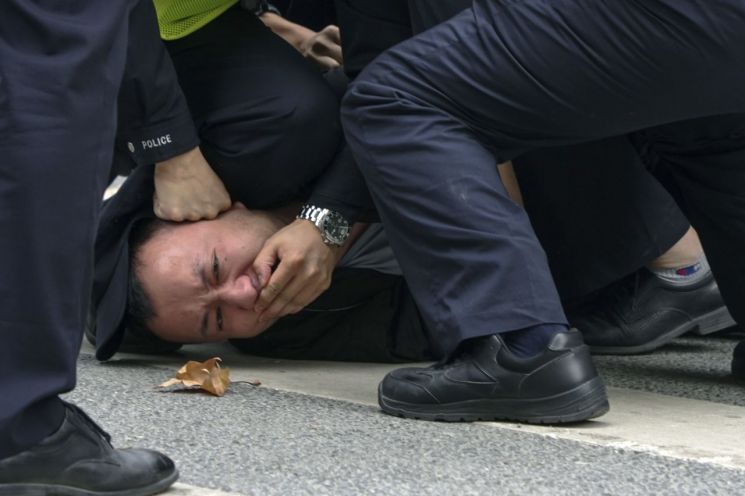
However, protests held last weekend in major Chinese cities such as Beijing, Shanghai, Hangzhou, and Nanjing have quieted down due to massive control by security authorities. In Beijing’s Haidian District, where protests were concentrated, police cars and riot police filled the streets, and in Shanghai, police were deployed in most alleys. According to Bloomberg News, authorities reportedly checked university students’ mobile phones on the streets to see if they were using apps banned in China such as Twitter, YouTube, or Telegram. The news agency also reported that they were monitoring the use of VPNs, which allow access to these apps.
◆Voices Inside China Call for Prioritizing the Economy= Inside China, voices are growing for COVID-19 prevention policies that can be implemented alongside economic growth without damaging it. According to SCMP, Yao Yang, Director of the National Development Research Institute at Peking University, said, "While prevention carries responsibility, local governments that do not bear economic responsibility naturally prioritize epidemic prevention," emphasizing, "The central government must clarify the priority of tasks." He added, "More targeted measures should be taken considering public sentiment," and "Only then can our economy recover quickly in the coming months." Goldman Sachs forecasts that China’s economic growth rate, which rebounded to 3.9% in the third quarter after growing only 0.4% in the second quarter, will remain sluggish in the fourth quarter and reach only about 3% annually.
Wang Yong, Director of the Center for International Political Economy at Peking University, recently urged policymakers on his social media to review the sustainability of control measures. Although he did not mention the recent march protests in major cities, he predicted that if strict control measures remain, clashes between workers and epidemic prevention personnel could recur at Foxconn’s manufacturing plant in Zhengzhou. He stressed, "Policymakers and the public must eliminate fear of the virus," and "If neighboring countries including South Korea, Vietnam, and India continue to reopen, we must believe we can do the same."
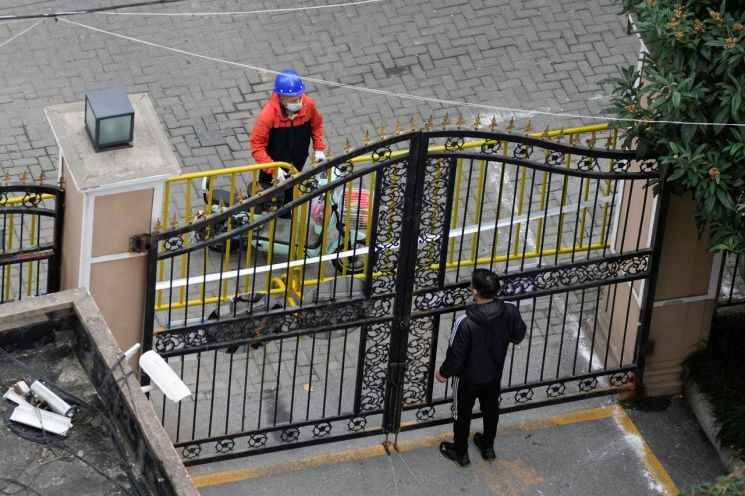
Meanwhile, China’s new COVID-19 cases exceeded 40,000 for the first time on the 27th, and on the 28th, the number somewhat eased to 38,421 (including 34,860 asymptomatic cases). However, the capital Beijing recorded 4,386 confirmed cases (including 3,429 asymptomatic), marking an all-time high. As of the 28th, the number of high-risk areas under lockdown in Beijing alone reached 3,265.
© The Asia Business Daily(www.asiae.co.kr). All rights reserved.
![User Who Sold Erroneously Deposited Bitcoins to Repay Debt and Fund Entertainment... What Did the Supreme Court Decide in 2021? [Legal Issue Check]](https://cwcontent.asiae.co.kr/asiaresize/183/2026020910431234020_1770601391.png)


















