Identified 54 Laws Referred to the Legislation and Judiciary Committee Over 60 Days
Politically Controversial Bills Remain 'Unsubmitted'
Political Conflicts Between Parties and Standing Committee Changes in Early and Late Sessions Also Cause Delays in Law Processing
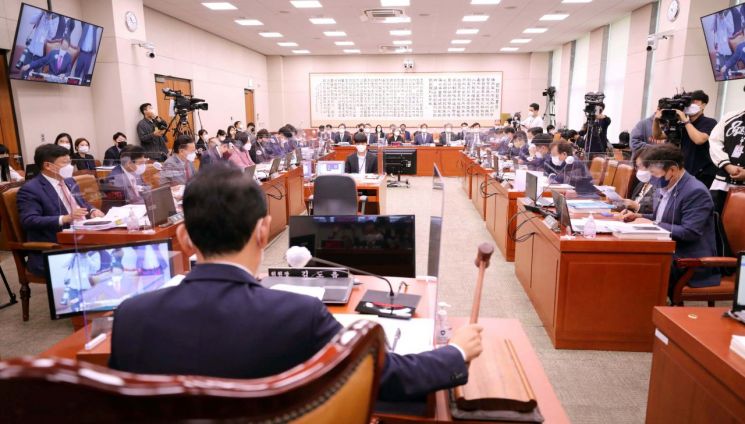
[Asia Economy Reporter Naju-seok] The National Assembly's Legislation and Judiciary Committee is suffering from a bottleneck of bills. Bills that have completed review in standing committees are pending in the Legislation and Judiciary Committee for systematic and legal scrutiny, with some cases confirmed where bills have been pending for over two years without a single discussion.
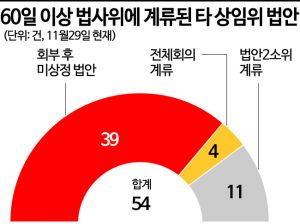
On the 29th, Asia Economy analyzed the bills pending in the Legislation and Judiciary Committee and found that 118 bills are waiting to undergo systematic and legal scrutiny after passing through other standing committees. Among these, nearly half, 54 bills, have been in the Legislation and Judiciary Committee for more than 60 days. Thirty-nine bills have not even been submitted to the committee. Eleven bills were submitted but sent to the so-called "graveyard of bills," the Bill Subcommittee 2, for additional discussion due to the need for further deliberation.
In particular, the "Act on the Promotion of the Animation Industry," proposed by Rep. Yoo Jeong-ju of the Democratic Party, passed the Culture, Sports and Tourism Committee plenary session on September 24, 2020, and was sent to the Legislation and Judiciary Committee but has not even been submitted for over two years. The "Special Act on the Promotion and Support of the Saemangeum Project," approved by the National Assembly Land, Infrastructure and Transport Committee plenary session on September 23 of the same year, was submitted to the Legislation and Judiciary Committee and discussed once but has seen no further progress.
The National Assembly stipulates that after a bill is processed in a standing committee, it must undergo systematic and legal scrutiny in the Legislation and Judiciary Committee. However, the committee often goes beyond mere scrutiny and re-examines bills from standing committees, effectively acting as an upper house, causing chronic bottlenecks. In particular, the Legislation and Judiciary Committee customarily delays bill processing by sending bills to the plenary session or the Bill Subcommittee 2 for additional discussion if even one member opposes it. The committee chairperson can also delay the submission of bills altogether.
An opposition party member of the Legislation and Judiciary Committee said, "There are many political reasons why bills from other standing committees are not submitted," adding, "Even if the ruling and opposition parties agree, progress is difficult if specific interest groups oppose."
Kim Seong-hwan, the Democratic Party Policy Committee Chair, warned at a press briefing, "If bills continue to be held up for various reasons, it is highly likely to become the first case where, according to the revised National Assembly Act, a bill can be directly referred to the plenary session with the approval of three-fifths of the standing committee." Currently, the National Assembly Act allows a bill to be directly submitted to the plenary session after 60 days without review in the Legislation and Judiciary Committee, following approval by the standing committee.
Current issues also make it difficult for the Legislation and Judiciary Committee to perform its normal duties. The committee is currently the "frontline" of political confrontation between the ruling and opposition parties. From the highly contentious "Complete Removal of Prosecutorial Investigation Rights" (Geomsu Wanbak) to investigations into the political sphere and controversies involving the Board of Audit and Inspection, the committee has become the center of political strife, causing bill processing to be sidelined.
Rep. Ki Dong-min, the Democratic Party's Legislation and Judiciary Committee secretary, said, "The committee has only fought so far and has not been faithful to its core duties," adding, "We have pledged several times, but it has not improved."
The change of committee members between the first and second half of the 21st National Assembly also slows the processing speed of bills from other standing committees. Bills that were not submitted during the first half of the 21st National Assembly's Legislation and Judiciary Committee tend to be pushed aside as the chairperson and secretaries change. A committee official said, "Recently, systematic and legal scrutiny has focused on newly submitted bills," adding, "Bills that previously had disagreements between the ruling and opposition parties are not being discussed at all."
© The Asia Business Daily(www.asiae.co.kr). All rights reserved.
![Clutching a Stolen Dior Bag, Saying "I Hate Being Poor but Real"... The Grotesque Con of a "Human Knockoff" [Slate]](https://cwcontent.asiae.co.kr/asiaresize/183/2026021902243444107_1771435474.jpg)

















