Judged that opposition to quarantine policies worsened due to the World Cup
Replace faces of no-mask spectators with players, coaches, and stadium footage on screen
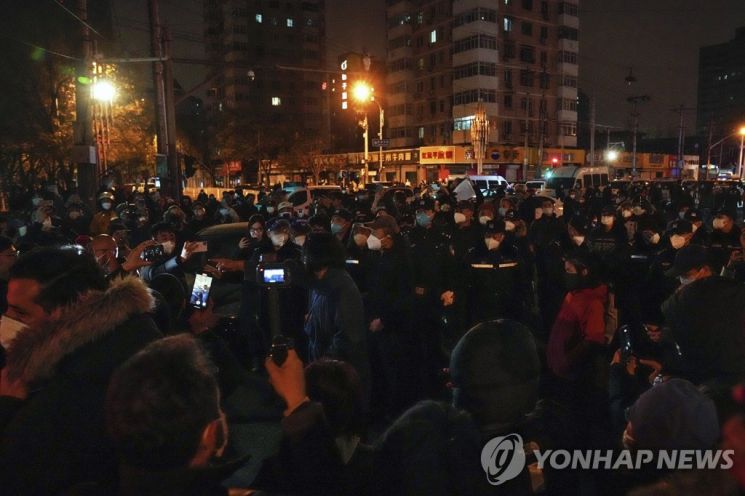 On the 27th in Beijing, China, protesters opposing COVID-19 quarantine measures confront the police. Photo by Yonhap News
[Asia Economy Intern Reporter Lee Gyehwa] An analysis has emerged that the 2022 Qatar World Cup has stirred public sentiment in China, which is tired of the 'Zero COVID' policy. On the 28th, Hong Kong Ming Pao reported, "The World Cup is intense, and public opinion has qualitatively changed," adding, "Recently, many people have begun to oppose the quarantine policy, and the anger that has long accumulated but had no outlet could cause bigger problems this winter."
The Chinese authorities have consistently emphasized that 'tangping' (??平, an attitude of giving up physically and mentally without further effort) is absolutely unacceptable in the fight against COVID-19 and that the 'Zero COVID' policy must be maintained. However, Ming Pao stated, "People (while watching the World Cup) seem no longer surprised by the increased infection rates overseas after 'tangping,'" and "Instead, people have started to question the meaning of maintaining Zero COVID at any cost." It further explained, "No one knows when China's Zero COVID will end," and "People looked for signals of easing quarantine measures after the 20th National Congress of the Communist Party, but with no changes and tighter control, public opinion shifted around the World Cup."
Although the Chinese national team did not qualify for the World Cup finals, the enthusiasm of Chinese people for watching the World Cup is intense. According to the Hong Kong South China Morning Post (SCMP), in Shanghai, police dispersed protesters who gathered to mourn the victims of the Urumqi fire and to protest quarantine policies, telling them, "Go home and watch the World Cup match."
Following the Urumqi fire tragedy, simultaneous protests against Zero COVID occurred from the 25th to the 27th, prompting authorities to begin censoring World Cup broadcasts. According to AFP, China Central Television (CCTV) broadcast the Japan-Costa Rica World Cup match live but replaced close-up shots of spectators waving the national flag without masks with footage of players, coaches, and the stadium. AFP compared the broadcast of the same match on the Chinese video platform Douyin with CCTV’s broadcast and found that CCTV showed wide shots of the stands where it was difficult to distinguish faces and areas with relatively fewer spectators. AFP explained that as scenes of foreign fans enjoying the match without masks in fully packed stands were openly shown in China’s living rooms through the World Cup broadcast, the authorities appeared to have started intervening due to the resulting impact.
© The Asia Business Daily(www.asiae.co.kr). All rights reserved.

















