Explosion of accumulated complaints over 'Zero COVID' after Urumqi apartment fire
Protests against lockdowns in 16 Chinese regions and 50 universities... Criticism of Xi Jinping
UN urges response in line with international human rights law amid growing concerns over China's tough measures
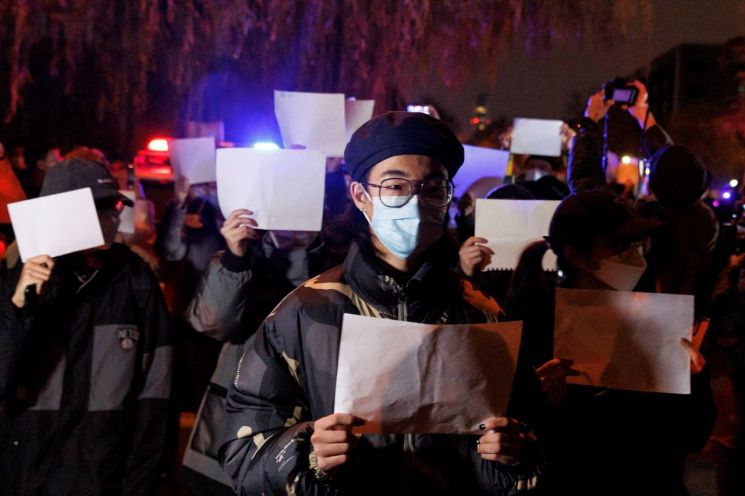 At a memorial service for the victims of the Urumqi fire held in Beijing, China on the 27th, citizens opposing the COVID-19 lockdown measures staged a "blank paper protest" as a symbol of resistance against censorship. Photo by Reuters·Yonhap News
[Asia Economy Reporter Yoon Seul-gi] In China, protests against the high-intensity COVID-19 prevention policy known as 'Zero COVID' are spreading with an anti-government character. As the protests escalate, including unprecedented criticism of Xi Jinping, China's top leader, concerns over the Chinese government's tough response have arisen, prompting the international community to emphasize the need for responses based on human rights standards.
According to foreign media such as CNN, BBC, and The Guardian on the 29th, protests against the strict COVID-19 prevention policy of Zero COVID, including lockdown measures, have continued for three days since the 26th across China.
Public sentiment in China began to boil over following an apartment fire in Urumqi, Xinjiang, in northwest China. On the 24th, a fire broke out in a high-rise apartment in Urumqi, Xinjiang, killing 10 residents and injuring 9. Claims spread on social media that the installations placed to enforce lockdowns for quarantine purposes had blocked firefighting efforts. This triggered accumulated dissatisfaction with Zero COVID policies over the past three years, leading to protests spreading nationwide.
Blank Paper Protests Originating from Hong Kong Demonstrations
CNN reported that protests against lockdown policies occurred in at least 16 regions within China, including Beijing and Shanghai. In Shanghai, protesters held blank sheets of paper and held candlelight vigils while chanting slogans such as "We need human rights and freedom" as a form of protest. The 'blank paper protest' began during the 2020 Hong Kong protests, where Hong Kong residents held blank sheets of paper to protest the strict new National Security Law.
The media also noted that protesters sang the socialist anthem "The Internationale," linking the protests to the Tiananmen democracy movement. The Internationale was used during the 1989 Tiananmen Square pro-democracy protests, which ended in a large-scale bloody crackdown.
CNN evaluated, "In China, where the Communist Party has strengthened control over all aspects of life, imposed comprehensive repression on dissenting opinions, swept away civil society, and built an advanced surveillance state, public protests are extremely rare." It added, "Signs are growing that public patience with Zero COVID has reached its limit after nearly three years of economic hardship and daily disruption."
The Guardian cited crowdsourced lists from social media, reporting that protests occurred at 50 universities across China. The Guardian stated, "The wave of civil disobedience against the Chinese government is unprecedented in mainland China over the past decade," and noted, "Nearly three years after the outbreak of the COVID-19 pandemic, frustration with President Xi Jinping's signature Zero COVID policy is intensifying."
As protests spread, slogans protesting against the top leader, President Xi Jinping, also emerged. CNN reported that on the first night of protests in Shanghai, crowds shouted slogans such as "Xi Jinping step down" and "Communist Party step down."
BBC Reporter Covering Protests Detained and Assaulted by Police
In response, Chinese authorities deployed public security forces to forcibly disperse protests at each location. Numerous citizens were reportedly detained for participating in the protests. In Shanghai, on the 27th, a BBC reporter covering the protests was detained, assaulted by police, and held for several hours before being released.
As concerns grew over the possibility of a harsh response by the Chinese government, voices from the international community called for a "measured response." Jeremy Laurence, spokesperson for the United Nations Office of the High Commissioner for Human Rights (OHCHR), told reporters on the 28th (local time), "We urge Chinese authorities to respond to the protests in accordance with international human rights laws and standards." He also pointed out, "If Chinese authorities allow broad societal discussions about the Zero COVID policy, it could lead to better public understanding of public policy."
© The Asia Business Daily(www.asiae.co.kr). All rights reserved.
![Clutching a Stolen Dior Bag, Saying "I Hate Being Poor but Real"... The Grotesque Con of a "Human Knockoff" [Slate]](https://cwcontent.asiae.co.kr/asiaresize/183/2026021902243444107_1771435474.jpg)
















