SNS Distribution of Child and Youth Sexual Exploitation Material: Deletion Support Without Request
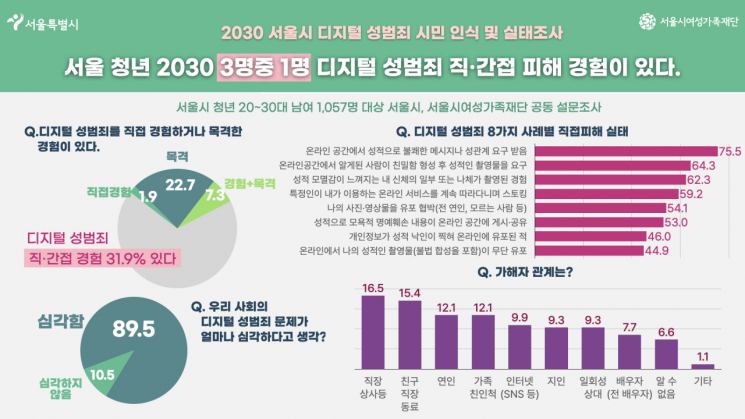
90% of 2030 Youth Recognize Digital Sex Crime as Serious Issue... 32% Experienced Direct or Indirect Harm
[Asia Economy Reporter Lim Cheol-young] The “Seoul Digital Sexual Crime Safety Support Center,” which opened on March 29 to provide integrated support for digital sexual crime victims?from video deletion to psychological healing?has marked its 7th month since opening.
According to Seoul City on the 28th, 270 digital sexual crime victims requested help from the center over the past 7 months. Through a cooperative system with the National Police Agency, the Korea Communications Standards Commission, and others, the center deleted over 2,000 (2,194) illegal videos and photos. Including deletion support, the center has assisted victims in 4,926 cases covering investigation, legal aid, psychological healing, and more. Among these 4,926 cases, deletion support was the most frequent with 2,194 cases, followed by psychological healing support with 791 cases, investigation and legal support with 729 cases, and victim support planning and monitoring with 854 cases.
In particular, the center proactively searches for and deletes child and adolescent sexual exploitation materials that are widely distributed online without being reported to the police. Of the 2,194 deletion support cases by Seoul City, more than half?1,203 cases (54.8%)?were child and adolescent sexual exploitation materials. Among these 1,203 deletion support cases, the most common distribution channel was social networking services (SNS) used frequently in daily life, accounting for 52.2%. This was followed by adult sites at 36.3% (437 cases) and online communities at 4.7% (56 cases).
The center prioritizes the full restoration of victims’ daily lives. For cases where deletion requests are made, the center provides integrated support including medical aid, psychological treatment, and legal and litigation support, in addition to deletion assistance. Notably, during this process, the center has achieved results such as the arrest and identification of seven perpetrators.
Among the total 270 victims who sought help from the center, those in their 20s accounted for the largest share at 37.4% (101 people), followed by those in their 30s at 18.5% (50 people), and children and adolescents at 15.5% (42 people). The types of victimization included illegal filming, online grooming, and distribution/re-distribution. The victimization types were as follows (with overlaps): distribution anxiety 1,187 cases, illegal filming 804 cases, distribution/re-distribution 641 cases, victim anxiety 490 cases, distribution threats 429 cases, and stalking 346 cases.
Digital sexual crimes are prevalent among children, adolescents, and the MZ generation who are familiar with the internet from an early age, as confirmed by actual survey results. The Seoul Foundation of Women and Family conducted a survey on the awareness and actual conditions of digital sexual crimes among Seoul’s 20-30-year-olds, revealing that one in three (31.9%, 338 people) had experienced direct or indirect harm from digital sexual crimes. The survey was conducted by the Seoul Foundation of Women and Family targeting 1,057 citizens aged 19 to 39 residing in Seoul.
Regarding types of victimization, “sexually unpleasant messages or sexual demands in online spaces” (75.5%) were the most common, followed by “requests for sexual videos after forming intimacy in online spaces” (64.3%), and “victimization involving sexual humiliation through partial or full nudity being filmed” (62.3%).
As digital sexual crimes continue to increase, exemplified by the recent “L case” known as the “second Nth room incident,” awareness of the problem is also growing. Among Seoul’s 20-30-year-olds, 89.5% (96.5% of women, 82.0% of men) recognized that digital sexual crime is a serious issue in society today.
Meanwhile, on the 30th, Seoul City will announce the results of this survey and the center’s operational status at the Seoul Women’s Plaza Gender Equality Library, and hold a forum titled “Cooperation Plan for Seoul City’s Response to Digital Sexual Crimes” to strengthen support for digital sexual crime victims.
Kim Seon-soon, Director of the Seoul City Women and Family Policy Office, stated, “Due to the nature of digital sexual crimes, which often show complex patterns combined with dating violence and stalking crimes, and the increasing diversity of crime methods, it is important to establish various cooperative systems for prevention and victim support, including legal and investigative measures. Based on the discussions at this forum, we will apply the outcomes to Seoul City policies and do our best to create a ‘Safe City Seoul without Digital Sexual Crimes.’”
© The Asia Business Daily(www.asiae.co.kr). All rights reserved.

















