Majority Opinion: "Include 'Registered Domicile' on Adoption Report... Not an Insufficient Measure"
Opposing Opinion: "Need Methods and Procedures to Further Confirm Adoption Agreement"
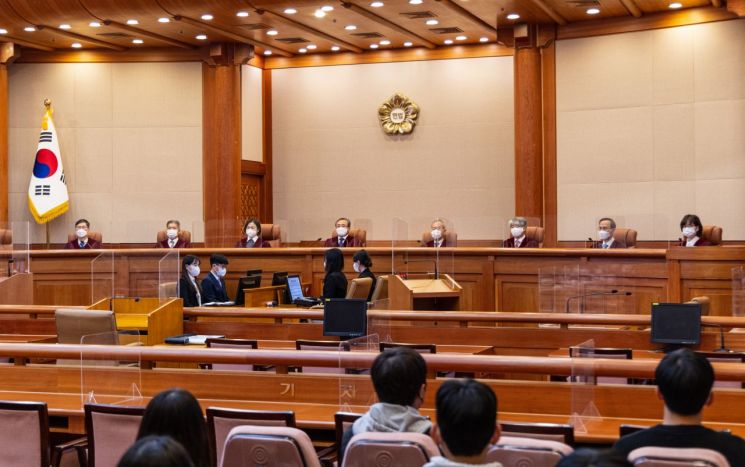 Chief Justice Yoo Nam-seok of the Constitutional Court and the constitutional justices entered the Grand Bench of the Constitutional Court in Jongno-gu, Seoul, on the afternoon of the 24th to begin the November ruling. [Image source=Yonhap News]
[Asia Economy Reporter Heo Kyung-jun] The Constitutional Court has ruled that the current law allowing adoption reports to be submitted without the parties directly appearing at administrative agencies, but only by presenting identification such as a resident registration card, does not violate the Constitution.
On the 29th, the Constitutional Court announced that it upheld the constitutionality of Article 23, Paragraph 2 of the Family Relations Registration Act by a 7 to 2 decision in a constitutional complaint case claiming that it infringes on the freedom of privacy and family life.
Mr. A asked his nephew Mr. B to take care of him in 2016 due to deteriorating health, and Mr. B cared for him until Mr. A passed away about eight months later. While living with Mr. A and nursing him, Mr. B submitted an adoption report form to the district office. Mr. B personally filled out the report and affixed Mr. A’s seal.
The current Family Relations Registration Act stipulates that family relations can be reported by presenting identification or proof of identity without the parties directly appearing at the local government office.
Relatives filed an annulment lawsuit claiming that Mr. B exploited Mr. A’s loss of mental capacity to monopolize assets worth hundreds of billions of won by submitting the adoption report form. They also filed a constitutional complaint arguing that the current Family Relations Registration Act, which forces the reporting party to appear in person or allows others to easily submit the report by presenting the party’s resident registration card or other identification without confirming the party’s intention, is unconstitutional.
The Constitutional Court judged that the ‘registered domicile,’ an item recorded on the adoption report form, is not included on identification such as the resident registration card, and can only be known by obtaining a certificate under the Family Relations Registration Act unless the party discloses it. This substantially guarantees the authenticity of the adoption party’s intention to report.
The Court stated, “While guaranteeing the freedom to form family relations by allowing adoption reports without the parties’ appearance, requiring the presentation of the absent party’s identification ensures the authenticity of the adoption party’s intention to report.”
It added, “Although requiring the absent party’s identification is not a perfect measure to prevent false adoptions, this legal provision cannot be regarded as entirely inappropriate or insufficient to prevent the formation of unwanted family relations.”
On the other hand, Justices Lee Sun-ae and Lee Eun-ae dissented, stating, “There should be additional methods to confirm the genuine agreement of adoption between the parties, or at least the reporting party should be notified by mail of the report so that there is an effective opportunity to correct adoption reports made against the party’s will.”
© The Asia Business Daily(www.asiae.co.kr). All rights reserved.

















