All Workers Instantly Recognize Safety Information to Enhance Response Ability
Experts Consulted and Colorblind Tests Conducted to Select and Apply 'Safety Colors' Distinguishable by Colorblind and Color-Deficient Individuals
[Asia Economy Reporter Lim Cheol-young] The Seoul Metropolitan Government announced on the 29th that it has developed the ‘Seoul Standard Safety Design for Industrial Accident Prevention,’ a standardized guideline that enables all workers in industrial sites to intuitively recognize various information directly related to safety.
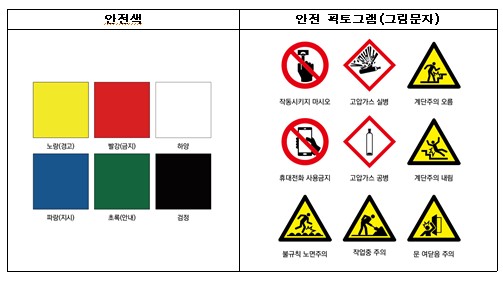
Seoul aims to proactively create industrial sites where risk management focused on prevention is possible through design elements, as more than half of all deaths caused by industrial accidents each year occur in incidents that could be prevented by adhering to basic safety rules. The newly developed ‘Seoul Standard Safety Design’ consists mainly of ▲‘Safety Colors’ distinguishable even by those with color vision deficiency ▲‘Safety Pictograms’ considering the industrial site environment ▲guidelines for applying safety signs ▲and emergency response measures for the safety of on-site workers.
‘Safety Colors’ were finalized through meticulous consultation with experts in color science, color psychology, design, and law, as well as tests involving colorblind individuals. The city explained that the safety colors currently defined by the Industrial Safety and Health Act are difficult for some colorblind people to distinguish, so within the legally permitted tolerance range, the color values were adjusted to select safety colors that are easily distinguishable even by those with color vision deficiencies. Previously, Seoul signed a memorandum of understanding (MOU) with Noroo Paint on October 31 to apply and implement the ‘Safety Colors.’ Noroo Paint will support the production of color samples for the safety design manual and the application of safety colors in industrial sites.
There are a total of nine ‘Safety Pictograms.’ Items that did not previously exist but are practically necessary in industrial sites, such as ‘No Mobile Phone Use,’ were newly developed, and existing pictograms that were difficult to understand, such as those for high-pressure gas, stair caution, and irregular surface caution, were improved and standardized with simple and clear designs. Seoul is promoting the registration of the newly developed pictograms as national standards (KS) and is also proceeding with official registration with the International Organization for Standardization (ISO) for global standardization. New pictograms without current regulations, such as ‘No Mobile Phone Use,’ are being prioritized for registration.
Additionally, guidelines for applying safety signs considering various industrial site environments have been prepared. By presenting application standards such as safety colors and pictograms, multilingual notation, and installation height for safety signs, the goal is to improve misuse cases of safety signs in industrial sites caused by ambiguous regulations and the absence of standardized guidelines. Emergency response measures for worker safety at construction sites have also been applied from a design perspective. Considering the characteristics of underground construction sites where lighting can suddenly drop during emergencies, evacuation routes are marked with photoluminescent materials to ensure safe evacuation even in complete darkness.
In particular, reflecting the opinions of on-site workers, button-type sirens and flashing lights were attached to safety helmets so that workers can signal their location if they become separated from others or in cases of collapse. In the event of an emergency during work, this allows for immediate response and helps emergency treatment and rescue by making it easier to locate workers before rescue.
© The Asia Business Daily(www.asiae.co.kr). All rights reserved.

















