COVID-19 Surge 'Slows Down'... Health Authorities Say "Peak Not Yet"
Severe Cases Remain in 400s for 10 Days... 89% Are Aged 60 and Over
Vaccination Rate for Elderly at 19%... Infection-Prone Facilities Only at 22%
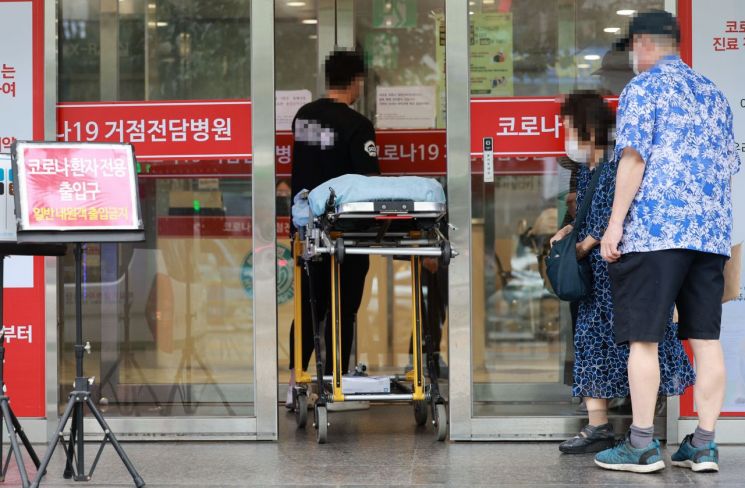
[Asia Economy Reporter Jo In-kyung] As the COVID-19 resurgence continues, the number of critically ill patients who have tested positive and are hospitalized is approaching 500. Although 90% of critically ill patients are aged 60 and above, and about half are over 80, the additional vaccination rate remains low, raising concerns about fatalities among the elderly.
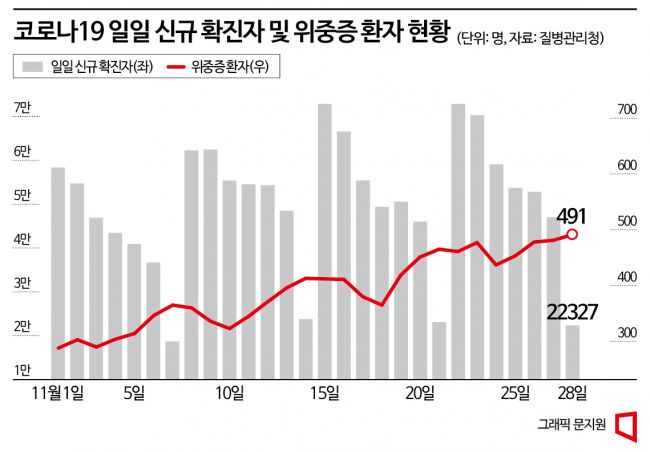
According to the Central Disease Control Headquarters on the 29th, as of midnight the previous day, the number of new COVID-19 cases was 22,327, which is 750 fewer than a week ago (23,077 cases). Due to a decrease in testing over the weekend, the number of confirmed cases dropped to about one-third of the 50,000 to 70,000 cases seen on weekdays, but it has decreased for two consecutive weeks even on Mondays.
On the other hand, the number of critically ill COVID-19 patients increased by 10 from the previous day to 491, continuing to rise in the 400s for the tenth consecutive day. This is the highest number in 68 days since 494 on September 21, when the summer resurgence was ongoing. The number of critically ill patients fell below 200 on the 22nd of last month but rose back to the 300s this month and surpassed 400 on the 14th. The average daily number of critically ill patients from the 22nd to the 28th was 468, an increase of 54 compared to 414 from the previous week (15th to 21st). Additionally, 40 to 50 deaths due to COVID-19 continue to occur daily over the past week.
In particular, most critically ill patients and deaths are concentrated among the elderly. Among the new cases on the 28th, those aged 60 and above accounted for 4,704 cases, or 21.1% of the total, but among critically ill patients, 435 were aged 60 and above, accounting for 88.6%. Of the 44 deaths reported the previous day, 34 were aged 80 and above, 6 were in their 70s, and 1 was in their 60s, with those aged 60 and above accounting for 95.5%.
However, the vaccination rate for these age groups during the winter season remains stubbornly low. Among the high-risk group aged 60 and above, the vaccination rate relative to the target population is 18.9%, still in the teens, and the vaccination rate in infection-vulnerable facilities such as nursing hospitals is only 22.3%.
Earlier, Professor Jung Jae-hoon of the Department of Preventive Medicine at Gachon University College of Medicine identified last week as the peak phase of the 7th wave, estimating that the number of hospitalized critically ill patients at the peak would be between 600 and 700. He said, "Although this is within the limits of medical response capacity, many difficulties and deaths are expected." Professor Eom Jung-sik of the Department of Infectious Diseases at Gachon University Gil Medical Center expressed concern, saying, "If the current vaccination rate continues, even with a similar scale of outbreak, more critically ill patients will occur," and "At the peak of the outbreak, daily deaths could reach 150 to 200."
As the number of critically ill patients increases, the bed occupancy rate has also risen. As of 5 p.m. on the 27th, the nationwide occupancy rate for intensive care beds was 34.8%, and for semi-intensive care beds, it was 44.9%.
The government plans to gradually reactivate 330 moderate-severity beds by securing additional dedicated nursing hospitals for elderly and bedridden patients. Intensive and semi-intensive care beds will be prepared mainly in tertiary general hospitals and large general hospitals to secure beds capable of responding to up to 200,000 daily confirmed cases, the maximum projected for the resurgence. Additionally, to expand COVID-19 vaccine booster shots during the winter, new reservations for the 3rd and 4th doses of existing monovalent vaccines will be suspended, and existing reservations will only be administered until the 16th of next month.
Meanwhile, the health authorities expect the threat from the resurgence to gradually decrease as the increase in confirmed cases slows, but they believe the peak has not yet passed. Lee Sang-won, head of the Epidemiological Investigation and Analysis Division at the Central Disease Control Headquarters, said, "We do not yet believe the outbreak has reached its peak, and there are still factors causing increases," adding, "It will increase gradually and reach its peak from December through March next year."
© The Asia Business Daily(www.asiae.co.kr). All rights reserved.
![Clutching a Stolen Dior Bag, Saying "I Hate Being Poor but Real"... The Grotesque Con of a "Human Knockoff" [Slate]](https://cwcontent.asiae.co.kr/asiaresize/183/2026021902243444107_1771435474.jpg)

















