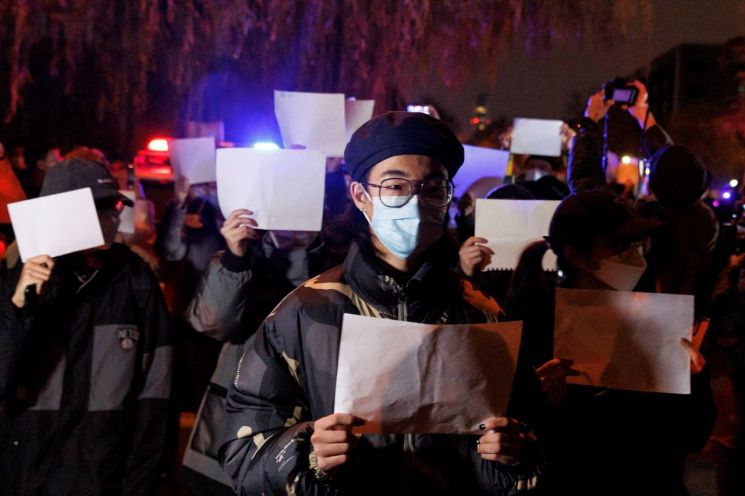
[Asia Economy Beijing=Special Correspondent Kim Hyunjung] As large-scale protests rejecting zero-COVID measures continue in China, the local stock market and the yuan exchange rate are also fluctuating.
On the 28th, the Foreign Exchange Trading Center under the People's Bank of China, the central bank, announced the yuan's central parity rate against the dollar at 7.1617 yuan, up 0.0278 yuan from the previous trading day. This represents a sharp 0.39% decline compared to the previous day. The onshore yuan recorded an exchange rate of 7.23 yuan per dollar, dropping about 1% in value, marking the largest decline since May.
The stock market also started on a downward trend. Right after the opening, the Hong Kong Hang Seng Index fell by over 4%, and the Shanghai Composite Index dropped by over 2%. According to Bloomberg News, foreign investors net sold stocks worth 3.8 billion yuan (approximately 703.6 billion KRW) on the Hong Kong stock market after the market opened that day. Robert Mumford, an investment manager at GAM Hong Kong asset management, explained, "The protests are causing uncertainty," adding, "While some view this popular pressure positively as it could promote reopening, we must first observe how the authorities respond to the recent events (protests)."
According to the National Health Commission of China, as of the previous day, the number of new COVID-19 cases nationwide reached 40,052 (including 36,304 asymptomatic cases), surpassing 40,000 for the first time ever. Until early this month, the number of confirmed cases in China was around 2,700, but it surged to the 10,000 range (November 10) within ten days and has been rapidly increasing daily since then.
Due to the rapid increase in confirmed cases, quarantine authorities have intensified control measures, and as fatal accidents have occurred across the country, large-scale protest demonstrations have continued in major cities such as Beijing and Shanghai. Bloomberg News reported, "The unprecedented resistance is increasing the threat of government crackdowns, and investors are reconsidering their investment plans."
Goldman Sachs forecasted that the Chinese central government will have to choose between more lockdowns and COVID-19 outbreaks, estimating about a 30% chance of ending zero-COVID before April next year. Until September, Goldman Sachs had only considered this probability as "somewhat low." Goldman Sachs also estimated that cities with 'high-risk areas' under the strictest quarantine measures accounted for 65% of China's gross domestic product (GDP) as of the 25th, up 14 percentage points from 51% the previous week.
© The Asia Business Daily(www.asiae.co.kr). All rights reserved.
!["The Woman Who Threw Herself into the Water Clutching a Stolen Dior Bag"...A Grotesque Success Story That Shakes the Korean Psyche [Slate]](https://cwcontent.asiae.co.kr/asiaresize/183/2026021902243444107_1771435474.jpg)
















