Gwangju Institute of Science and Technology Research Team Successfully Screens Drug
Muscle Growth Confirmed After Injection in Rats
 Asia Economy DB
[Asia Economy Reporter Kim Bong-su] Domestic researchers have discovered a candidate drug substance for treating muscle loss caused by aging.
The research team led by Professor Darren Williams of the Department of Life Sciences at Gwangju Institute of Science and Technology (GIST) announced on the 28th that they successfully identified 'Malotilate,' a drug approved by the U.S. Food and Drug Administration (FDA), which has the efficacy to reduce muscle fiber atrophy.
Malotilate is currently used as a treatment for liver cirrhosis and liver damage. The research team revealed that this drug reduces the activity of an enzyme in the body called '5-lipoxygenase,' which increases during the process of skeletal muscle atrophy. Through this mechanism, it lowers the concentration of LTB4 (leukotriene B4), an inflammatory mediator within muscle cells, thereby inhibiting the action of FoxO3, a transcription factor that plays a key regulatory role in muscle loss.
The team conducted experiments using mice induced with sarcopenia and aged mice. When Malotilate was administered, the diameter of muscle fibers?the most important measure to determine muscle mass increase or decrease?was observed to increase by an average of 46.9% compared to the control group. The rate of muscle protein synthesis was also confirmed to increase. Expression levels of IGF-1 (insulin-like growth factor), a hormone involved in the anabolic process of muscle protein, were elevated. Compared to the control group that did not receive the drug, the weight of the front thigh muscle (quadriceps femoris) in the Malotilate-administered group increased by 21.58%. Muscle performance, quantitatively evaluated by measuring grip strength?the force with which the experimental mice could pull the handle of a measuring device?also increased by 39.31% compared to the control group.
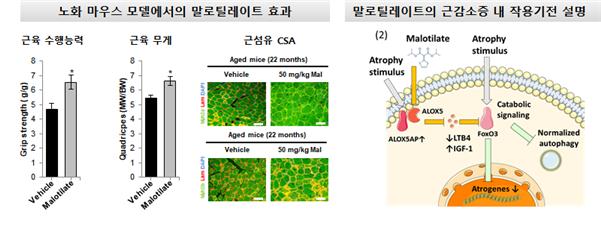 (Left) In an aging mouse model aged 21 months or older, after 28 days of oral administration of maltolylate, results from grip strength tests, muscle weight measurements of the sampled leg muscles, and histological analysis showed that maltolylate treatment increased muscle strength, muscle weight, and the diameter of muscle fibers regardless of fiber type. (Right) Under sarcopenic conditions, it was demonstrated that maltolylate treatment inhibits the activity of 5-lipoxygenase, alleviating muscle protein degradation mechanisms and promoting the expression of Igf-1, which is important for muscle protein synthesis.
In particular, the research team confirmed the effect of alleviating sarcopenia through oral administration of Malotilate in an aging mouse model experiment. This advantage means that the drug can be taken not only by injection but also orally, making it easier for patients to accept the treatment.
Professor Darren Williams stated, “Through this study, we have proposed a new drug and target for the treatment of sarcopenia, and we expect that the drug repurposing strategy will accelerate the development of a safe oral treatment for sarcopenia.”
The results of this study were published online last month in the ‘Journal of Cachexia Sarcopenia and Muscle,’ a journal ranked in the top 3% in the field of geriatric medicine.
© The Asia Business Daily(www.asiae.co.kr). All rights reserved.
![User Who Sold Erroneously Deposited Bitcoins to Repay Debt and Fund Entertainment... What Did the Supreme Court Decide in 2021? [Legal Issue Check]](https://cwcontent.asiae.co.kr/asiaresize/183/2026020910431234020_1770601391.png)
















