Increased Transportation Difficulties in Steel, Petrochemicals, and Automobiles
Korea International Trade Association Reports 56 Damage Cases... "Transaction Disruptions Due to Single Item Delays"
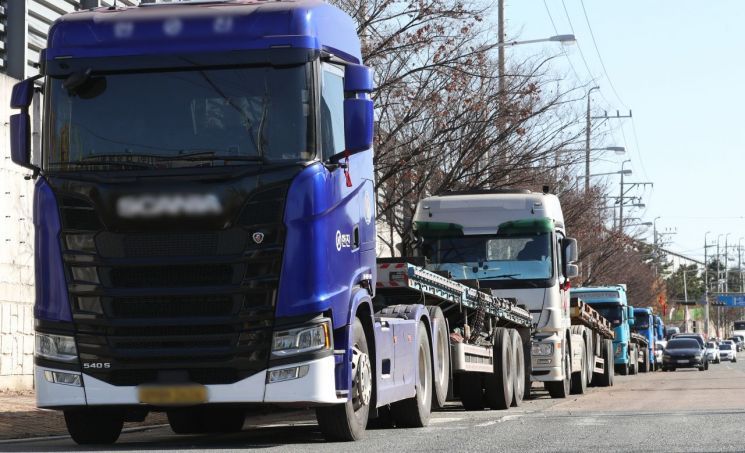 On the morning of the 27th, the fourth day since the total strike began by the Pohang branch of the Cargo Solidarity Headquarters (Cargo Solidarity) of the Korean Confederation of Trade Unions Public Transport Workers' Union, cargo vehicles stood still in the Pohang Steel Industrial Complex, Ocheon-eup, Nam-gu, Pohang-si, Gyeongbuk.
[Asia Economy reporters Choi Dae-yeol, Jung Dong-hoon, Choi Seo-yoon] The total strike by the Cargo Solidarity Headquarters of the Korean Public Service and Transport Workers' Union under the Korean Confederation of Trade Unions (KCTU) has entered its fifth day, causing a sharp decline in raw material transportation and container import/export, with damages snowballing across various industrial sites. Some key gas stations have run out of stock, and steel shipments have been halted. With major logistics hubs blocked, the worst-case scenario of a paralysis of the land logistics system is being anticipated. Additionally, the three shipbuilding companies of Hyundai Heavy Industries Group are scheduled to hold their first joint strike on the 30th, raising concerns about production disruptions and damages extending to the shipbuilding industry.
According to the Korea International Trade Association and related industries on the 28th, 56 reports from 32 companies (with overlapping damage types) related to the Cargo Solidarity's collective transport refusal were received through the emergency complaint and damage reporting center by 9 a.m. Among the types of reports, 25 cases (45%) involved "penalties due to delivery delays and severed overseas buyer relationships," and 16 cases (29%) involved "increased logistics costs due to collective transport refusal." Following these were 13 cases (23%) of "production stoppages due to raw and subsidiary material import disruptions," and 2 cases (4%) of "product disposal due to factory and port import/export disruptions."
In fact, Company G, which exports recycled tires and other products, failed to meet export deadlines due to the Cargo Solidarity strike, resulting in cancellations of additional orders. A representative from Company G expressed frustration, saying, "This is the busiest time of the year with the highest volume, so the damage is even greater," and added, "The inability to procure imported raw materials has also caused production disruptions at the factory."
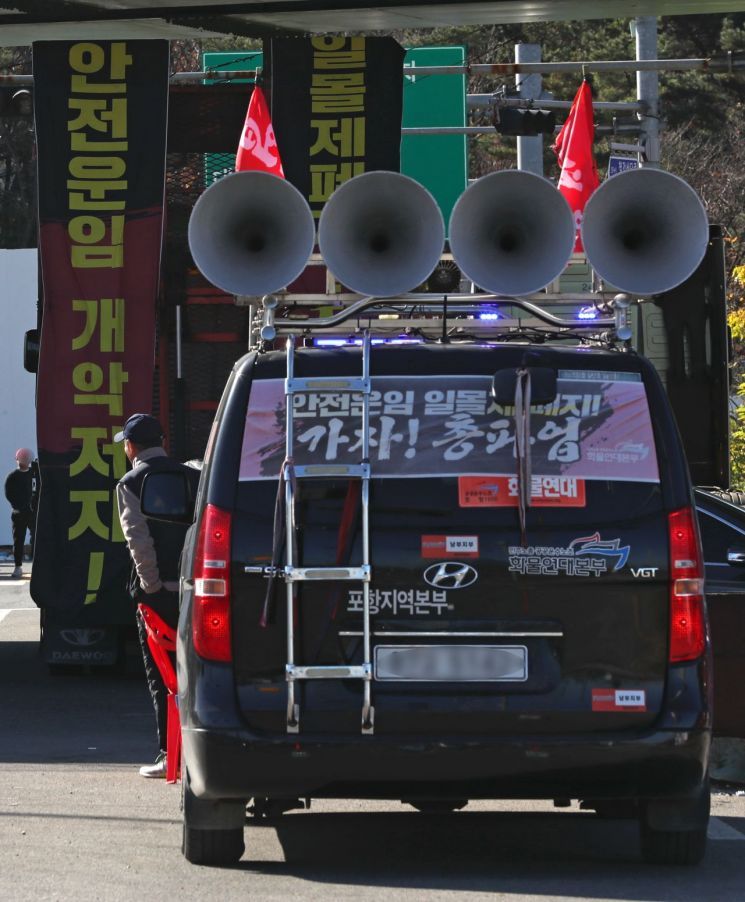 On the morning of the 27th, the fourth day since the total strike began, members of the Pohang branch of the Cargo Solidarity Headquarters of the Korean Public Service and Transport Workers' Union (Cargo Solidarity) continue their strike at the Pohang Steel Industrial Complex in Ocheon-eup, Nam-gu, Pohang-si, Gyeongbuk.
The industrial sector is left stunned by the growing scale of damages. The steel industry has virtually halted shipments using trucks. Major domestic steelmakers such as POSCO and Hyundai Steel have conducted pre-shipments in preparation for the strike, and currently, transportation is only proceeding via rail and sea. POSCO, which is still in the midst of recovery work after suffering damage from Typhoon Hinnamnor in September this year, has been continuously requesting cooperation from the Cargo Solidarity to allow the transportation of equipment materials for flood recovery. A steel industry official said, "If the Cargo Solidarity strike prolongs like in June this year, there will be serious problems with product shipments," adding, "We will continue to communicate with customers and seek solutions for handling large volumes."
The four major refiners?SK, GS, S-OIL, and Hyundai Oilbank?are concerned about potential supply disruptions of gasoline and diesel to gas stations if the strike prolongs. Some gas stations have already run out of stock. A representative from the Korea Petroleum Association said, "About 90% of tanker trucks affiliated with refiners in the metropolitan area and 70% nationwide are members of the Cargo Solidarity, making transportation difficult," and lamented, "Some gas stations have run out of stock, and product supply disruptions may occur."
In the automotive industry, a so-called 'road delivery' system is being used, where employees personally transport newly manufactured cars from the factory to delivery points. Previously, these vehicles were transported using car carriers, but due to the Cargo Solidarity's transport refusal, the operation rate has dropped. Having experienced delivery issues during the strike in June, the industry has preemptively organized delivery personnel and teams to prepare for the strike. Automotive parts logistics are reportedly maintaining normal flow, so there are no major disruptions in production.
Meanwhile, the labor unions of Hyundai Heavy Industries, Hyundai Mipo Dockyard, and Hyundai Samho Heavy Industries?affiliates of Hyundai Heavy Industries Group?are also planning a strike on the 30th. If wage and collective bargaining negotiations fail, additional damages are expected due to compounded logistics and labor shortages.
© The Asia Business Daily(www.asiae.co.kr). All rights reserved.
![Clutching a Stolen Dior Bag, Saying "I Hate Being Poor but Real"... The Grotesque Con of a "Human Knockoff" [Slate]](https://cwcontent.asiae.co.kr/asiaresize/183/2026021902243444107_1771435474.jpg)












