WSJ Criticizes UN Security Council Blocked by China and Russia
US Congress Also Calls for "Secondary Boycott"
Experts Say "Necessity Clear... Possibility Doubtful"
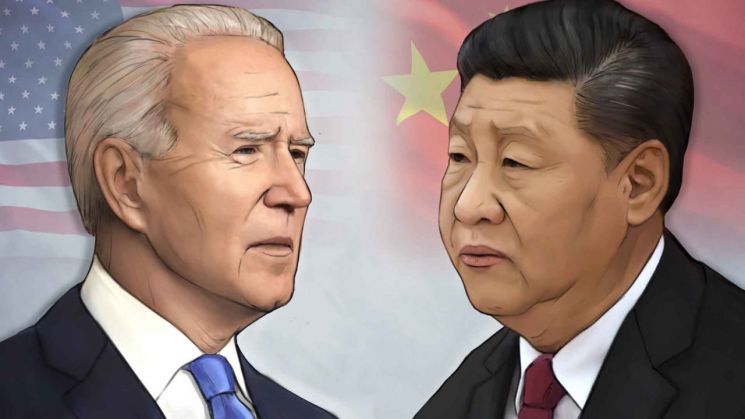 President Joe Biden of the United States and President Xi Jinping of China [Image source=Yonhap News]
[Asia Economy Reporter Jang Hee-jun] As North Korea's nuclear and missile threats escalate, a 'secondary boycott' targeting China is being discussed as a countermeasure. This is because sanctions resolutions at the United Nations Security Council continue to fail due to the non-cooperation of China and Russia. With even the U.S. media pointing out the 'Security Council futility theory,' there is a growing call for a 'Plan B' to pressure North Korea. Experts acknowledge the necessity of a secondary boycott but predict that the U.S. will take a cautious stance.
The U.S. Wall Street Journal (WSJ) editorial on the 26th (local time), titled 'North Korea's UN Protectors,' stated, "It has been proven these days that the Security Council is largely useless," and pointed out that "today, it is in a state where it cannot even condemn rogue regimes that recklessly wield nuclear weapons and threaten their neighbors."
This criticized the fact that the Security Council, which convened 10 times this year, all ended empty-handed due to China and Russia shielding North Korea's nuclear and missile threats. In the past, the Security Council adopted nine sanctions resolutions related to North Korea's nuclear tests between 2006 and 2017.
As it becomes difficult to expect international sanctions against North Korea through the Security Council, the only means to pressure North Korea are effectively unilateral sanctions by individual countries. However, considering that North Korean hackers remain active despite U.S. sanctions, questions remain about their effectiveness.
Accordingly, the necessity for the U.S. to implement a secondary boycott as a means to pressure North Korea is being raised. A secondary boycott involves imposing sanctions on third-country companies, banks, and governments that do business with the sanctioned country, and at this point, it targets China. China has repeatedly been requested to play a 'constructive role' regarding the North Korean nuclear threat through diplomacy between the South Korean and U.S. leaders, but it has consistently maintained a lukewarm attitude, thereby supporting North Korea.
According to local media, voices urging additional North Korea-related sanctions on China-based companies are emerging within the U.S. Congress from both Democrats and Republicans. Since early this year, Republican lawmakers have consistently argued for sanctions against China to curb North Korean provocations.
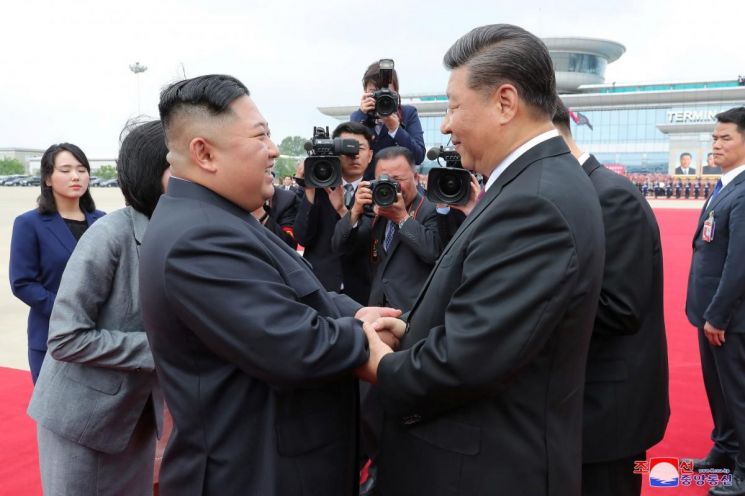 Kim Jong-un, General Secretary of the Workers' Party of Korea, and Xi Jinping, President of China
 [Photo by Yonhap News]
In fact, China continues to act as North Korea's 'backer.' In May this year, it blocked the adoption of a new UN Security Council sanctions resolution against North Korea, and on the 21st (local time), a public meeting on North Korea's intercontinental ballistic missile (ICBM) launch was also adjourned due to excessive use of veto power by China and Russia. This was the tenth such failed meeting this year.
Meanwhile, North Korea has launched ballistic missiles 63 times this year alone, including eight ICBM launches. The prevailing view is that only the seventh nuclear test remains, with the timing being coordinated.
The Biden administration has hinted at the possibility of sanctions against China. Earlier this month, two Chinese nationals involved in North Korea's missile development were added to the list of individuals subject to unilateral sanctions. However, these individuals are reported to be operating not in China but in a third Southeast Asian country. Above all, sanctions at the individual level are widely seen as unlikely to bring about meaningful changes in China's government stance.
Experts emphasize the need for the U.S. to pursue a secondary boycott against China but express skepticism about its feasibility.
Moon Sung-mook, head of the Unification Strategy Center at the Korea Institute for National Strategy, said, "With the Republicans, who have consistently advocated for a secondary boycott targeting China, now controlling the House of Representatives, their voices may become louder than before," and analyzed, "If the UN Security Council fails to play its role in pressuring North Korea, ways must be devised to make China and Russia recognize that 'helping North Korea will inevitably lead to losses.'"
Moon also referred to recent remarks by Jake Sullivan, U.S. National Security Advisor, who said, "If North Korea continues provocations, the U.S. will have no choice but to strengthen its military power in Northeast Asia," and predicted, "The U.S. preparing enhanced measures in military security is not limited to the Korean Peninsula but may be a prelude to strengthening military actions in the Indo-Pacific region."
Park Won-gon, a professor in the Department of North Korean Studies at Ewha Womans University, said, "A secondary boycott is definitely necessary to significantly enhance the effectiveness of sanctions against North Korea, but the possibility is low," adding, "There should have been changes when North Korea broke the moratorium and launched an ICBM in March, but given severe inflation and worsening economic conditions, it is questionable whether the U.S. is prepared to wage an economic war by implementing a secondary boycott."
© The Asia Business Daily(www.asiae.co.kr). All rights reserved.


















