First Step in Reconstruction 'Safety Inspection' Regulations Eased This Year
Rental Business Regulations Also Relaxed to Stabilize Rental Market
Support for Real Estate Market That Caused Short-Term Capital Market Tightening
Deputy Prime Minister Choo Kyung-ho: "Continuously Expanding Housing Supply Base"
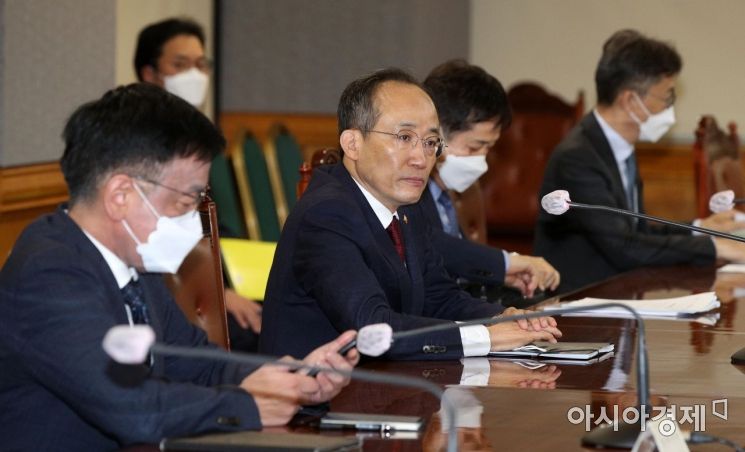 Deputy Prime Minister and Minister of Economy and Finance Choo Kyung-ho is presiding over the Emergency Macroeconomic and Financial Meeting held at the Bankers' Hall in Jung-gu, Seoul on the 28th. Photo by Kim Hyun-min kimhyun81@
The government has decided to further ease real estate regulations related to reconstruction safety inspections and the registered rental business operator system within this year. This move aims to fundamentally resolve issues as the recent housing market slump, caused by continuous base rate hikes, is expanding into short-term capital market instability.
On the 28th, Deputy Prime Minister and Minister of Economy and Finance Choo Kyung-ho held an emergency macroeconomic and financial meeting at the Bankers Hall in Jung-gu, Seoul, stating, "We will closely monitor market conditions and push for additional easing of real estate regulations within the year, including reforming the registered rental business system and improving reconstruction safety inspection standards."
The Ministry of Economy and Finance believes that relaxing the reconstruction safety inspection standards could revitalize local reconstruction projects, thereby aiding the sluggish real estate market. Safety inspections are the first step in reconstruction projects, but under the Moon Jae-in administration, regulations were significantly tightened to stabilize housing prices, causing major reconstruction projects in Seoul to stall.
Regarding the registered rental business operator system, registered operators who supply jeonse (long-term lease) units receive benefits such as exclusion from the comprehensive real estate holding tax. However, concerns about misuse for speculation during the Moon administration led to a significant reduction of this system, now limited mostly to long-term non-apartment rentals.
It is analyzed that if reconstruction safety inspection standards are eased and the registered rental business operator system is revived, the stagnant housing market could gain momentum. This could lead to a recovery in short-term capital market liquidity. Previously, the government also announced regulatory easing measures such as lifting restrictions on real estate regulation zones and allowing mortgage loans on houses exceeding 1.5 billion won within speculative overheating districts.
However, when asked about plans to further ease the loan-to-value ratio (LTV) on mortgage loans, Deputy Prime Minister Choo cautiously responded, "Financial regulations related to the real estate market and the market regulations themselves will be judged based on market conditions, and if decisions are made, they will be announced."
The LTV for non-homeowners in regulated real estate areas will be eased from the current 20-50% to a flat 50% regardless of price starting next month. However, since the debt service ratio (DSR), which measures the proportion of loan principal and interest payments to income, remains at 40%, some argue that the effect of easing LTV regulations will be limited.
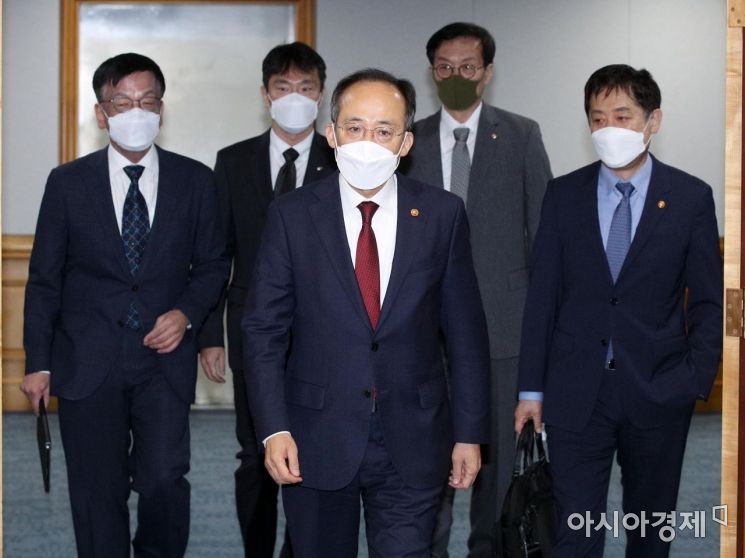 Deputy Prime Minister and Minister of Economy and Finance Choo Kyung-ho, along with heads of financial authorities, are attending the Emergency Macroeconomic and Financial Meeting held on the 28th at the Bankers' Hall in Jung-gu, Seoul. From the left, Choi Sang-mok, Senior Secretary for Economic Affairs; Lee Bok-hyun, Governor of the Financial Supervisory Service; Deputy Prime Minister Choo; Lee Chang-yong, Governor of the Bank of Korea; Kim Joo-hyun, Chairman of the Financial Services Commission. Photo by Kim Hyun-min kimhyun81@
On the same day, the Ministry of Economy and Finance also announced plans to expand real estate project financing (PF) to prevent funding shortages for construction companies. First, the guarantee scale for real estate PF projects preparing for sales after obtaining permits will be increased by 5 trillion won, and the loan interest rate cap for guaranteed loans will be abolished, further relaxing guarantee eligibility requirements.
A new 5 trillion won PF guarantee product for unsold housing will be introduced to support PF loans for unsold projects before completion. This system was originally scheduled to be implemented in February next year but has been moved up to January.
Deputy Prime Minister Choo said, "To ensure stable housing for ordinary citizens, it is essential to continuously expand the housing supply base," and added, "We urge smooth funding supply for normal PF and real estate projects."
© The Asia Business Daily(www.asiae.co.kr). All rights reserved.
!["The Woman Who Threw Herself into the Water Clutching a Stolen Dior Bag"...A Grotesque Success Story That Shakes the Korean Psyche [Slate]](https://cwcontent.asiae.co.kr/asiaresize/183/2026021902243444107_1771435474.jpg)

















