Government Orders Active Shipment Trusting Public Authority... Non-Union BCT Drivers Reluctant to Operate
Decision on Resuming Cement Shipments Likely Based on Negotiations Between Ministry of Land and Cargo Solidarity
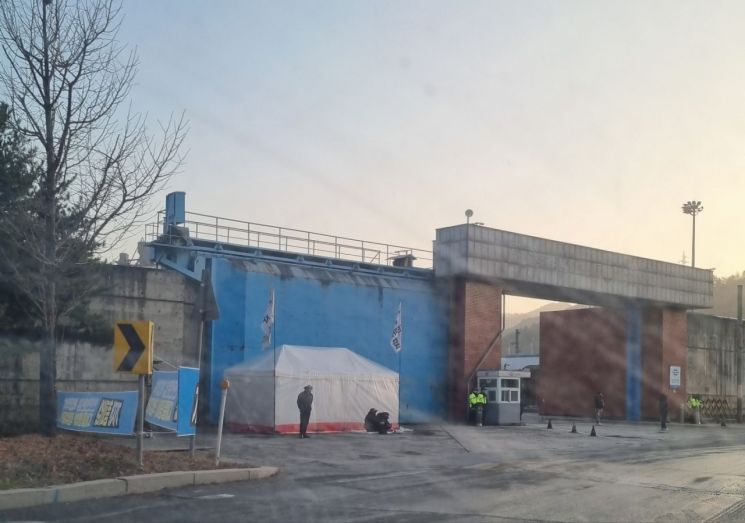 The main gate of a cement factory in Danyang, Chungbuk, on the 25th. Members of the Cargo Solidarity Union have set up tents, and police officers are stationed nearby to prevent union members from obstructing shipments.
 [Photo by Korea Cement Association]
[Asia Economy Reporter Kim Jong-hwa] Cement haulers resumed cement shipments starting today. However, due to the passive participation of non-union Bulk Cement Trailer (BCT) drivers who have experienced obstruction by members of the Cargo Solidarity, a union under the Korean Confederation of Trade Unions Public Transport Workers' Union (hereafter Cargo Solidarity), it is unlikely that the dramatic resolution of the shutdown crisis at ready-mixed concrete plants and construction sites will be achieved.
According to related industries on the 28th, encouraged by the government's active promotion of cement shipments, cement companies resumed shipments from today using non-union BCT drivers.
On the 25th, Eom Myung-so, the 2nd Vice Minister of the Ministry of Land, Infrastructure and Transport, held a meeting with the cement industry at Hanil Cement factory in Danyang, Chungbuk, stating, "Due to the Cargo Solidarity's collective refusal to transport, work has been halted nationwide at apartment complexes, public construction, and major infrastructure construction sites, putting related construction workers at risk of stopping work. The unjustified collective refusal to transport by the Cargo Solidarity must be immediately withdrawn. The government will provide support, so cement companies are urged to resume operations."
Police officials from the jurisdictional area also attended the meeting, stating, "Police forces will be deployed at factory entrances, and Cargo Solidarity members blocking BCT vehicles in operation will be forcibly removed from the site." On the 27th, Yoon Hee-geun, Commissioner of the National Police Agency, visited the inland container depot (ICD) in Uiwang, the largest logistics base and cement storage site in the metropolitan area, declaring a firm stance: "Illegal acts such as obstruction of non-union transport or blocking entrances will be met with on-site arrests as a principle and without exception, followed by judicial action."
Following this government stance, seven domestic cement manufacturers ordered the normal dispatch of BCTs targeting about 1,000 non-union drivers among approximately 3,000 BCT drivers and decided to resume operations from today. However, the situation at the factories this morning was reported to be not much different from before.
A cement industry official explained, "Although a request to resume transportation was made to carriers the day before, it has not yet resumed. It seems that the Cargo Solidarity is persuading drivers that it is not too late to act after observing negotiations with the government," adding, "BCT drivers are reluctant to transport in front of Cargo Solidarity members. Police are stationed at factory entrances alongside Cargo Solidarity members."
This means that non-union drivers who experienced obstruction by Cargo Solidarity members during the previous strike (refusal to transport) are passive about operating. During the previous Cargo Solidarity strike, non-union BCT vehicles attempting to ship suffered damage from stone-throwing by Cargo Solidarity members, leading to distrust in the protection of public authority.
A representative of a transportation company in the metropolitan area said, "Because public authorities did not protect non-union drivers despite rough obstruction by the Cargo Solidarity, they could not start shipments. It is also burdensome to confront union members they know personally, and public authorities seem too distant. We will observe today's negotiations and decide whether to participate," he revealed.
Ultimately, the decision on whether to resume cement transportation is expected to be determined based on the results of the first negotiation between the Ministry of Land, Infrastructure and Transport and the Cargo Solidarity to be held this afternoon at the Government Complex Sejong. The Cargo Solidarity is demanding the continuation and expansion of the Safe Freight Rate system, which is the minimum wage equivalent for truck drivers.
As of the fourth day of the Cargo Solidarity's refusal to transport, the cement industry recorded cumulative losses of 46.4 billion KRW. The Korea Cement Association announced on the 26th that although 103,000 tons of cement were planned to be shipped, only about 9% or 9,000 tons were actually shipped due to the Cargo Solidarity strike. The estimated daily damage amounts to about 9.4 billion KRW, totaling 46.4 billion KRW in cumulative losses.
The ready-mixed concrete industry is also expected to halt production at most plants nationwide starting today. An industry official stated, "Since last Friday, small and medium-sized plants have stopped operations, and from today, most ready-mixed concrete plants are expected to shut down due to lack of cement."
Meanwhile, five construction and material industry associations?the Korea Cement Association, Korea Construction Association, Korea Specialty Contractors Association, Korea Ready-Mixed Concrete Industry Cooperative Federation, and Korea Ready-Mixed Concrete Association?issued a joint statement titled "Joint Statement from the Construction and Material Industries on the Cargo Solidarity's Collective Refusal to Transport," urging, "The Cargo Solidarity must immediately stop the collective refusal to transport and return to transportation immediately."
The five associations stated, "This unjustified selfish behavior, which holds the labor rights of non-union members, the livelihoods of construction and material industry workers, national logistics, and housing supply stability hostage, is putting the national economy at risk," adding, "In a situation where the government, National Assembly, companies, and workers are putting all their efforts into overcoming the economic crisis, such illegal acts cannot be tolerated."
They further requested, "The government must strictly respond to the Cargo Solidarity's illegal acts according to law and principles," and urged, "Please swiftly and strictly enforce the law against the Cargo Solidarity's illegal acts so that businesses can operate on a foundation of fairness and common sense and focus on their fundamental roles of ensuring national housing stability and building social infrastructure."
© The Asia Business Daily(www.asiae.co.kr). All rights reserved.

















