Number of Selected Candidates Decreased by 58 Compared to Last Year
Daegu Haany University and Dong-Eui University Allow 'Haktong' Selectors to Apply
Only Natural Science Applicants Selected at Busan National University
[Asia Economy Reporter Han Jinju] Korean Medicine colleges are a field within the medical and pharmaceutical disciplines that do not restrict the choice of mathematics or science elective subjects, making them accessible to students from humanities backgrounds as well. This year, the number of recruits has decreased compared to last year, making the competition expected to be more intense.
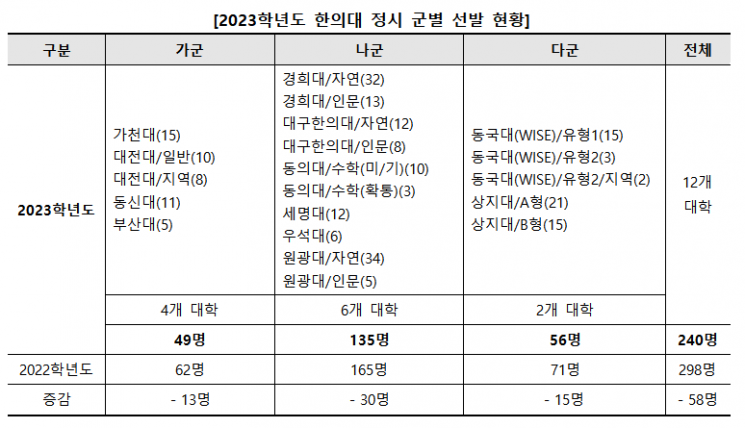
According to JinHakSa on the 28th, the number of regular admissions for Korean Medicine colleges in the 2023 academic year is 240 students across 12 universities: 49 students in Group A (4 universities), 135 students in Group B (6 universities), and 56 students in Group C (2 universities). The number of regular admissions for Korean Medicine colleges has decreased by 58 compared to the previous year.
In Group A, 49 students are selected from four universities: Gachon University, Daejeon University, Dongshin University, and Pusan National University. Although Pusan National University (5 students) moved to Group A, the selection size in Group A is limited to 49 students, a decrease of 13, because Daejeon University and Dongshin University each reduced their quotas by 9 students.
Group B, which includes Kyung Hee University, Daegu Haany University, Dong-Eui University, Semyung University, Woosuk University, and Wonkwang University, has the largest number of recruits with 135 students across six universities, but this is a decrease of 30 students compared to the previous year. This is due to reductions in quotas at Daegu Haany University (-10), Dong-Eui University (-7), Semyung University (-6), and Wonkwang University (-2).
Group C is only recruiting from two universities, Dongguk University (WISE) and Sangji University, with Dongguk University (WISE) reducing its quota by 15 students, resulting in a total of 56 recruits.
Korean Medicine colleges do not restrict elective subjects, allowing humanities students to apply, and some universities operate separate admission types for humanities-type CSAT (College Scholastic Ability Test) takers. Six universities?Kyung Hee University, Daegu Haany University, Dong-Eui University, Dongguk University (WISE), Sangji University, and Wonkwang University?select freshmen separately for humanities and natural sciences types.
However, even for types that humanities students can apply to, only Daegu Haany University and Dong-Eui University restrict applicants to those who chose 'Probability and Statistics.' The other four universities (Kyung Hee University, Dongguk University (WISE), Sangji University, Wonkwang University) simply do not restrict elective subjects, allowing both humanities and natural sciences students to apply together. This creates tough competition for humanities students who are expected to be at a disadvantage in the mathematics section.
Gachon University, Daejeon University, Dongshin University, Semyung University, and Woosuk University allow cross-application. However, except for Daejeon University, they give additional points to applicants who chose calculus and geometry in mathematics or science subjects. Pusan National University is the only university that admits only natural sciences applicants.
It is also important to check the changes in the weighting ratios of CSAT subjects compared to last year. Kyung Hee University changed Korean history to a penalty system and increased the weighting of the inquiry (science) section by 5 percentage points, increasing its importance, while the score difference between English grades decreased, reducing the influence of English. Daegu Haany University lowered the weight of Korean and mathematics and set the weighting of the four subjects equally at 25% each. Dongguk University (WISE) changed the scoring indicator from standard scores to percentiles, increasing the mathematics weighting by 5% and lowering the inquiry section's ratio.
Daejeon University, Dongshin University, and Sangji University place a very high emphasis on English. Although these universities reflect English percentiles with a weighting of 20%, similar to other universities, their own English conversion scores assign 100 points for grade 1 and 90 points for grade 2, creating a large score gap between grades 1 and 2. Since English accounts for 20% of the total 1000-point score, effectively, grade 1 in English corresponds to 200 points and grade 2 to 180 points, making it difficult for students with English grade 2 to apply. Dongshin University, unlike other universities, reflects only one subject in the inquiry section this year as well.
Yoo Yeon-cheol, head of the JinHakSa Admissions Strategy Research Institute, said, "With the overall decrease in medical field recruitment this year, Korean Medicine colleges have also significantly reduced their quotas, so applicants should keep in mind the possibility of increased competition rates and admission cutoffs when planning their application strategies. Special caution is needed when referring to last year's admission results for universities with changes such as Kyung Hee University and Daegu Haany University."
© The Asia Business Daily(www.asiae.co.kr). All rights reserved.

















