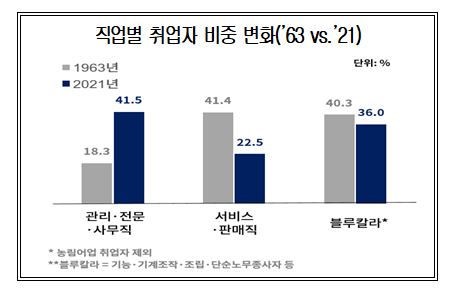
Significant Job Changes Over the Past 60 Years... Increase in Management, Professional, and Clerical Positions (18% → 42%), Decrease in Production Jobs (40% → 36%)
[Asia Economy Reporter Jeong Dong-hoon] The business community has argued that the working hours system should be improved to align with changing times.
The Korea Chamber of Commerce and Industry (KCCI) stated in its report titled "International Comparison and Implications of Exclusion Systems in Working Hours Application," released on the 28th, that "the uniform working hours regulatory system, originally designed for manufacturing and production jobs, is increasingly diverging from the rapidly changing industrial structure and work patterns since the implementation of the 52-hour workweek." It added, "Flexible working hour systems such as flexible, selective, and discretionary work arrangements should be improved to fit the realities of companies, and a 'Korean-style White-collar Exemption' system allowing selective exclusion of working hours regulations through labor-management consultation and agreement should be introduced immediately."
According to the report, the proportion of white-collar workers among total employees has significantly increased alongside changes in Korea's industrial structure. The white-collar ratio, which was 18.3% in 1963, rose markedly to 41.5% in 2021. Conversely, service and sales jobs decreased from 41.4% to 22.5%, and blue-collar jobs dropped from 40.3% to 36.0% during the same period.
The KCCI basically agrees with the government's direction to flexibilize the working hours system as part of labor market reforms but evaluated that the ongoing improvement plans are still within the existing working hours regulatory framework, making it difficult to reflect the diverse demands and realities of companies.
In fact, since July, the government has formed an expert-centered Future Labor Market Research Committee to discuss flexibilization of the working hours system, and a draft was announced in mid-November. The contents include changing the extended working hours management unit from 'week → month/year,' introducing a working hours savings account system, and expanding the scope of selective working hours application, but these measures do not significantly depart from the existing total working hours regulation framework.
In response, the KCCI report emphasized the need to devise various options for utilizing working hours, considering the characteristics of industries and tasks and the diversity of work types, beyond just flexible and selective working hour systems.
Overseas, High-income Workers Have Greater Autonomy Over Working Hours with Labor-Management Agreement
The report explained, "The reason why major advanced countries with shorter working hours than Korea have little debate over working hours flexibilization is that they have already introduced systems that either do not apply working hours regulations to certain jobs or allow labor and management to conclude agreements exceeding statutory working hours."
In the United States, the 'White-collar exemption' system exempts professional, managerial, and high-income workers, for whom evaluating job performance based on working hours is inappropriate, from working hours regulations. The eligible group includes high-level managers, administrative staff, and professionals earning at least $684 per week (approximately 910,000 KRW) or high-income workers with an annual income of $107,432 (approximately 143.74 million KRW) or more.
Japan also amended its Labor Standards Act to implement a similar 'Exemption system for highly professional workers (de-timed wage system)' from April 2019. The target group is high-income professional workers earning 10.75 million yen (approximately 103.18 million KRW) or more annually, exempting them from overtime pay, holiday pay, and working hours regulations. However, unlike the U.S., Japan mandates health protection measures such as guaranteeing at least 104 days off per year.
The UK and France operate working hours regulatory systems in a broader manner. The UK has an 'Opt-Out' system allowing workers to agree through contracts to work beyond the maximum 48 hours per week. However, to protect workers, even if an opt-out contract is signed, it can be freely canceled, and employers are prohibited from penalizing or dismissing workers for doing so.
France has an 'Annual Comprehensive Agreement System' through collective agreements that cover annual working days and wages. When such agreements are made, statutory working hours and maximum working hours regulations do not apply.
Discussion Needed on Introducing Advanced Country-type Systems That Exclude Application of Current Working Hours Regulations
The report further proposed that Korea introduce a white-collar exemption for high-income professionals, managers, and R&D workers, along with a working hours freedom selection system (opt-out) that allows labor and management to autonomously decide working hours regulatory methods.
Examples of target workers include professionals, managers, and researchers who fall within the top 2% of total earned income (based on 2020 earned income, approximately 129 million KRW) or those earning at least five times the minimum wage (approximately 115 million KRW as of 2022).
In the past, during the 20th National Assembly, a bill was proposed to amend the Labor Standards Act to exempt workers within the top 3% of earned income from regulations on working hours, breaks, and holidays. However, the bill was discarded without significant social discussion.
Additionally, the report noted, "Due to changes in the industrial environment, tasks where it is difficult for employers to give specific instructions on how to perform work and allocate time are increasing, and outcomes based on creative ideas rather than total working hours are becoming more important." It also suggested that "introducing a working hours freedom selection system (opt-out) that allows autonomous regulation through labor-management agreements, similar to the UK and France, is necessary to enable flexible working hours arrangements suited to company circumstances."
Yoo Il-ho, head of the Employment and Labor Policy Team at KCCI, emphasized, "For Korea's economic strength to be enhanced, it must become an innovative country where venture companies and startups can thrive and grow into unicorn companies, but uniform labor market regulations are hindering this." He added, "We must promptly establish a working hours regulatory system that aligns with the changing industrial environment to revitalize our economy and create quality jobs."
© The Asia Business Daily(www.asiae.co.kr). All rights reserved.

















