WSJ Introduces Story of Kherson Tropinka Hospital Chief
Refused to Lower Ukrainian Flag and Was Imprisoned
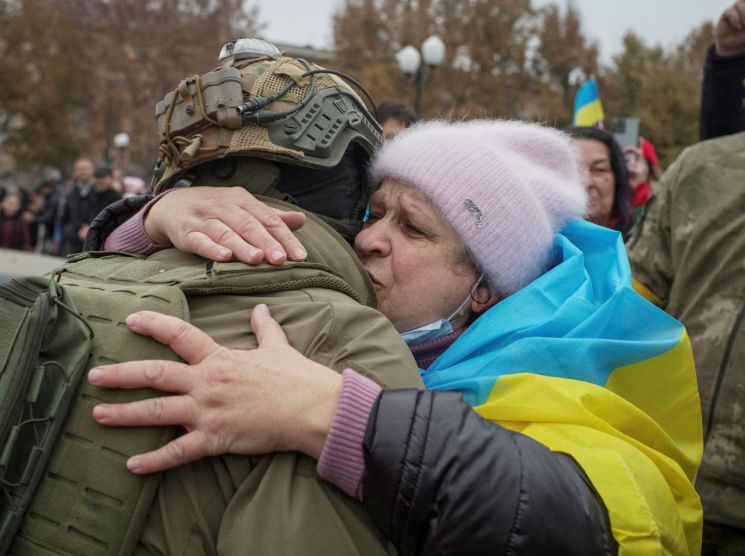 A Ukrainian citizen is embracing and welcoming their country's soldier on the 12th (local time) in Kherson, southern Ukraine, from which Russian troops have withdrawn. Photo by Reuters Yonhap News
[Asia Economy Reporter Kim Hyunjung] The story of a doctor who demonstrated resilience and courage for months to protect a hospital in Kherson, one of the fiercest battlegrounds in the Russia-Ukraine war, has become a hot topic.
The Wall Street Journal (WSJ) on the 25th (local time) introduced the story of Dr. Leonid Remiga (68), the chief physician and head of Trofinka Hospital in Kherson, Ukraine. In March, shortly after Russian forces occupied Kherson, they stormed into Trofinka Hospital and demanded that the Ukrainian flag hanging at the hospital’s main entrance be taken down. Dr. Remiga ignored their demand and confronted them, saying, "If you want, shoot me. But I will not take down the flag." The Russian troops left without further demands, but this was just the beginning of another fierce battle to maintain control over the hospital throughout the Russian occupation of Kherson.
Founded in 1914, Trofinka Hospital has suffered from poor infrastructure since Ukraine gained independence from the former Soviet Union in 1991, with no investments made in its facilities. Dr. Remiga, a former city council member and a member of Ukraine’s European Solidarity party, has worked at this hospital since 1995. Believing that Ukraine’s future lies with the West, he sought ways to prevent the hospital from falling into Russian hands from the start of the invasion.
A few days after Dr. Remiga refused to lower the flag, more Russian soldiers arrived at the hospital in armored vehicles. They intended to convert Trofinka Hospital into a military hospital. Dr. Remiga greeted them fully clad in protective gear, including foot covers, and told them that no one could enter due to COVID-19 restrictions. The staff had already plastered the hospital walls with warnings about infection. Their tactic worked, and the soldiers left.
In April, Dr. Remiga’s wife, son, and grandson fled to an unoccupied area, but he stayed at the hospital. Recalling that time, he said, "We could not allow our hospital to become a Russian hospital. All the staff felt the same." After the Russian forces fully took control of Kherson, they tightened their grip. On June 7, the health minister of Kherson appointed by the occupying forces summoned Dr. Remiga and ordered him to step down as hospital director, appointing head nurse Larisa Maleta as his successor. On that day, Dr. Remiga collapsed from a stroke while protesting. Head nurse Maleta refused the position, saying, "I am not a doctor," but accepted it after Dr. Remiga asked her to stay at the hospital.
The two conspired to outwardly comply with Russian demands while secretly resisting. Later, the head nurse escaped to another region in August, and Dr. Remiga went into hiding before being captured and imprisoned by Russian forces in September. In the cramped prison, every morning he had to link arms with other prisoners and sing Russian military songs, shouting "Glory to Russia, glory to Putin."
While he was imprisoned, the situation in Kherson changed. A few days before Russia’s complete withdrawal from Kherson last month, officials appeared at the hospital to steal medical equipment. The staff took computers home, and a doctor hid the remote controls for expensive equipment, saying, "If you take them, they won’t work," thus protecting the hospital’s assets.
Finally, Russian forces disappeared from Kherson on the 10th, and Ukrainian troops arrived the next day. Dr. Remiga was also able to return to the hospital. He said, "When the invasion began, there were 460 hospital doctors, but now only 70 remain," and expressed hope that "many who left will now return."
© The Asia Business Daily(www.asiae.co.kr). All rights reserved.

















