China's EV sales expected to surge 4.2 times in 3 years from 370,000 units this year
Standardization of specifications and coupling methods decision, large-scale investment required 'challenge'
"Korea needs adoption... Government to promote commercialization through taxi and bus pilot projects"
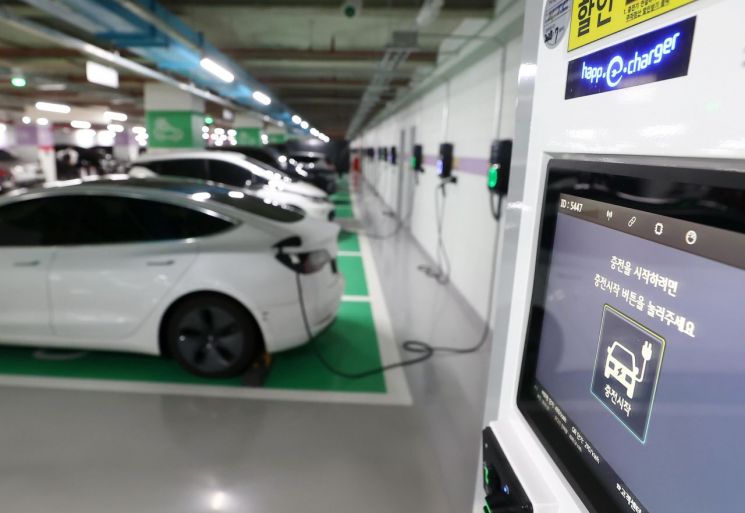
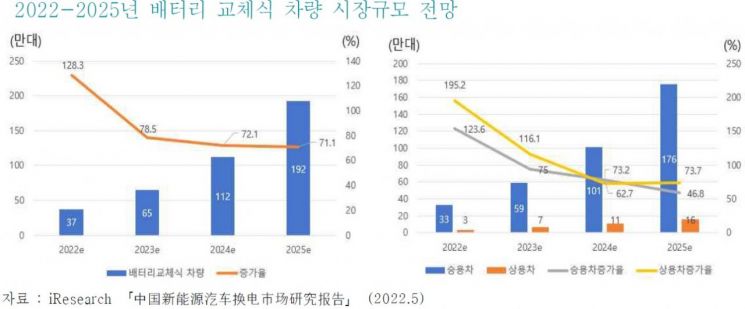
[Asia Economy Reporter Moon Chaeseok] There is an urgent call for the domestic introduction of the 'battery swapping' service, which replaces fully charged electric vehicle batteries at battery exchange stations within 2-3 minutes. China has already implemented this service for 370,000 electric vehicles as of this year, and it is expected to surge to 1.92 million vehicles, a 4.2-fold increase, in three years. However, South Korea remains stagnant. It is urged that the government accelerate commercialization by promoting pilot projects for taxis and buses, where standardization is easier.
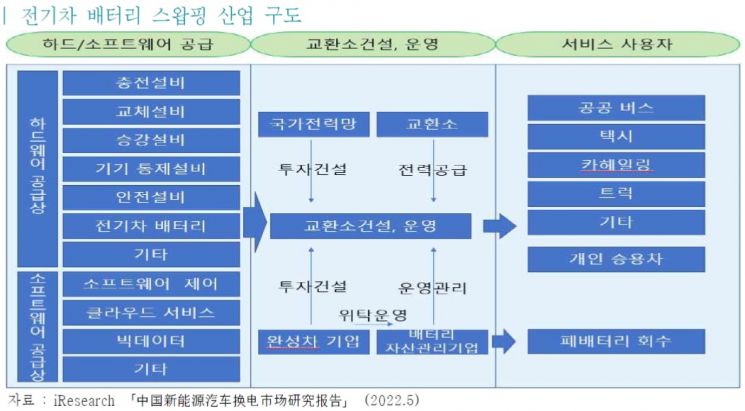
On the 28th, the Korea International Trade Association (KITA) released a report titled "Review and Implications of Introducing Electric Vehicle Battery Swapping in South Korea." The electric vehicle battery swapping service is a system that replaces fully charged batteries at exchange stations to overcome limitations in charging speed, safety, and adoption rate, and it is widespread in countries like China. The world's largest battery manufacturer, CATL, has recently established related companies, indicating active market entry. It is considered a battery supply method suitable for the transitional period before the completion of 'fast charging' systems.
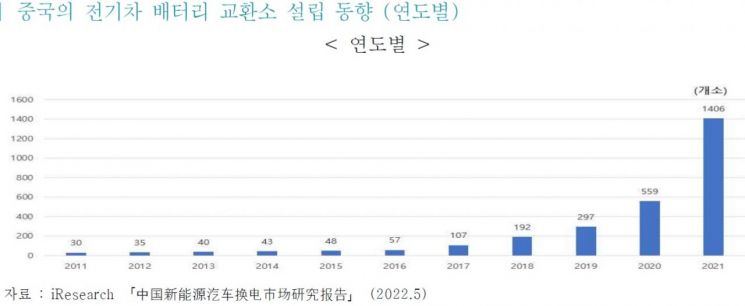 Trends in the Establishment of Electric Vehicle Battery Swap Stations in China by Year. (Source: KITA)
As of last year, the Chinese battery swapping market size was 4.5 billion yuan (approximately 840 billion KRW), and it is expected to grow more than 20 times to over 100 billion yuan (about 18 trillion KRW) by 2025. There were 1,406 battery exchange stations in China last year, and this number is expected to increase to over 30,000 by 2025. The number of battery-swappable electric vehicles in China is projected to rise from 370,000 this year to 1.92 million in 2025. Annual growth of about 86% is predicted over the three years from this year to 2025.
KITA explained that introducing a battery swapping system can efficiently utilize national land and manage the power grid, as the burden of installing charging stations is reduced. Moreover, it enhances electric vehicle battery safety, extends battery life, manages explosion risks, and promotes battery reuse and recycling. From the consumer's perspective, purchasing an electric vehicle without the battery reduces the price burden, thereby aiding the spread of electric vehicles. The report suggested, "South Korea should also consider introducing battery swapping."
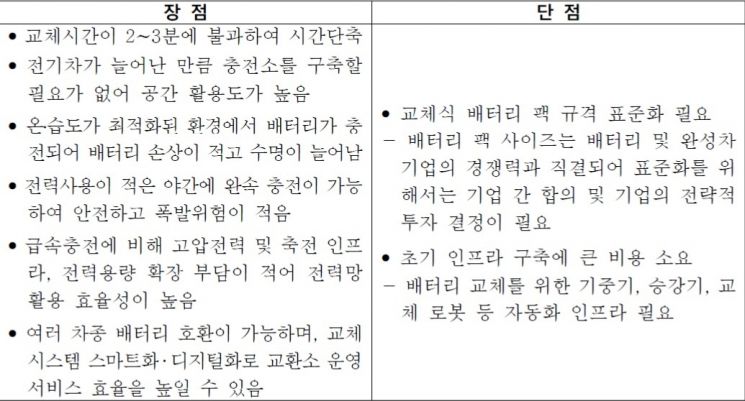 Advantages and Disadvantages of Battery Swapping System Compared to Conventional Electric Vehicle Charging Methods. (Source: KITA)
The issue lies in the need for strategic decision-making among companies to standardize battery specifications and coupling methods. Large-scale capital investment is also required. This naturally may lead to a concentration of dominance by large corporations. Preconditions for introducing battery swapping include securing automated robotic equipment capable of battery removal and installation, as well as skilled technical personnel; establishing collaborative business models between small and large enterprises; and standardizing electric vehicle design and battery specifications through cooperation between automakers and battery manufacturers. KITA pointed out that conflicts among stakeholders are inevitable until the system is established.
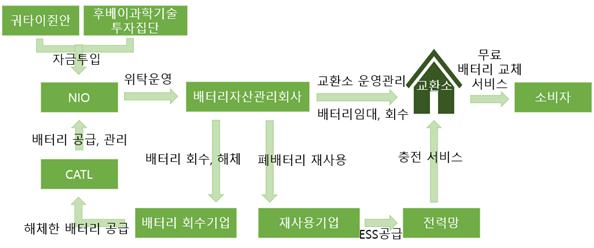 Revenue structure of the Battery as a Service (BaaS) model for battery swapping by NIO, a leading Chinese electric vehicle manufacturer. (Source: KITA)
KITA emphasized that government coordination is essential. It urged accelerating commercialization starting with pilot projects. Kim Heeyoung, a KITA research fellow, said, "Not only battery replacement at exchange stations but also services such as vehicle inspection, repair, and related parts sales can be linked to create a win-win business model between large and small enterprises." He advised, "The government should explore the feasibility of 'battery swapping' with stakeholders in automaking, battery manufacturing, and recycling, and promote pilot projects starting with taxis and buses, where standardization and efficiency are easier, to enable rapid commercialization."
© The Asia Business Daily(www.asiae.co.kr). All rights reserved.
![Clutching a Stolen Dior Bag, Saying "I Hate Being Poor but Real"... The Grotesque Con of a "Human Knockoff" [Slate]](https://cwcontent.asiae.co.kr/asiaresize/183/2026021902243444107_1771435474.jpg)













