122 Million People Subject to Comprehensive Real Estate Tax... Exceeds 1 Million
Low-Income Groups Also Face Increased Burden... Regressive Aspects Present
If Government Proposal Passes Parliament, Taxpayers Will Decrease to 660,000
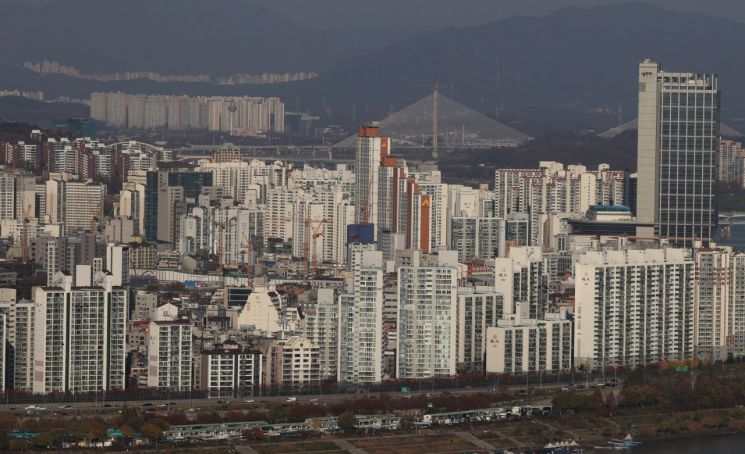 View of downtown apartments from ASEM Tower in Samseong-dong, Gangnam-gu, Seoul [Image source=Yonhap News]
The Ministry of Economy and Finance emphasized that if housing prices fall, the burden of the comprehensive real estate holding tax (종합부동산세, 종부세) must also be lowered, stating, "We will do our utmost to ensure the passage of the 종부세 reform bill in the National Assembly so that the public's burden does not increase any further."
They also explained that the current 종부세 system places a considerable burden even on low-income single-home households, making normalization absolutely necessary due to its regressive aspects.
On the 27th, the Ministry released a press reference stating, "Last year's 종부세 abnormally increased due to the combined effects of a sharp rise in publicly announced prices, an increase in the fair market value ratio, and tax rate hikes," adding, "The government proposal aims to normalize the tax burden to the 2020 level."
According to the government, the number of taxpayers subject to the housing portion of 종부세 this year reached 1.22 million, an increase of 289,000 from last year, surpassing one million for the first time. This accounts for about 8 out of every 100 homeowners.
Among those newly subject to taxation this year, there are 375,000 taxpayers, with an average tax amount of 2,449,000 KRW. Additionally, 471,000 taxpayers saw an increase in their 종부세 tax bills compared to last year, representing about 38.7% of all taxpayers.
In particular, the government found that low-income earners with incomes below 50 million KRW account for more than half (52.2%) of the single-home household 종부세 taxpayers. Taxpayers earning 20 million KRW or less, which is around the minimum wage level, make up 31.8%.
The Ministry stated, "Taxpayers earning 10 million KRW or less bear an average burden of 752,000 KRW, while those earning between 50 million and 100 million KRW bear an average of 971,000 KRW," adding, "The difference in tax amounts is small compared to income differences, so the tax burden is felt more heavily by low-income groups."
 View of downtown apartments from ASEM Tower in Samseong-dong, Gangnam-gu, Seoul [Image source=Yonhap News]
The Yoon Suk-yeol administration proposed an amendment to the 종부세 law last September aimed at reducing the tax burden, focusing on abolishing the heavy tax rate for multiple homeowners and raising the basic deduction amount. The reform plan includes ▲raising the basic deduction amount for the housing portion of 종부세 ▲abolishing the heavy tax rate for multiple homeowners ▲adjusting the tax burden cap, among other measures.
If the government proposal passes the National Assembly, the number of taxpayers subject to 종부세 will decrease to about 660,000, similar to the 2020 level (665,000), and the proportion of taxpayers will drop to around 4%.
The Ministry pointed out, "To ease the burden caused by this year's sharp rise in publicly announced prices, the fair market value ratio for the housing portion of 종부세 was lowered (from 100% to 60%)," but noted, "However, when publicly announced prices rise sharply, the taxable base actually increased in the lower price ranges where housing prices are relatively low."
Furthermore, the government made efforts to reduce the tax burden by introducing special provisions for temporary two-home ownership, inherited homes, and low-priced homes in rural areas, as well as deferral of tax payments for elderly and long-term owners. However, since the introduction of a special deduction of 300 million KRW failed to pass the National Assembly, the number of single-home household taxpayers increased by about 100,000, and the burden on owners of mid- to low-priced homes also rose.
Regarding the heavy tax rate for multiple homeowners, the government stated, "No major foreign country imposes differentiated property taxes based on the number of homes owned for the purpose of managing the real estate market," adding, "Excessive tax burdens on multiple homeowners are passed on to tenants. It is inappropriate to categorically label multiple homeowners as speculators and regulate them."
They continued, "Adjusting only the fair market value ratio makes it difficult to reduce the tax burden for all taxpayers, including those in the mid- to low-priced ranges," and explained, "Fundamental reform of 종부세, such as raising the basic deduction amount, abolishing the heavy tax rate for multiple homeowners, and lowering tax rates, is absolutely necessary."

However, the Ministry emphasized that even if the 종부세 law amendment passes, it is not a 'tax cut for the wealthy.'
The Ministry stated, "The highest tax rate in the government proposal is 2.7%, similar to the Participatory Government (highest rate 3%) and the first tax strengthening under the Moon Jae-in administration (highest rate 2.7%), and significantly higher than the 2009?2018 rates (highest rate 2%)," adding, "The tax rates in the government proposal are by no means low and are sufficient to respond to real estate speculative demand."
The Ministry stressed that as housing prices are rapidly falling due to the recent sharp increase in the base interest rate, the household burden from homeownership is quickly increasing, making fundamental reform of 종부세 inevitable.
The Ministry concluded, "The 종부세 strengthening measures introduced during the real estate overheating period must be normalized to a sustainable level," and said, "The government will do its utmost to ensure the passage of the 종부세 reform bill in the National Assembly so that the public's burden does not increase any further."
© The Asia Business Daily(www.asiae.co.kr). All rights reserved.
![Clutching a Stolen Dior Bag, Saying "I Hate Being Poor but Real"... The Grotesque Con of a "Human Knockoff" [Slate]](https://cwcontent.asiae.co.kr/asiaresize/183/2026021902243444107_1771435474.jpg)













