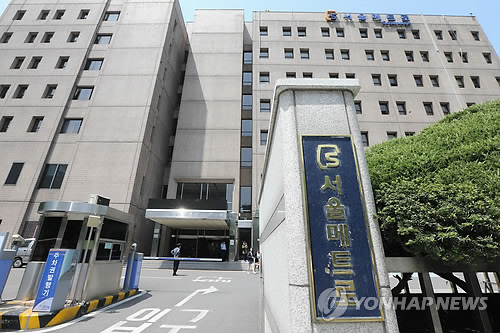
 Reference photo. Seoul Metro headquarters. Photo by Yonhap News
[Asia Economy Reporter Heo Kyung-jun] The Supreme Court has ruled that Seoul Metro (now Seoul Transportation Corporation) must pay damages for failing to fulfill its promise to rehire employees of a subcontracted company.
The Supreme Court's 2nd Division (Presiding Justice Min Yoo-sook) announced on the 27th that it overturned the lower court's partial ruling in favor of the plaintiffs, including Mr. A, in their appeal lawsuit against the corporation regarding confirmation of employee status, and remanded the case to the Seoul High Court.
Seoul Metro, which operates the Seoul subway, spun off non-core tasks in 2008 to reduce the number of employees by outsourcing the light and heavy maintenance of trains to subcontractor Company B and transferred some employees to Company B. The transferred employees were promised an extension of their retirement age by 2 to 3 years compared to before, and that if Company A went bankrupt or the contract with Seoul Metro was terminated, they would be rehired.
However, the situation changed after an accident on May 28, 2016, when Kim (then 19 years old) died while repairing a screen door at Guui Station in Gwangjin District, Seoul. After this accident, Seoul Metro reverted the outsourced work from Company B back to direct management. Contrary to the promise, employees who had moved to Company B were not rehired.
Mr. A and others filed a lawsuit demanding the implementation of the retirement age extension and claimed that those whose retirement age had not yet arrived should be employed and that they be paid wages not received during the dismissal period.
The first and second trials judged that Mr. A and others, who had received the employment promise, were unemployed without fault. Accordingly, they ruled that the corporation had an obligation to employ those whose retirement age had not passed. Additionally, Seoul Transportation Corporation was ordered to pay part of the wages that could have been earned during the period when employees were not rehired.
The Supreme Court also agreed with the lower courts' judgment. However, it found that the lower court had erred in its judgment regarding the retirement age of employees who had moved to Company A and ordered a retrial on this point only.
The second trial accepted all wage-equivalent damage claims of eight people born before the first half of 1956 and also accepted the wage-equivalent damage claims and employment intention claims of seven people born after the second half of 1956. The Supreme Court ruled that the retirement age of those born in the second half of 1956 should be considered as having arrived on June 30, 2019.
The Supreme Court accepted the plaintiffs' argument that Seoul Metro set employees' retirement age as "the end of June in the year they turn 60" according to internal personnel regulations, and that this regulation should apply to employees who moved to Company B as well, meaning the retirement age should be considered as the end of June in the retirement year, not the birthday.
© The Asia Business Daily(www.asiae.co.kr). All rights reserved.
















