RO "Make the Safe Freight Rate System Permanent... Increase Vehicle Types and Items"
Government "No to Abolishing the Sunset Clause or Expanding Items in the Freight Rate System"
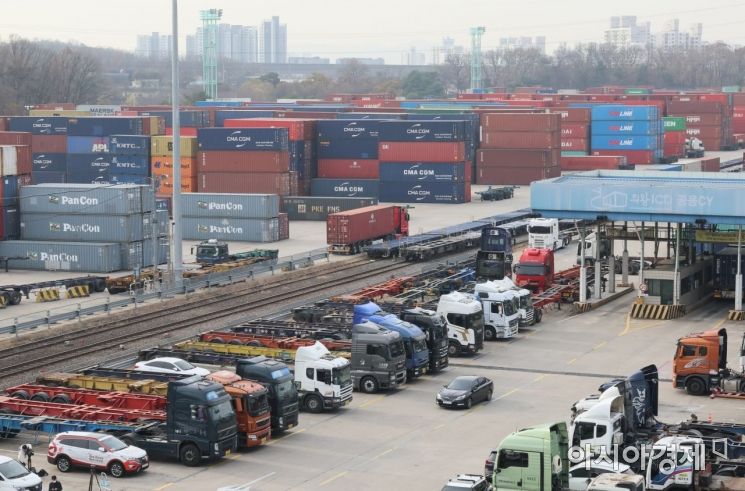 On the 24th, when the Cargo Solidarity Headquarters of the Public Transport Union under the Korean Confederation of Trade Unions (Cargo Solidarity) began an indefinite general strike, containers were stacked behind cargo trucks stopped at the Inland Container Terminal in Uiwang-si, Gyeonggi-do. Photo by Dongju Yoon doso7@
[Asia Economy Reporter Moon Chaeseok] On the 27th, as the nationwide general strike by the Cargo Solidarity Headquarters of the Public Transport Workers' Union under the Korean Confederation of Trade Unions (Cargo Solidarity) entered its fourth day, logistics transportation disruptions occurred across the country over the weekend. Corporate management has been hit, physical clashes have taken place, and the import and export at major ports have sharply dropped to about 35% of normal levels. The government and labor representatives are scheduled to negotiate the next day, but a wide gap between the two sides over key issues such as the abolition of the sunset clause of the Safe Freight Rate System and the expansion of its application scope is expected to make negotiations difficult.
According to the Ministry of Land, Infrastructure and Transport, about 5,400 union members (government estimate) continued to hold rallies nationwide the previous morning. This accounts for about one in four of the estimated 22,000 union members. The Cargo Solidarity claims the number is higher. According to the Korea International Trade Association, by 6 p.m. on the 25th, 53 reports of difficulties and damages were received from 31 companies. Cases of management damage reported include delivery delay penalties and disruption of overseas buyer transactions (24 cases, 45% of total), increased logistics costs (15 cases, 28%), and production stoppages (13 cases, 25%).
The industrial sector is concerned that industries such as cement and steel may suffer significant damage due to logistics disruptions. It is expected that the damage will become more apparent after the weekend. The Korea Cement Association announced that only 20,000 tons, about one-tenth of the scheduled 200,000 tons shipment on the 25th, were shipped. Shipments have been completely halted at major bases in the metropolitan area. Industry forecasts also suggest that nationwide production may stop on the 29th.
The steel industry is also distressed. Industrial sites may face a shutdown starting the next day. Since the 24th, Hyundai Steel's Pohang plant has reportedly been unable to ship its daily volume of 8,000 tons for three consecutive days, with the stock piling up in warehouses.
The refining industry is in a similar situation. It is known that 70-80% of the drivers of the so-called "Big Four" refineries are Cargo Solidarity union members, raising concerns about fuel supply disruptions at gas stations if the strike prolongs.
Physical clashes have already occurred. At Busan New Port, around 7 a.m. the previous day, a striker threw an object presumed to be a metal ball, damaging a cargo vehicle operating normally and injuring the driver. Minister of Land, Infrastructure and Transport Won Heeryong, who has been on-site at Busan New Port since the first day of the strike, stated, "We must actively ensure the safety of cargo truck drivers who are not participating in the strike and are operating normally," and requested thorough police investigations.
The problem is that despite the management damage and physical clashes, the possibility of reaching an agreement between the government and labor is not high. The government is pressuring the labor side by threatening to issue work commencement orders to affected industries such as cement and ready-mixed concrete, but the labor side is adamant that the sunset clause of the Safe Freight Rate System must not be abolished.
The Safe Freight Rate System, which is set to expire at the end of the year, guarantees a minimum transportation fee so that cargo truck drivers do not have to overwork, overspeed, or overload, and imposes fines on shippers who violate this. It was temporarily introduced in 2020 for cement and container cargo, among others.
Cargo Solidarity demands ▲ permanent establishment of the Safe Freight Rate System ▲ expansion of applicable vehicle types and items to five categories including steel products, automobiles, hazardous materials, feed and grains, and parcel delivery trunk and feeder lines ▲ and the government and ruling party's withdrawal of the Safe Freight Rate System amendment bill. The government maintains that it cannot accept the abolition of the sunset clause or the expansion of applicable items.
© The Asia Business Daily(www.asiae.co.kr). All rights reserved.

















