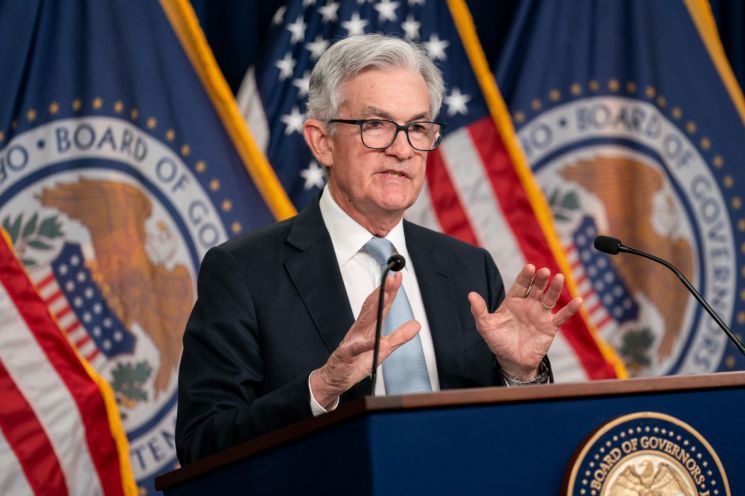
[Asia Economy Reporter Lee Seon-ae] This week (28th~2nd), the domestic stock market is expected to engage in a cautious trading range ahead of major events such as the year-end U.S. Federal Open Market Committee (FOMC) meeting. The decisions of the Federal Reserve (Fed) at the FOMC meeting scheduled for December 13-14 largely depend on the inflation and employment data to be announced consecutively on the 1st and 2nd. Accordingly, the market is likely to react sensitively to Fed Chair Jerome Powell’s remarks scheduled for the 30th. Chair Powell is expected to discuss the Fed’s views on the U.S. economy, inflation, the pace of tightening, and the outlook for the benchmark interest rate.
On the 27th, securities firms predicted that the KOSPI would fluctuate around 2400 this week. No one realistically expects a recovery to 2500. NH Investment & Securities set the weekly KOSPI range at 2370-2490. Kim Young-hwan, a researcher at NH Investment & Securities, said, "For further gains in the domestic stock market, risk appetite in the financial markets needs to strengthen, and until the December FOMC, a cautious trading range is expected as investors try to glean clues about Fed policy from economic indicators such as employment and inflation." Seo Jung-hoon, a researcher at Samsung Securities, also said, "Since there is no additional momentum for a rise in the domestic stock market recently, the consolidation phase may be extended for some time."
This week, several important economic indicators that influence U.S. tightening policy will be released, including the Beige Book. The Beige Book is a summary of economic conditions in 12 districts surveyed by the Federal Reserve Banks and provides insight into the Fed’s economic assessment. Additionally, the October Personal Consumption Expenditures (PCE) price index, November ISM Manufacturing Index, and October employment report will be announced, along with the unemployment rate.
In the minutes of the November FOMC meeting released on the 23rd (local time), the idea of "slowing the pace of rate hikes" was raised. However, there was also consensus that the terminal rate should be higher than initially expected. The forecast for the upper bound of the U.S. benchmark interest rate next year was raised to 5-5.25%. A 0.50 percentage point rate hike is expected at the December FOMC meeting, with the year-end benchmark rate projected at 4%. Currently, market attention is focused on Chair Powell’s remarks scheduled for a dialogue at the Brookings Institution on the 30th.
Park Hee-chan, a researcher at Mirae Asset Securities, advised, "For the recent stock price rebound to lead to a December Santa rally, reassurance must be maintained in the November employment data released this week and the November consumer price index released just before the FOMC." He added, "Although a slowdown in November job growth is anticipated in the U.S., recent data such as retail sales have exceeded expectations, so caution is warranted."
Meanwhile, the positive factors for the stock market this week include ▲ easing of credit risk and ▲ growth prospects for eco-friendly related stocks. Negative factors include ▲ weaker consumption in countries other than the U.S. and ▲ China’s COVID-19 lockdown measures.
Expectations are rising for easing interest rate volatility in the commercial paper (CP) market. A 1.8 trillion KRW scale real estate project financing (PF)-asset-backed commercial paper (ABCP) purchase program began operation on the 24th and will run until May 30 next year.
Consumption trends in countries other than the U.S. are also a focus. According to a survey by Boston Consulting Group covering nine countries including the UK, Australia, France, and Germany, the U.S. is the only country where consumers plan to spend more this year compared to last year.
Recently, the resurgence of COVID-19 and strengthened lockdown measures in China have highlighted COVID-19 risks, posing a burden on the domestic stock market. On the 24th, China recorded about 29,000 new COVID-19 infections, setting a record high. For the first time in six months since May, COVID-19 deaths (3) were reported. As the Chinese government re-implemented lockdown-style quarantine measures, downward pressure on the economy is increasing. Yang Ji-yoon, a researcher at NH Investment & Securities, said, "Last week, the stock market declined due to concerns about global demand and economic slowdown as the Chinese government resumed strict lockdown measures restricting population movement."
© The Asia Business Daily(www.asiae.co.kr). All rights reserved.
![Clutching a Stolen Dior Bag, Saying "I Hate Being Poor but Real"... The Grotesque Con of a "Human Knockoff" [Slate]](https://cwcontent.asiae.co.kr/asiaresize/183/2026021902243444107_1771435474.jpg)
















