European Iceye Founder: "If We Had Applied NASA's Approach, We Wouldn't Have Developed Small Satellites"
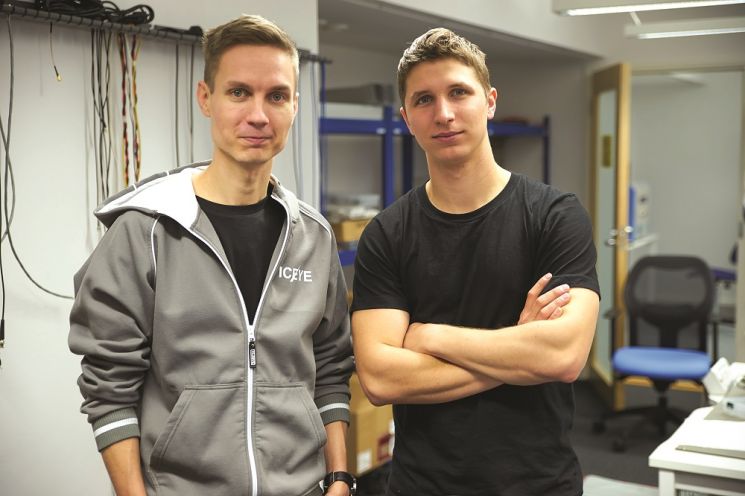 Pekka Laurila (left), Chief Financial Officer (CFO) of European company ICEYE, and Rafal Modrzewski, Chief Executive Officer (CEO) of ICEYE.
[Asia Economy Yang Nak-gyu, Military Specialist Reporter] The center of the aerospace industry is shifting globally from nations and large corporations to private and small-to-medium enterprises. This is due to the so-called ‘New Space’ trend, where private investment is activated and the industry is becoming service-oriented, leading to increasing calls for fostering the next-generation small satellite industry.
The government has announced that it will nurture the ‘Defense Space Defense Project’ to leap into a ‘2030 Defense Space Power’ in response to the New Space era. The government (including government-funded research institutes) plans to focus on securing core technologies and transferring owned technologies to the private sector, while the mass production of satellites will be handled by private companies, promoting a private-sector-centered industrialization. In particular, to establish a foundation for space development and build a satellite industry ecosystem, plans include creating defense space assembly and testing facilities and forming public-private consultative bodies for discussions on defense space industrialization.
Within the industry, it is pointed out that for the government’s goal of becoming a defense space power, opportunities for groundbreaking challenges should be given by observing foreign cases. There are also opinions that cooperation through technology transfer with successful foreign companies should be applied to our military capabilities.
A representative company that is most active with our military is the European company ICEYE. ICEYE was founded in 2014 by Pekka Laurila, who was attending Aalto University in Finland, and Rafal Modrzewski, a Polish international student.
At that time, the two students proposed to Professor Mike Lyons, an exchange professor at Stanford University, to develop a small synthetic aperture radar (SAR) satellite. SAR satellites can observe target points regardless of most weather conditions such as clouds and smoke, day or night. However, Professor Lyons discouraged them, calling it a “reckless endeavor.”
ExxonMobil was the first to recognize their ambition at a glance. Interested in monitoring sea ice movement in the Finnish Gulf and the Arctic Circle, ExxonMobil signed a contract in 2015 to build a small radar satellite and provided $20 million in investment and support funds. This was the small beginning of ICEYE.
Their small start turned the world upside down three years later. On December 3, 2018, the ‘SmallSat Express’ program was operating at Vandenberg Air Force Base, a spaceport on the coast of California, USA, launching 64 small satellites commissioned from various countries into orbit. Among them was a small satellite made by ICEYE. ICEYE did not have high expectations; the goal was only to verify the satellite’s space flight. However, the launch was successful, and the X-2 safely settled into orbit. A few days later, it sent back clear images of the Basque region in Spain. These images were exclusively released by the US CNBC, bringing global attention to the young Finnish startup.
ICEYE’s small satellite amazed the world once again with its revolutionary idea. Satellites require an enormous amount of electricity. They also need precise receiving equipment capable of detecting faint reflected echoes from targets on Earth. To handle these, large solar panels and power management facilities are necessary. This was the reason Professor Lyons initially opposed the development.
Pekka Laurila, CEO of ICEYE, said, “If we had applied NASA’s methods, our satellite would never have succeeded,” adding, “There was nothing easy about antenna aperture size, power management, flight control, or the satellite’s lifecycle, but we ultimately succeeded.” The industry likens this to a ‘Little League batter hitting a home run in his first Major League at-bat.’
Orbiting the Earth more than 15 times a day at 90-minute intervals, the low Earth orbit radar satellite uses most of its available power and transmits electromagnetic waves during the brief tens of seconds it flies over the mission area, receiving minute reflected waves. It then transmits the received information back to the ground. Considering this operation method, it was practically impossible.
ICEYE has launched a total of 21 satellites over four years, from the first-generation GEN1 to the third-generation GEN3 satellites. Next month, it plans to launch the fourth-generation GEN4 satellite. It is the world’s largest scale operator of ultra-small SAR satellites.
The GEN4 satellite has various observation modes. It can achieve a ground resolution of 0.25 meters, which is the standard limit of X-band radar satellites, observe a wide area exceeding tens of thousands of square meters, and detect minute changes in ground target areas through phase change measurements at the millimeter level.
ICEYE has already signed information exchange contracts with multinational insurance companies in Europe, Japan, and other countries for natural disaster and disaster observation and damage progression prediction functions using radar satellite information assets. Following Russia’s invasion, Ukraine also purchased ICEYE satellites currently operating in orbit.
Oleksii Reznikov, Ukraine’s Minister of Defense, said on social media, “We operated ICEYE’s ultra-small satellite for only two days but discovered about 60 Russian military equipment units,” adding, “Thanks to synthetic aperture radar (SAR), we were able to detect Russian military equipment camouflaged behind forests or obstacles.”
In addition, the United States, Finland, Brazil, and others have adopted ICEYE satellites, and the UK’s BAE Systems announced plans to launch the Azalea satellite constellation, a multi-sensor military cluster satellite concept, using ICEYE satellites.
ICEYE signed a memorandum of understanding (MOU) with LIG Nex1 in the satellite industry sector and another MOU with Hanwha Systems to promote joint projects in the ultra-small satellite field at the recent ‘Defence Expo Korea 2022.’
© The Asia Business Daily(www.asiae.co.kr). All rights reserved.

















