Ssangchung Jeongryeogak, Important Materials Reflecting the Era Such as Local Hyangchon Community History
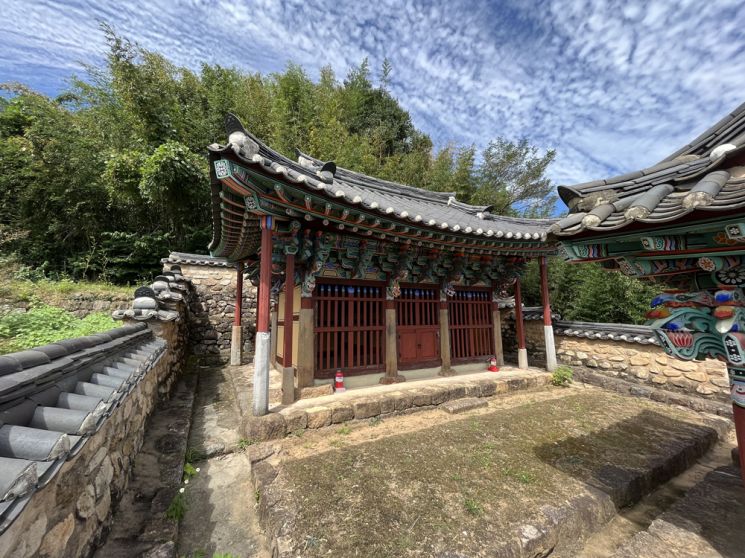
[Goheung=Asia Economy Honam Reporting Headquarters, Reporter Sim Jeong-woo] Goheung-gun, Jeollanam-do (Governor Gong Young-min) announced that the ‘Goheung Yeosan Song Clan Ssangchung Jeongryegak’ (currently a Jeollanam-do Monument) has been designated as a national cultural treasure.
The Cultural Heritage Administration resolved on November 17, after deliberation by the Cultural Heritage Committee, to designate the ‘Goheung Yeosan Song Clan Ssangchung Jeongryegak’ as a ‘Treasure (寶物)’ and officially announced the designation on November 25.
The Goheung Yeosan Song Clan Ssangchung Jeongryegak is a Jeongrye (a memorial arch) bestowed by the Joseon court in honor of Song Daerip (宋大立, 1550?1598) of the Yeosan Song clan and his son Song Chim (宋諶, 1590?1637), who achieved military merits and died in loyalty during the Imjin War and the Byeongja Horan. Since the construction of the Jeongryegak in 1704 (the 30th year of King Sukjong’s reign), it has undergone several repairs and maintenance to the present day.
This Jeongryegak is a five-bay building with a hipped-and-gabled roof, consisting of three bays on the front with the central bay (Eokan) slightly narrower, and two bays on the side. Inside, there are two Jeongrye plaques dated 1704 and four Jeongrye restoration records.
Notably, as a Jeongrye architecture, it uses a rare style of Dapo (multiple bracket sets between columns) type Ikgong series hybrid-style bracket system, presenting a very splendid appearance. The structure employs double bracket arms supporting the eaves and the corner brackets, combining structural and decorative functions. It also uses stone pillars and jangchoseok (stone bases), enhancing the dignity and decorative quality of the Jeongrye architecture, earning recognition as a representative example of Jeongrye architecture.
Furthermore, the Yeosan Song Clan Ssangchung Jeongryegak is a symbolic monument of the Yeosan Song clan, a family that produced many loyal figures in Goheung, and represents the region’s patriotic loyalty. It serves as a valuable resource to understand the governance methods of the late Joseon dynasty and the local rural society of the time. Its historical and academic value is further highlighted by architectural techniques such as the use of splendid brackets.
Song Daerip was a descendant of Chungganggong (Loyal and Strong Duke) Song Gan (宋侃). During the Imjin War, he served under General Kwon Yul and later as a military officer under Admiral Yi Sun-sin, frequently appearing in the War Diary. Notably, a report by Heungyang Magistrate Choi Heeryang to Admiral Yi Sun-sin and Jeolla Governor Hwang Sin mentions that ‘on March 23, 1598, in the Battle of Cheomsan (located in Donggang-myeon, Goheung-gun), Song Daerip achieved military merits.’
Song Chim passed the military examination in 1614, served as Hongwon Magistrate and Hamheung Jin-gwan Byeolmacheolje (Commander) in Hamgyeong Province in 1635, and died in loyalty during the Byeongja Horan at the Battle of Namsan Station in Anbyeon, Hamgyeong Province in 1637. In 1704, Song Chim was posthumously promoted to Tongjeong Daebu Seungjeongwon Jwaseungji and Gyeomgyeongyeon Chamchan-gwan.
A Goheung-gun official stated, “It is the mission of future generations to honor the noble loyalty of our ancestors who sacrificed their lives for the country,” adding, “We will continue to seek out additional valuable hidden materials.”
Goheung=Asia Economy Honam Reporting Headquarters, Reporter Sim Jeong-woo hss79@asiae.co.kr
© The Asia Business Daily(www.asiae.co.kr). All rights reserved.

















