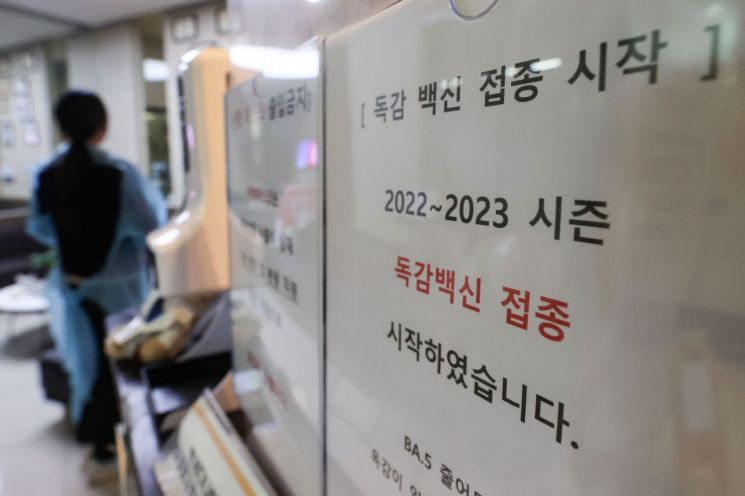
[Asia Economy Reporter Byun Seon-jin] The number of flu patients continues to rise during the winter season. The government has taken steps to secure supply quantities to prevent a 'cold medicine shortage' caused by the 'twindemic.'
According to infectious disease statistics from the Korea Disease Control and Prevention Agency on the 26th, the proportion of suspected flu patients in the past week (November 13?19) was 13.9 per 1,000 outpatients, slightly up from 13.2 the previous week. This means that among 1,000 visitors to hospitals and clinics, 13 to 14 showed symptoms such as high fever over 38℃, cough, and sore throat. This level is more than twice the influenza epidemic threshold of 4.9 per 1,000 outpatients for this winter and has been increasing for five consecutive weeks.
The spread of the flu is steep among adolescents. The flu patient rate among those aged 13 to 18 was 41.8 per 1,000 outpatients, a 27% increase from 32.8 the previous week. Next were ▲7?12 years old at 22.7, ▲19?49 years old at 18.2, and ▲1?6 years old at 12.2, respectively.
Flu typically spreads mainly among children and adolescents, but in 2020 and 2021, strengthened preventive and quarantine measures such as mask-wearing and social distancing prevented its spread. This year, as daily life has resumed, the flu epidemic is intensifying.
The government will raise the price of prescription cold medicines to prevent a shortage caused by the simultaneous spread of COVID-19 and the flu during winter. The insurance price of prescription acetaminophen, which was about 50 won per tablet, will be increased by up to 20 won starting in December. Additionally, measures such as expanding cold medicine production and strengthening crackdowns on hoarding will be implemented.
© The Asia Business Daily(www.asiae.co.kr). All rights reserved.
![Clutching a Stolen Dior Bag, Saying "I Hate Being Poor but Real"... The Grotesque Con of a "Human Knockoff" [Slate]](https://cwcontent.asiae.co.kr/asiaresize/183/2026021902243444107_1771435474.jpg)
















