Samsung SDI Still Has Investment Capacity in the North American Battery Market
Highlighting Its Long-Standing Strength in the Cylindrical Battery Sector
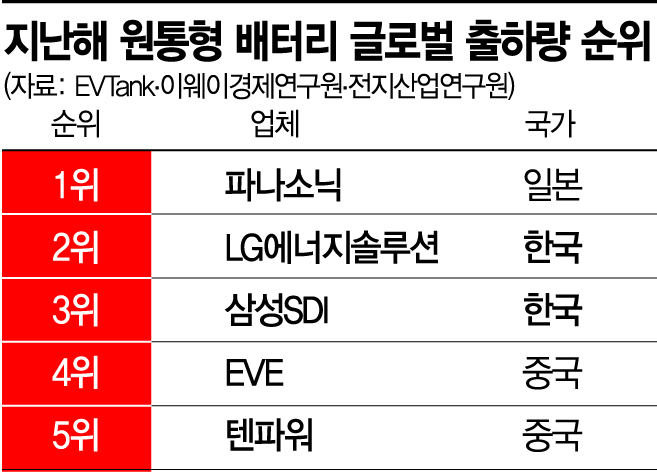
Industry consensus is that Samsung SDI's additional investment in North America is becoming more tangible, highlighting the strengths of Samsung SDI's cylindrical batteries, which the company has long been dedicated to developing.
On the 27th, Samsung SDI is reported to be discussing the supply of '46-pie (Ø·diameter 46 mm)' cylindrical batteries, considered next-generation batteries, with multiple automakers. The company stated in its Q2 conference call in July, "Several automakers are showing interest in cylindrical batteries for cost reduction and are reviewing their application."
Amid this, there is also an assessment that Samsung SDI could pioneer the cylindrical battery market in the North American market, where large-scale investments are being made under the Inflation Reduction Act (IRA). Among the three major domestic battery companies, LG Energy Solution and SK On have already made North American investments by fully utilizing personnel and financial capabilities with North American automakers such as GM, Ford, and Stellantis. However, since they plan to produce prismatic and pouch-type batteries, there is speculation that Samsung SDI could promise cylindrical battery supply.
Samsung SDI's expertise in cylindrical batteries spans over 20 years since it introduced its first mass-produced battery in 2000. Samsung SDI was also the first to introduce a 2000mAh cylindrical battery in the laptop market, where 1600mAh was mainstream. The company aims to apply its know-how in producing cylindrical batteries from the small battery sector to electric vehicle batteries.
Samsung SDI is currently establishing a next-generation cylindrical battery pilot line at its Cheonan plant. It is also investing 1.7 trillion KRW to build a second battery factory at its key cylindrical production base, the Seremban plant in Malaysia. The 46-pie battery is a next-generation battery with five times the energy capacity and six times the output of the existing 2170 (diameter 21 mm) cylindrical battery. While the diameter is fixed at 46 mm, the length?whether 80 mm or longer?has not yet been decided.
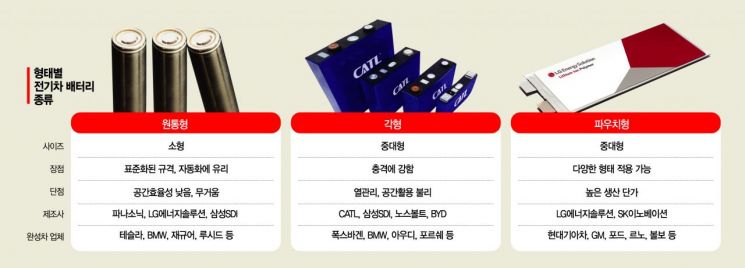
Batteries are broadly classified by shape into cylindrical, pouch, and prismatic types. They are made by manufacturing cathodes and anodes and combining them with separators and electrolytes. However, energy density varies depending on the battery shape, and production processes and technical difficulty also differ.
Among these, cylindrical batteries are the most traditional type. Their origin traces back to the cylindrical shape of primary batteries (non-rechargeable batteries). The main reason for making them cylindrical is that the winding method, which involves rolling the cathode and anode like a roll of toilet paper, makes it easy to produce a complete unit. Since standardized specifications exist, the same application is possible at global production bases, facilitating mass production. If supply shortages occur at demand sites, it is easy to install batteries from other manufacturers, enhancing economic efficiency. Being the fundamental battery form, it has the highest accumulated technology and safety, gaining attention in the recent electric vehicle market.
The global cylindrical battery market is expanding from traditional power tools and micro-mobility to electric vehicles and energy storage systems (ESS). It is expected to grow from 10.17 billion cells this year to 15.11 billion cells by 2027, showing an average annual growth rate of 8%.
© The Asia Business Daily(www.asiae.co.kr). All rights reserved.
![Clutching a Stolen Dior Bag, Saying "I Hate Being Poor but Real"... The Grotesque Con of a "Human Knockoff" [Slate]](https://cwcontent.asiae.co.kr/asiaresize/183/2026021902243444107_1771435474.jpg)

















