4th Seasonal Fine Dust Management Plan Implementation
[Asia Economy Sejong=Reporters Kim Hyewon and Lee Dongwoo] The government is expanding the restriction on the operation of Grade 5 emission vehicles not only in the Seoul metropolitan area but also to Busan and Daegu during the winter fine dust seasonal management period. It will halt the operation of 8 to 14 public coal power plants, limit the output of up to 44 units to 80%, and introduce spectroscopic equipment to remotely monitor chimney emissions. High concentration forecasts in the metropolitan area will be advanced from 12 hours to 36 hours in advance.
On the 25th, Prime Minister Han Duck-soo chaired the 10th Special Committee on Fine Dust Measures at the Government Seoul Office and reviewed the ‘4th Fine Dust Seasonal Management Implementation Plan’ with these details. This is a measure to further reduce air pollutant emissions from December 1 to March 31 of the following year, when ultrafine dust concentrations increase, and this time the reduction target has been raised by up to 10%. This is the largest reduction scale since the fine dust seasonal management was first implemented in 2019.
Prime Minister Han said, "The nationwide measurement of ultrafine dust in Korea started for the first time in 2015 at 26㎍/㎥ and improved to 18㎍/㎥ last year," adding, "The Yoon Seok-yeol administration has set lowering the annual average concentration of ultrafine dust to the OECD average level of 13㎍/㎥ by 2027 as a national agenda."
First, in the public sector, from this month, restrictions on the operation of Grade 5 vehicles for administrative and public institutions, crackdowns on illegal emissions in major industrial complexes, and collection of agricultural waste will be focused on. Energy-saving measures such as limiting indoor temperature to 17℃, sequential suspension of heating devices, banning personal heaters, and prohibiting the use of landscape and indoor lighting have already been proactively implemented since last month.
In the industrial sector, voluntary reduction targets are quantitatively assigned to 350 large workplaces nationwide, and local environmental offices are in charge of managing compliance. In addition, new spectroscopic equipment for remote monitoring of chimney emissions, along with unmanned aerial vehicles (drones) and mobile measurement vehicles, will be introduced, and private monitoring teams will be deployed to intensively inspect suspected illegal emission workplaces.
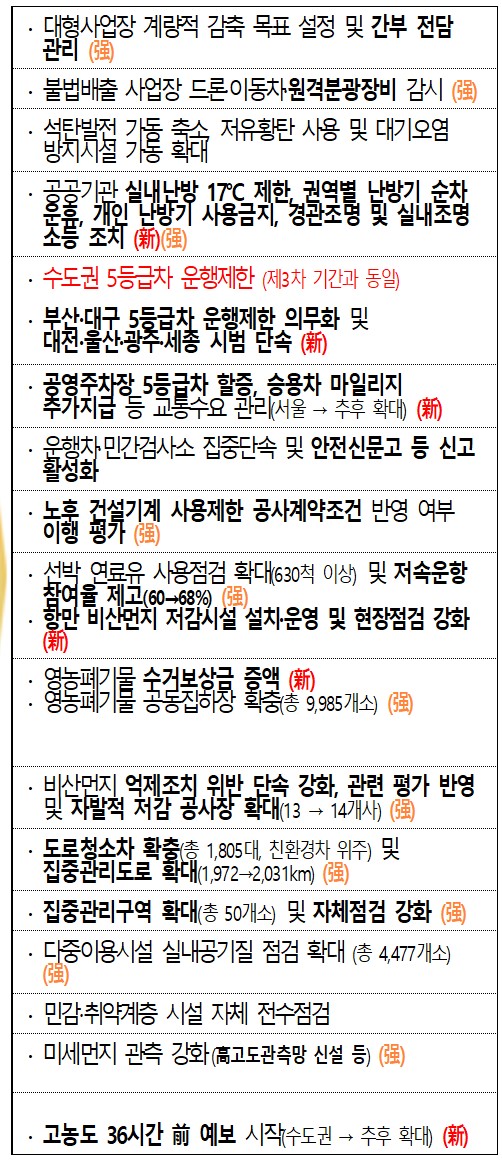
In the transportation sector, restrictions on the operation of Grade 5 emission vehicles will be expanded to Busan and Daegu as well as the metropolitan area, and fines will be imposed on violating vehicles. Daejeon, Ulsan, Gwangju, and Sejong will also pilot operation restrictions even though they are not mandatory areas. In Seoul, parking fees will be surcharged for Grade 5 vehicles using public parking lots, and special points will be awarded to passenger car mileage members who drive below a certain distance to manage traffic demand. In the agriculture and daily life sector, the government subsidy for the collection of agricultural waste vinyl will be doubled from 10 won to 20 won per kilogram.
From this year, high concentration forecasts in the metropolitan area will be advanced from 12 hours to 36 hours. The government plans to expand the forecast target to other regions in the future while simultaneously improving accuracy.
In the power generation sector, 8 to 14 public coal power plants will be shut down. As of this month, this accounts for 24.5% of the total 57 coal power generators operating domestically. The government will also promote an output cap system limiting the output of up to 44 units to 80%. The government plans to sign voluntary agreements with all private coal power plants such as GS Donghae Power, Goseong Green Power, and Gangneung Eco Power.
However, voices from the industrial sector call for postponing the implementation of the fine dust seasonal management. They argue that the share of coal power generation, which is relatively cheaper than the sharply rising LNG fuel price, should be maintained as is. In a press conference last September, Jang Young-jin, 1st Vice Minister of the Ministry of Trade, Industry and Energy, stated, "If the fine dust seasonal management is postponed, the trade balance will improve by about 2.5 billion dollars over 3 to 4 months." Accordingly, the government plans to finalize the shutdown and output cap of coal power plants in February to March next year, considering power supply and demand and the international energy crisis situation.
© The Asia Business Daily(www.asiae.co.kr). All rights reserved.
![Clutching a Stolen Dior Bag, Saying "I Hate Being Poor but Real"... The Grotesque Con of a "Human Knockoff" [Slate]](https://cwcontent.asiae.co.kr/asiaresize/183/2026021902243444107_1771435474.jpg)











