32,695 Confirmed Cases on the 24th... Over 30,000 for Two Consecutive Days
Repeated Isolation and Lockdowns Lead to Shortage of Accommodation Facilities
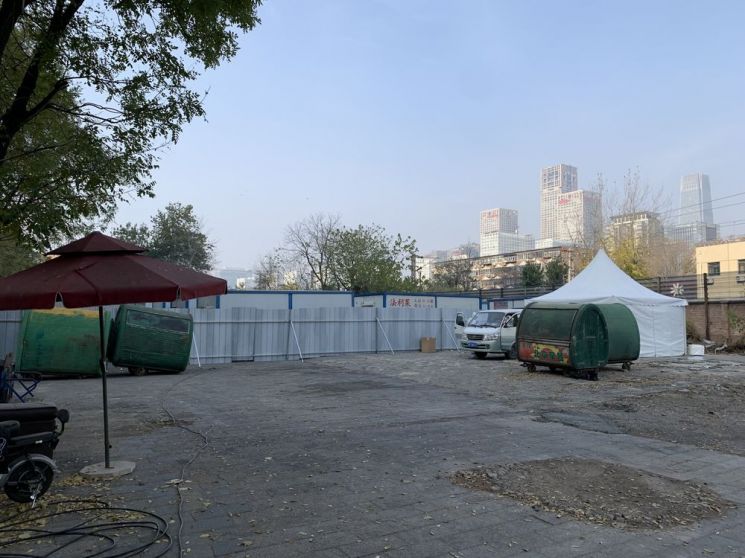 Temporary COVID-19 quarantine facility under construction south of Beijing Central Business District (Photo by Bloomberg News)
[Asia Economy Beijing=Special Correspondent Kim Hyunjung] A temporary quarantine facility called 'Fangcang (方艙)' has been set up in the heart of Beijing, the capital of China. Recently, as the daily number of new COVID-19 cases in China has exceeded 30,000, marking an all-time high, this is interpreted as a response to curb the spread through lockdowns and quarantines. It is also estimated that about 400 million people in China have been restricted in their movements due to the renewed strict zero-COVID measures.
According to the National Health Commission of China on the 25th, the number of new COVID-19 cases nationwide the previous day was 32,695 (including 29,654 asymptomatic cases), marking over 30,000 cases for two consecutive days and the highest since official statistics began in April 2020. Until early this month, the number of confirmed cases in China was around 2,700, but it surged to over 10,000 on November 10th within ten days, then jumped to over 20,000 on November 15th, showing an unprecedented rapid spread.
On the same day, 1,860 people (including 1,436 asymptomatic cases) in Beijing were confirmed positive and transferred to centralized quarantine facilities. As the number of people requiring quarantine surged and hospital beds became insufficient, health authorities are constructing Fangcang facilities in the heart of Beijing. Fangcang, a prefabricated structure the size of a shipping container, is mainly used for temporary quarantine and treatment.
On the 24th (local time), Bloomberg reported that Fangcang recently appeared on a street in the Central Business District (CBD), a bustling area, suggesting that Beijing officials believe more infrastructure is needed to handle the rising number of COVID-19 cases. The report stated, "More than 30 mobile cabins and two restrooms were already installed by the morning of the 23rd," and quoted an official on site explaining that "this will be a temporary quarantine facility for patients with mild or asymptomatic cases." Additionally, Beijing city announced that the National Convention Center on the outskirts has been converted into a quarantine facility and is currently in operation.
China recently announced '20 measures' instructing quarantine for only 8 days for close contacts, but the criteria for 'close contact' are unclear, causing the number of quarantined individuals to rise daily. The scope of application varies by community, and in some cases, even if a PCR test is negative, all households on the same line and floor of an apartment where a confirmed case occurred are moved to quarantine facilities. Bloomberg explained, "Apartment complexes across the city are being locked down due to confirmed or suspected cases, and close contacts are being sent to hospitals or quarantined," adding, "Most others are currently confined at home and only undergoing PCR testing."
Given this situation, the number of people restricted in movement due to lockdowns or quarantine is increasing exponentially. According to Japan's Nihon Keizai Shimbun, Nomura Securities estimated that as of the 21st, about 412 million people in 49 Chinese cities are under movement restrictions. This is an increase of 100 million compared to the estimate on the 7th.
The economic impact of the COVID-19 spread is also expected to continue. Lu Chuan, Chief China Economist at Nomura International, revised China's GDP growth rate for this year down from 2.9% to 2.8%, and for next year from 4.3% to 4.0%, stating that "the damage to both supply and demand will be prolonged." Hui Shan, an economist at Goldman Sachs, also projected China's GDP growth rate at 3.0% this year. Both figures fall far short of China's original target growth rate of 5.5%.
© The Asia Business Daily(www.asiae.co.kr). All rights reserved.

















