BOJ Governor Kuroda's Term Ends April Next Year
Achievements in Negative Interest Rate and YCC Policies
Criticism for Causing Yen Depreciation
Amamiya and Nakaso Mentioned as Successors
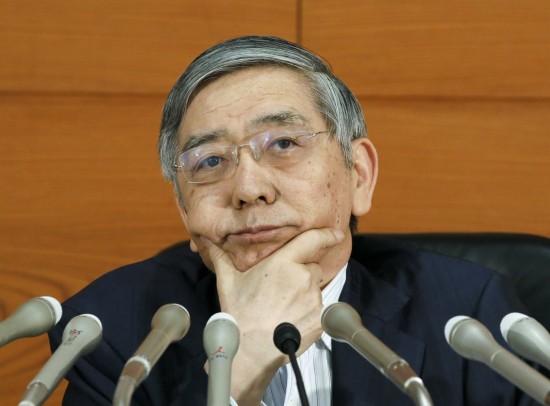 Kuroda Haruhiko, Governor of the Bank of Japan
 Photo by Yonhap News
[Asia Economy Reporter Lee Ji-eun] With about four months remaining until the end of the term of Haruhiko Kuroda, Governor of the Bank of Japan who led large-scale monetary easing policies, attention is focused on whether the Japanese government will shift the direction of its existing financial policies. Governor Kuroda argues that although the yen has fallen to its lowest value in 32 years this year, monetary easing policies must continue to stably achieve the 2% inflation target.
On the 10th, Governor Kuroda attended the House of Councillors’ Committee on Financial Affairs and expressed his refusal to seek reappointment after his term expires. He stated, "It has been exactly 10 years since I took office this year," and added, "I have no personal desire to be reappointed as governor." Bloomberg reported that Japanese Prime Minister Fumio Kishida is currently searching for the next governor, and the appointment proposal is expected to be presented at the regular Diet session convening in January next year.
◆Governor Kuroda, Helmsman of Abenomics... Also Criticized for Causing Yen Depreciation
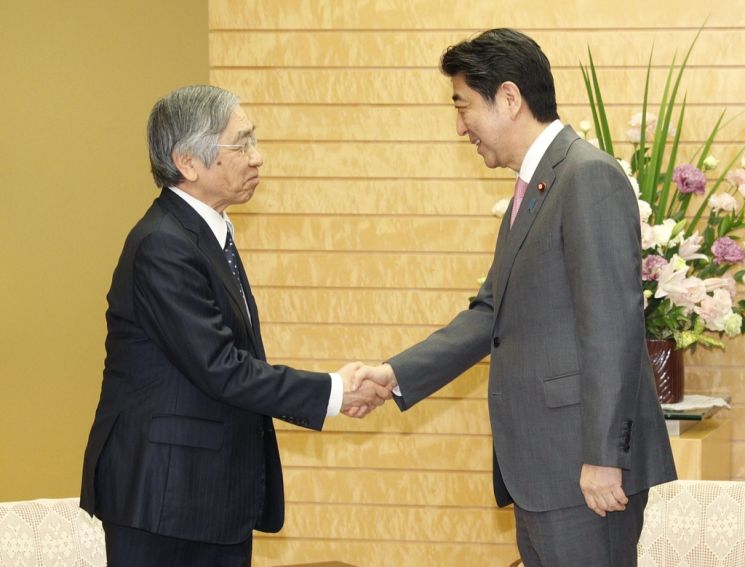 In April 2018, then Japanese Prime Minister Shinzo Abe and Haruhiko Kuroda, Governor of the Bank of Japan, are shaking hands at the Japanese Prime Minister's Official Residence.
Governor Kuroda took office in March 2013, shortly after the launch of the second Shinzo Abe Cabinet, and played a leading role in the large-scale monetary easing policy known as "Abenomics." In 2016, he introduced a negative interest rate policy by lowering the benchmark interest rate to -0.1% to increase the money supply. He also implemented the Yield Curve Control (YCC) policy, purchasing government bonds without limit to keep Japan’s 10-year government bond yields between 0% and 0.25%.
The reason Governor Kuroda took these extraordinary measures was that the Japanese economy had been trapped in deflation for 30 years. Since the real estate market crash in the 1990s, Japan’s inflation rate hovered around 1%, except for April 2014 when prices rose due to a consumption tax increase.
With prolonged deflation, wage growth also stagnated. According to OECD statistics, when 1997 is set as 100, wages in Japan and South Korea were 90.3 and 158, respectively. This means that while South Korean workers’ wages rose by 58% over about 20 years, Japanese wages actually fell by 10%. Due to low wages, private consumption sentiment weakened, and the economy struggled to gain momentum. Consequently, Governor Kuroda set a 2% inflation target and launched large-scale monetary easing policies.
The problem is that Governor Kuroda’s monetary easing coincided with the U.S. Federal Reserve’s aggressive interest rate hikes, causing a sharp depreciation of the yen. The yen, which traded around 115 per dollar at the beginning of this year, broke the 2015 record low of 125.86 in April after the Fed raised interest rates for the first time in three years. In October, the yen-dollar exchange rate surpassed the psychological threshold of 150 yen, marking the lowest yen value in 32 years.
The rapid depreciation of the yen, combined with rising international commodity and energy prices, expanded Japan’s trade deficit. The Ministry of Finance announced on the 20th of last month that the trade deficit for the first half of this year was 11.075 trillion yen, the largest deficit since 1979.
However, at the Monetary Policy Meeting held on the 22nd of last month, Governor Kuroda reiterated, “It is necessary to achieve the price stability target (2%) accompanied by wage increases,” and emphasized, “Continuing monetary easing is appropriate. There will be no interest rate hikes for the time being.”
◆'Mr. BOJ vs. International Economic Experts'... Policy Changes Possible Depending on Next Governor
 Masayoshi Amamiya, Deputy Governor of the Bank of Japan (left), Hiroshi Nakaso, Director of Daiwa Institute of Research (right) [Image source=Bank of Japan, Japan Business Federation]
Major foreign media predict that financial policies may change after Governor Kuroda’s term ends. Currently, Masayoshi Amamiya, Deputy Governor of the Bank of Japan, and Hiroshi Nakaso, Director of Daiwa Institute of Research, are considered leading candidates for Kuroda’s successor.
Deputy Governor Amamiya led the YCC policy introduced shortly after Governor Kuroda took office and is known within the Bank of Japan as "Mr. BOJ." He is known to have planned monetary policy behind the scenes under Kuroda and is well-versed in overall financial policy, earning a reputation for flexible responses.
Bloomberg analyzed that since Amamiya contributed to planning the Kuroda regime, if he becomes governor, it is highly likely that current financial policies will be maintained.
Earlier, in a lecture held in July, Amamiya expressed the view that "monetary easing policies need to continue to raise wages and sustain stable 2% inflation."
On the other hand, if Director Nakaso becomes governor, financial policies may change. Nakaso played a key role as Director of the Financial Markets Department during the 2008 global financial crisis and has experience responding to the global economic crisis. He served as Deputy Governor of the Bank of Japan for five years after Kuroda’s appointment in 2013 and also chaired the Market Committee of the Bank for International Settlements (BIS).
Bloomberg explained that if Nakaso becomes governor, he is likely to focus on resolving side effects caused by the market rather than maintaining monetary easing policies. At a discussion in September, he said, "I think the policy mix of Abenomics was appropriate," but also pointed out, "During the implementation of Abenomics, the Bank of Japan was overly relied upon and performed roles beyond what a central bank should do." Bloomberg reported that this statement suggests he would not continue monetary easing policies if he becomes the next governor.
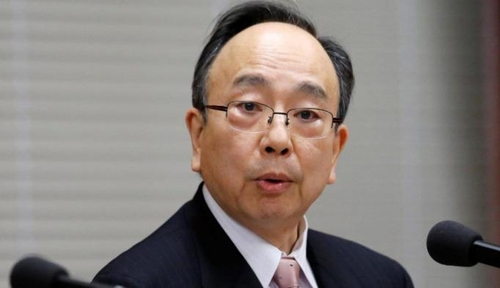
Japanese media currently predict a high possibility of Deputy Governor Amamiya’s appointment. Nihon Keizai reported that in a survey conducted in September among 21 Bank of Japan policy analysts (BOJ Watchers), 80% of respondents said Amamiya would become the next governor.
A UBS Securities official told Nihon Keizai, "Prime Minister Kishida is likely to judge that appointing Deputy Governor Amamiya, who helped build financial policy under Governor Kuroda, as successor will ensure a smooth succession of financial policies."
However, Nihon Keizai also forecasted, "If inflationary pressures intensify, Prime Minister Kishida might choose a third candidate."
© The Asia Business Daily(www.asiae.co.kr). All rights reserved.
![Clutching a Stolen Dior Bag, Saying "I Hate Being Poor but Real"... The Grotesque Con of a "Human Knockoff" [Slate]](https://cwcontent.asiae.co.kr/asiaresize/183/2026021902243444107_1771435474.jpg)


















