[At-Risk Korean Companies]①
Companies Hit by a Perfect Storm...An Unprecedented Time of Crisis
Cargo Solidarity Union Strikes Again on the 24th Following June Walkout
Logistics Shutdown Fears Cause Widespread Damage from Day One
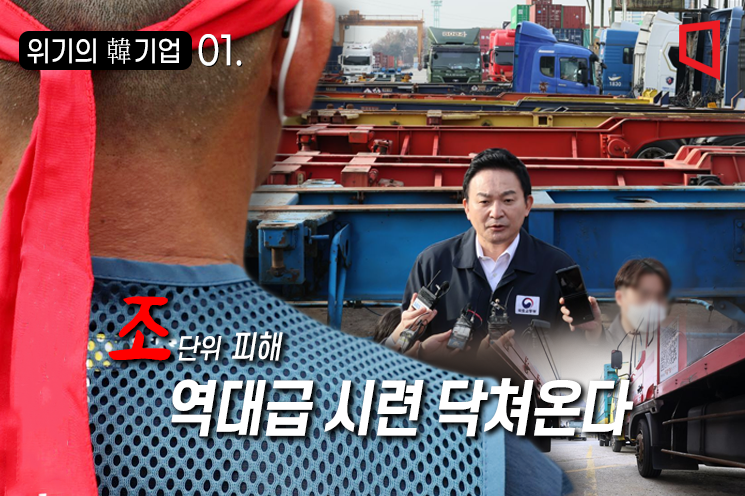
[Asia Economy Reporter Choi Dae-yeol] As the possibility grows that the logistics sites, considered the 'lifelines' at the forefront of industry, may come to a halt due to the Cargo Solidarity Union's collective transport refusal, companies' concerns have deepened. Particularly worrying is the increased likelihood of a prolonged standoff as the Cargo Solidarity Union and the government continue a strong confrontation, each blaming the other. With railway and subway labor unions also beginning legal strikes or planning to strike, the worst-case scenario of a complete halt in industrial logistics cannot be ruled out.
As the Cargo Solidarity Union's general strike entered its second day on the 25th, the conflict between labor and the government became more pronounced. Less than a day after Minister of Land, Infrastructure and Transport Won Hee-ryong announced a compulsory 'work commencement order,' President Yoon Suk-yeol responded by stating, "If irresponsible transport refusals continue, we will have no choice but to consider various measures, including the work commencement order."
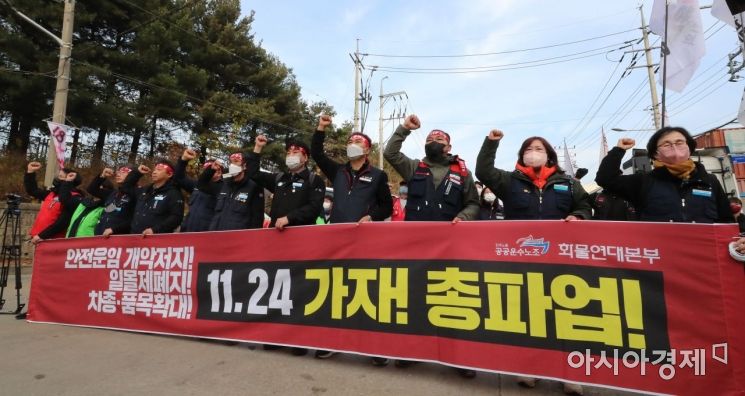 On the 24th, when the Cargo Solidarity Union began an indefinite general strike, members of the Cargo Solidarity Union held a send-off ceremony near the Uiwang Inland Container Terminal in Gyeonggi-do. Photo by Dongju Yoon doso7@
The labor side also pushed back. The Cargo Solidarity Union protested that the Ministry of Land, Infrastructure and Transport unilaterally broke the agreement made during the strike in June, contrary to promises. They criticized the government's work commencement order as violating International Labour Organization (ILO) conventions and accused the government of only protecting large corporate shippers. Amid an already wide gap between labor and government, the dispute escalated into a battle over facts and emotions, making an exit strategy even more elusive.
If the transport refusal situation extends beyond a week, the damage at the frontline is expected to escalate rapidly. At Hyundai Steel, for example, nearby plants that held send-off ceremonies at the start of the strike the previous day were unable to ship products.
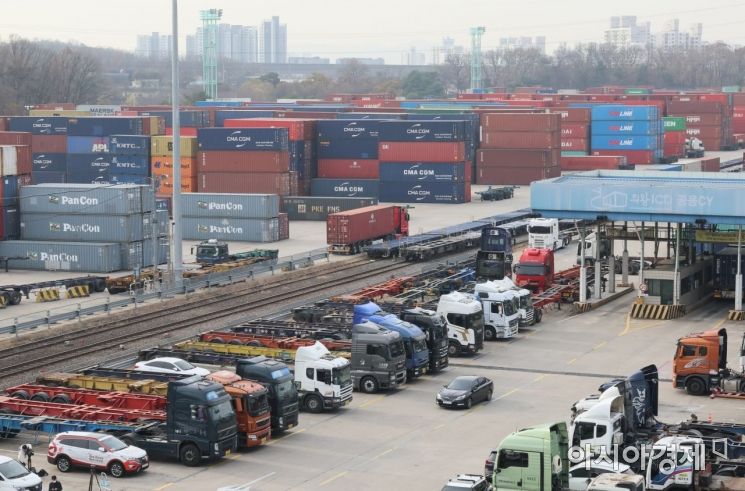 On the 24th, when the Cargo Solidarity Union began an indefinite general strike, containers were stacked behind the cargo trucks stopped at the Uiwang Inland Container Terminal in Gyeonggi Province. Photo by Dongju Yoon doso7@
A representative from another steel company said, "There is a high possibility of production disruptions due to lack of raw materials, shipment delays because finished products cannot be sent out, and sales setbacks due to inventory turnover issues. If essential materials are not produced and shipped on time across major sectors such as construction, shipbuilding, and home appliances, the foundation of our industry could be shaken."
According to the Ministry of Land, Infrastructure and Transport, on the first day of the strike, container import and export volume was 15,000 TEU (1 TEU equals one 20-foot container), shrinking to less than half of the usual amount. Among various industries related to the Cargo Solidarity Union, container transport has a relatively high proportion of union members.
This indicates a high likelihood of problems arising in overseas exports and imports. According to government data, during the initial six days of the strike in June, the damage to related industries such as automobiles, steel, and petrochemicals totaled 1.6 trillion won. In addition, disruptions to domestic manufacturers' exports are expected to cause intangible damage by eroding external trust, which the industry views as significant. Jang Jung-woo, head of labor-management cooperation at the Korea Employers Federation, said, "Since shippers are spread across the country, it is difficult to inspect every location thoroughly, but the government needs to actively communicate that it will respond according to law and principles and also engage in preventive measures."
© The Asia Business Daily(www.asiae.co.kr). All rights reserved.



















