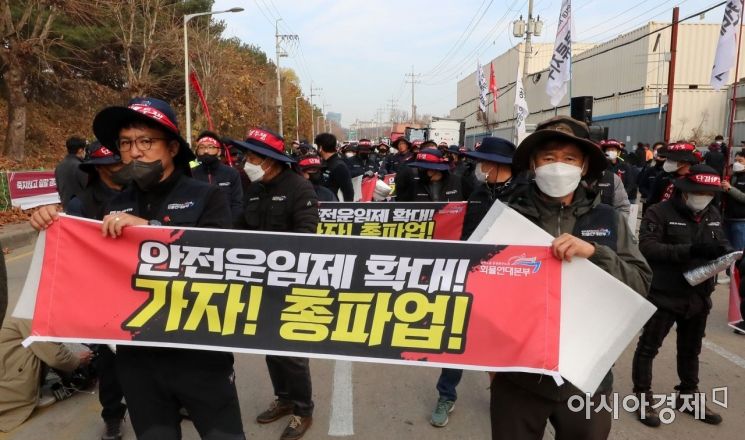
 On the 24th, when the Cargo Solidarity Union began an indefinite general strike, members of the Cargo Solidarity Union held a send-off ceremony near the Uiwang Inland Container Terminal in Gyeonggi-do. Photo by Dongju Yoon doso7@
[Asia Economy Reporter Kwangho Lee] The Cargo Solidarity Headquarters of the Korean Confederation of Trade Unions Public Transport Workers' Union (hereinafter Cargo Solidarity), which launched a general strike on the 24th, urged the government to "stop the unconstitutional threat of work commencement orders."
Lee Bong-ju, chairman of the Cargo Solidarity Headquarters, said at a press conference held at the inland container depot (ICD) in Uiwang, Gyeonggi Province, "The forced labor order on the private sector declares that the Republic of Korea is not a democratic country."
Chairman Lee said, "The government claims that since Cargo Solidarity members are special employment workers, that is, self-employed, it is inappropriate to apply the Safe Freight Rate System and that the market economy should be left alone. I question on what grounds they intend to issue a work commencement order," adding, "The Yoon Seok-yeol administration is only making tough response threats without any effort to stop the strike."
Earlier, Land, Infrastructure and Transport Minister Won Hee-ryong announced in a public address at the Government Seoul Office in the morning that if a serious crisis arises due to Cargo Solidarity's collective refusal to transport, a work commencement order would be issued.
The Cargo Truck Transport Business Act allows the Minister of Land, Infrastructure and Transport to order the commencement of work if a transporter or transport worker collectively refuses cargo transport without just cause, causing significant disruption to cargo transport. If a transport worker refuses this order, they may face imprisonment of up to three years or a fine of up to 30 million won.
Until now, a work commencement order related to transport has never been issued.
Cargo Solidarity demands ▲ permanent implementation of the Safe Freight Rate System ▲ expansion of applicable vehicle types and items beyond existing containers and cement to include steel products, automobiles, hazardous materials, feed and grains, and parcel delivery trunk and feeder services, totaling five items ▲ and the withdrawal of the Safe Freight Rate System revision plan.
The Safe Freight Rate System guarantees a minimum transportation fee so that cargo truck drivers do not need to overwork, overspeed, or overload, and imposes fines on consignors who violate this. It was temporarily introduced from 2020 until the end of this year only for cement and container cargo.
© The Asia Business Daily(www.asiae.co.kr). All rights reserved.
![Clutching a Stolen Dior Bag, Saying "I Hate Being Poor but Real"... The Grotesque Con of a "Human Knockoff" [Slate]](https://cwcontent.asiae.co.kr/asiaresize/183/2026021902243444107_1771435474.jpg)
















